Death Tax Repeal Act of 2021 This bill repeals the estate and generation-skipping transfer taxes. It also makes conforming amendments related to the gift tax.
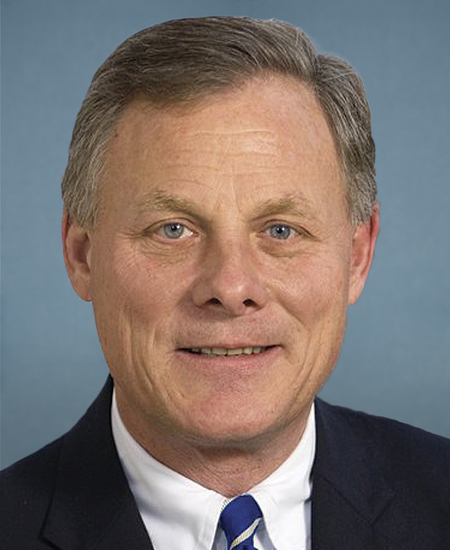
Sen. Richard Burr
Sponsored bills
Moving and Fostering Innovation to Revolutionize Smarter Transportation Act or the Moving FIRST Act This bill authorizes through FY2026 the Department of Transportation to award Strengthening Mobility and Revolutionizing Transportation grants to communities of varying sizes to promote technological innovation (e.g., autonomous vehicles, electric vehicles, and roadway electrification) in transportation systems.
Stop Underrides Act This bill requires the installation of rear, side, and front underride guards on certain trucks and trailers. Specifically, the Department of Transportation (DOT) must require the installation of rear, side, and front underride guards on the following a trailer or semi-trailer that is more than 10,000 pounds, and a single unit truck for which the bottom of the carriage is greater than 22 inches above the ground and that is more than 10,000 pounds. For rear and side underride guards, DOT must require adherence to a performance standard that requires the guards to be able to prevent intrusion from the body or frame of a trailer, semi-trailer, or truck into the passenger compartment of the motor vehicle that contacts the guard while traveling at 35 miles per hour. In addition, DOT must require drivers to (1) conduct a pre-trip inspection of the underride protection system on their vehicles; (2) identify rusted metal compromising structural integrity, cracked welds, or missing or loose fasteners; and (3) complete any necessary repairs. DOT must establish a Committee on Underride Protection to oversee the ongoing underride guard rulemaking process. DOT must publish data on victims of truck underride crashes.

VOCA Fix to Sustain the Crime Victims Fund Act of 2021 This bill adds a new source of revenue for the Crime Victims Fund and makes changes to formula grants supported by the fund. Specifically, the bill directs revenues collected from deferred prosecution and non-prosecution agreements to be deposited into the Crime Victims Fund. Currently, such revenues are deposited into the general fund of the Treasury. Additionally, the bill increases the percentage—from 60% to 75%—of state compensation payments to crime victims in the prior fiscal year used to calculate formula grants for state victim compensation programs. Finally, the bill directs states to waive the matching requirement for recipients of state victim assistance formula grants during and for one year after a pandemic-related national emergency. It also allows states to waive the matching requirement pursuant to a policy established by the state.
This joint resolution proposes an amendment to the Constitution to require that the Supreme Court consist of nine Justices.
Main Street Tax Certainty Act This bill makes permanent the tax deduction for qualified business income. (Under current law, the deduction expires after December 31, 2025.) Qualified business income is defined as the net amount of qualified items of income, gain, deduction and loss with respect to any trade or business, excluding capital gains or losses, dividends, interest income, or income earned outside the U.S.
Iran Sanctions Relief Review Act of 2021 This bill restricts the President's authority to unilaterally undertake certain actions with respect to Iran and increases congressional oversight of those actions. Specifically, the President must report to Congress before terminating or waiving sanctions related to Iran or taking a licensing action that significantly alters U.S. foreign policy with respect to Iran. Each report must (1) describe the proposed action and its rationale, and (2) indicate whether or not the action is intended to significantly alter foreign policy concerning Iran. If the intention is to alter that policy, the report must provide additional information about the policy objectives and anticipated effects of the action. After the President submits a report, the bill provides Congress with a 30-day period to review it; this period is extended to 60 days for reports submitted between July 10 and September 7. During this period, Congress may enact a joint resolution approving or disapproving the action. During the review period, the President may not take the action unless Congress passes a joint resolution of approval; if Congress enacts a joint resolution of disapproval, the bill prohibits the President from taking the action. The bill also outlines procedures for the introduction and consideration of these types of joint resolutions.
This resolution recognizes Black History Month as an opportunity to reflect on U.S. history and to commemorate the contributions of African Americans. It calls for the United States to (1) honor the contribution of pioneers who helped to ensure its legacy; and (2) move forward as a nation "indivisible, with liberty and justice for all."
National Right-to-Work Act This bill repeals those provisions of the National Labor Relations Act and the Railway Labor Act that permit employers to make an agreement with a labor union to require employees to join such union as a condition of employment. Currently, at least 27 states have enacted laws prohibiting employers from compelling employees to become members of a union as a condition of employment.
Emergency Reporting Act This bill requires the Federal Communications Commission (FCC) to report on certain activations of the Disaster Information Reporting System (the system through which communications providers report their operational status during times of crisis) and to adopt specified rules related to network outage reporting. If the system was activated for at least seven days, the FCC must issue a preliminary a report that includes (1) the number and duration of any service outages, (2) the approximate number of users or the amount of infrastructure potentially affected by a service outage, and (3) the number and duration of any outages at public safety answering points (PSAPs) that prevent the PSAPs from receiving and routing emergency calls to emergency service personnel. The FCC must also hold at least one public field hearing in the area affected by the event, and it must issue a final report that includes recommendations on how to improve the resiliency of affected communications or networks recovery efforts. The FCC must also determine the circumstances under which it shall require certain service providers to notify a PSAP of a communications service disruption that prevents the origination of 9–1–1 calls or the delivery of information that allows the PSAP to identify the number of or locate a 9–1–1 caller. Further, the FCC must require this notification to be made and specify the appropriate timing of the notification.