

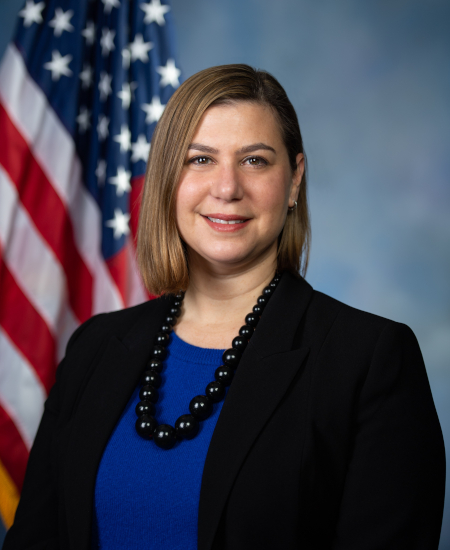
Photo of Elissa Slotkin
D United States Senate · Michigan

Sen. Elissa Slotkin

Compare
Total votes
2,625
all sessions
Attendance
98%
63 missed
Near the chamber average
With party
94%
of cast votes
Near the chamber average
Bipartisan score
3%
crosses aisle rarely
Near the chamber average
Sponsored
1,210
bills & resolutions
Near the chamber average
Committees
11
assignments
1,210 bills and resolutions

Sponsored bills

Total
1,210
Primary
151
Co-sponsor
1,059
This page
1,210
matching current filters
Co-sponsor HR 7194
In committee · United States House · Co-sponsor
PFAS Accountability Act of 2024

Maddy summaryThis bill creates a federal legal cause of action for individuals significantly exposed to PFAS chemicals (found in drinking water and human blood) to sue manufacturers responsible for the exposure. It establishes a medical monitoring remedy, requiring courts to order regular health screenings for those at increased risk of PFAS-linked diseases like cancer, with costs shifted from individuals to manufacturers. The bill includes a presumption of significant exposure if individuals show PFAS was released in areas they frequented for at least one year or have detectable PFAS in their bodies. It does not replace state law claims and aims to encourage industry-funded safety research on PFAS.

In committee Feb 2, 2024 1 co-sponsor
Co-sponsor HR 7185
In committee · United States House · Co-sponsor
HIDTA Reauthorization Act of 2024

Maddy summaryHR 7185 reauthorizes the High Intensity Drug Trafficking Areas (HIDTA) program through 2030, with specific focus on fentanyl. It allocates $302 million annually for HIDTA operations and adds $14.2 million yearly for grants to enhance fentanyl seizure efforts through competitive grants. The bill requires annual reports detailing fentanyl seizures and trafficking data, and directs the Attorney General to assign at least 16 assistant U.S. attorneys to prioritize fentanyl trafficking cases. This directly affects federal drug task forces, law enforcement agencies, and prosecutors working on fentanyl-related investigations.

In committee Feb 1, 2024 1 co-sponsor
Co-sponsor HR 7165
In committee · United States House · Co-sponsor
Credit for Caring Act of 2024

Maddy summaryThe Credit for Caring Act of 2024 creates a new federal tax credit for family caregivers. It allows eligible caregivers to claim a credit equal to 30% of qualified caregiving expenses (like home modifications, medical supplies, or respite care) exceeding $2,000 per year, capped at $5,000 annually. To qualify, caregivers must earn over $7,500 in income and provide care for a relative (like a spouse or parent) certified by a healthcare provider as needing long-term care for at least 180 days. The credit phases out for higher earners, with a $75,000 income threshold for single filers and $150,000 for joint returns.

In committee Jan 31, 2024 1 co-sponsor
Co-sponsor HR 7108
In committee · United States House · Co-sponsor
Expanding Access to Mental Health Services in Schools Act of 2024

Maddy summaryHR 7108, the Expanding Access to Mental Health Services in Schools Act of 2024, authorizes federal grants to help high-need public schools hire and retain mental health staff. It targets schools that meet specific criteria: being in the top 15% of need (based on student poverty or other metrics) and failing to meet minimum staffing ratios for counselors, psychologists, or social workers. Grants fund recruitment (through salary stipends or loan repayment), retention (via professional development or incentives), and evidence-based mental health services, with grantees required to contribute 25% matching funds and report annually on provider numbers, demographics, and student-to-provider ratios. The program runs through 2029 and requires all services to comply with privacy laws like FERPA.

In committee Jan 29, 2024 1 co-sponsor
Co-sponsor HR 7062
In committee · United States House · Co-sponsor
Farm and Food Cybersecurity Act of 2024

Maddy summaryThe Farm and Food Cybersecurity Act of 2024 requires the U.S. Department of Agriculture to conduct biennial studies assessing cyber threats and vulnerabilities across the entire food supply chain - including farmers, processors, distributors, and retailers - and submit reports to Congress detailing risks to food safety, public health, and national security. It also mandates annual cross-sector simulations with agencies like Homeland Security and Health and Human Services to test emergency responses to food-related cyber incidents, involving government and private sector stakeholders. The bill authorizes $1 million annually (2024-2028) to fund these studies and simulations, aiming to identify gaps and improve coordination. These requirements directly affect federal agencies, state/local governments, and food industry entities responsible for food production, distribution, and security.

In committee Jan 22, 2024 1 co-sponsor
Co-sponsor HRES 976
In committee · United States House · Co-sponsor
Recognizing the roles and the contributions of Americas Certified Registered Nurse Anesthetists (CRNAs) and their critical role in providing quality health care for the public and the Nations Armed Forces for more than 150 years, through multiple public health emergencies, and beyond.

Maddy summaryHRES 976 is a resolution recognizing Certified Registered Nurse Anesthetists (CRNAs) for their 150+ year contributions to healthcare. It highlights CRNAs as essential providers of anesthesia and pain management, especially in rural areas and military/veterans' healthcare settings, where they administer over 50 million anesthetics annually. The resolution encourages public and professional recognition of CRNAs during National CRNA Week (January 21-27, 2024) and urges stakeholders to utilize CRNAs' full potential. As a non-binding commemorative resolution, it does not create new policies or directly affect healthcare delivery.

In committee Jan 19, 2024 1 co-sponsor
Co-sponsor HR 7056
In committee · United States House · Co-sponsor
Access to Family Building Act

Maddy summaryHR 7056, the Access to Family Building Act, establishes federal rights for individuals to access assisted reproductive technology (ART) like IVF without unreasonable restrictions, directly affecting patients seeking fertility treatments and health care providers offering ART services. The bill prohibits states from imposing limitations on ART that are more burdensome than those for comparable medical procedures, fail to advance safety, or unduly restrict access, while allowing health and safety regulations that are necessary and least restrictive. It creates federal enforcement mechanisms, including lawsuits by the Attorney General or affected individuals to challenge violating state laws, and preempts conflicting state regulations. The bill explicitly preserves state authority over health/safety regulations and does not alter existing state insurance coverage laws for ART.

In committee Jan 19, 2024 1 co-sponsor
Co-sponsor HR 7046
In committee · United States House · Co-sponsor
Supporting Farm Operations Act of 2024

Maddy summaryThis bill maintains the existing minimum wage rate for H-2A agricultural workers in each state as it stood on December 31, 2023, through December 31, 2025. It directly affects farms that hire H-2A visa workers by requiring the Department of Labor to use these state-specific rates for wage calculations during this period. The bill also clarifies that wage determinations for these workers must consider their primary job duties, especially when workers perform multiple tasks. This provides stability for farms relying on seasonal agricultural labor without changing the current wage structure.

In committee Jan 18, 2024 1 co-sponsor
Co-sponsor HR 5922
In committee · United States House · Co-sponsor
CROP for Farming Act

Maddy summaryThe CROP for Farming Act (HR 5922) amends conservation programs under the Food Security Act of 1985 to include climate-focused goals. It updates eligibility for conservation incentive contracts by adding greenhouse gas emissions reductions (like methane or nitrous oxide) and carbon storage in soil or plants as qualifying practices. This directly affects farmers participating in USDA conservation programs who may now pursue contracts centered on these climate benefits. The key change modifies existing program language to explicitly allow these metrics as part of conservation planning.

In committee Jan 18, 2024 1 co-sponsor
Co-sponsor HR 5915
In committee · United States House · Co-sponsor
Supporting Urban and Innovative Farming Act of 2023

Maddy summaryThe Supporting Urban and Innovative Farming Act of 2023 establishes a new USDA office to provide technical assistance for urban and innovative agricultural operations, including rooftop farms, hydroponics, and community gardens. It authorizes competitive grants with mandatory annual funding starting at $15 million in 2024 (rising to $50 million by 2028) to support projects improving fresh food access in underserved areas, prioritizing microgrants for individual urban farmers and initiatives serving disadvantaged communities. The bill requires the USDA to collect and report data on urban farming locations, demographics, and production methods like vertical farming and aquaponics. These provisions directly affect urban farmers, community organizations, and local governments working to expand food production in cities.

In committee Jan 18, 2024 1 co-sponsor
Showing 461 to 470 of 1,210 bills
Previous 1 … 46 47 48 … 121 Next