

Making Advances in Mammography and Medical Options for Veterans Act This bill addresses the Department of Veterans Affairs (VA) provision of mammograms and breast cancer treatment. Among other requirements, the VA must submit a strategic plan for improving breast imaging services for veterans; implement a three-year pilot program to provide telescreening mammography services for veterans who live in locations where access to breast imaging services at a VA facility is difficult or unfeasible; upgrade all mammography services at its facilities to use three-dimensional breast imaging; study the availability of access to testing for the breast cancer gene for veterans diagnosed with breast cancer, as recommended by the guidelines from the National Comprehensive Cancer Network; update guidelines to increase the use of molecular testing and genetic counseling for veterans diagnosed with breast cancer; study the accessibility of breast imaging services at VA facilities for veterans with paralysis, spinal cord injury or disorder, or another disability; and update its policies and directives to ensure that it confirms the accessibility of a breast imaging site when referring a veteran with a spinal cord injury or disorder to a non-VA provider. The Inspector General of the VA must report to the VA and to Congress on mammography services furnished by the VA. In addition, the VA must enter into a partnership with at least one cancer center of the National Cancer Institute of the National Institutes of Health in each Veterans Integrated Service Network to expand access to high-quality cancer care for women veterans. In implementing such partnerships, the VA must ensure that veterans with breast cancer who reside in rural areas or states without a partner cancer center are able to receive care through telehealth. Finally, the VA must collaborate with the Department of Defense and report on all current research and health care collaborations between the departments on treating veterans and members of the Armed Forces with breast cancer.
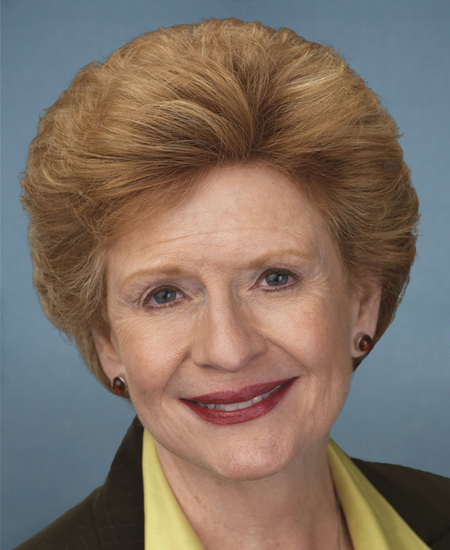
Sen. Debbie Stabenow
Sponsored bills
United States Army Rangers Veterans of World War II Congressional Gold Medal Act This bill provides for the award of a single Congressional Gold Medal to the U.S. Army Rangers Veterans of World War II in recognition of their dedicated service during World War II.
This resolution expresses support for the rights, freedoms, and equal treatment of lesbian, gay, bisexual, transgender, and queer (LGBTQ) individuals. The resolution r ecognizes that LGBTQ rights are human rights and protected by the laws of the United States and international treaties. Additionally, the resolution encourages the celebration of LGBTQ Pride Month in June.
This resolution celebrates 100 years of continuous diplomatic relations between the United States and Estonia, Latvia, and Lithuania (the Baltic States). The resolution also commits to providing continued support for the Baltic States through economic and security cooperation, including through the Baltic Security Initiative.
Affordability is Access Act This bill establishes several requirements relating to health insurance coverage of, and access to, over-the-counter contraceptives. Specifically, the bill requires the Department of Health and Human Services, the Department of Labor, and the Department of the Treasury to specify that private health insurance plans must cover over-the-counter contraceptives that are approved by the Food and Drug Administration (FDA), even without a prescription. Under current law, private health insurance plans (with some exceptions) must cover FDA-approved prescription contraceptives, without cost-sharing requirements. The bill also prohibits retailers from interfering with an individual's access to oral contraceptives that are meant for routine, daily use and are FDA-approved for use without a prescription.
Deepfake Task Force Act This bill requires the Department of Homeland Security to coordinate with the White House Office of Science and Technology Policy to temporarily establish the National Deepfake Provenance Task Force. Comprised of federal and nonfederal stakeholders, the task force must address threats posed by digital content forgeries (i.e., digital audio, images, and text fabricated or manipulated using artificial intelligence, machine learning, and other emerging technologies with the intent to mislead). The task force's activities include developing a plan to reduce the proliferation of digital content forgeries. The task force terminates 90 days after submitting its final report.
Palliative Care and Hospice Education and Training Act This bill requires the Department of Health and Human Services (HHS) to take a series of actions relating to palliative-care training. Specifically, HHS must provide support for Palliative Care and Hospice Education Centers. The centers must improve the training of health professionals in palliative care and establish traineeships for individuals preparing for advanced-education nursing degrees, social-work degrees, or advanced degrees in physician-assistant studies in palliative care. HHS may provide support to medical schools, teaching hospitals, and graduate medical-education programs for training physicians who plan to teach palliative medicine. HHS must (1) provide Palliative Medicine and Hospice Academic Career Awards to individuals to promote their career development, (2) support entities that operate a Palliative Care and Hospice Education Center, (3) support individuals in specified fields who are pursuing an advanced degree in palliative care or related fields, and (4) award grants to nursing programs to train individuals in providing palliative care. The Agency for Healthcare Research and Quality must provide for a national education and awareness campaign to inform patients, families, and health professionals about the benefits of palliative care. The National Institutes of Health must expand national research programs in palliative care.
Access to Baby Formula Act of 2022 This bill authorizes the Department of Agriculture (USDA) to take certain actions to address emergencies, disasters, and supply chain disruptions (particularly the shortage of infant formula in the United States) affecting participants of the Special Supplemental Nutrition Program for Women, Infants, and Children (WIC). For example, the bill directs USDA to require each infant formula cost containment contract to include remedies in the event of an infant formula recall, including how an infant formula manufacturer would protect against disruption to WIC participants in the state.
Zero-Emission Homes Act of 2021 This bill directs the Department of Energy to establish a Zero-Emission Homes Program that provides rebates to homeowners and owners of multifamily buildings for qualified electrification projects (e.g., electric stoves or heat pumps).
This resolution recognizes that women's health is a critical issue for the U.S. economy and workforce and supports increased health research focused on women.