

Supporting the Well-Being and Mental Health of Grandfamilies Act This bill extends the Advisory Council to Support Grandparents Raising Grandchildren for four additional years and limits the number of nonfederal members serving on the council to 10.
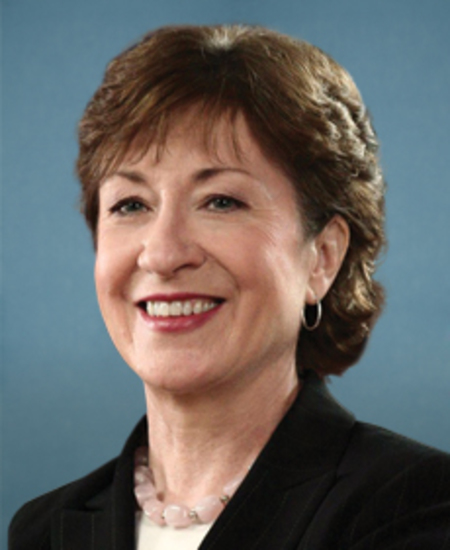
Sen. Susan M. Collins
Sponsored bills
This resolution celebrates the 50th anniversary of the Federal Pell Grant program and expresses support for the designation of June 23 as National Pell Grant Day.
Historic Lighthouse Resiliency Act This bill authorizes the U.S. Army Corps of Engineers to carry out projects to (1) improve the resilience of historic light stations against the adverse effects of climate change, (2) ensure continued public access to historical light stations, and (3) improve public safety on the grounds of historical light stations. The Corps must conduct a study of national historic light stations to determine the long-term protection needs of such stations and establish a national database of the stations based on the results of the study.
Modernizing the Accelerated Approval Pathway Act of 2022 This bill modifies provisions relating to the accelerated approval of drugs for serious or life-threatening diseases or conditions, including by requiring the Food and Drug Administration (FDA) to publish its reasons when it determines a postapproval study to be unnecessary. The bill also establishes a pilot program and an FDA council to support the development of drugs for rare diseases and ensure the appropriate use of the accelerated approval pathway, respectively.
Screening for Communities to Receive Early and Equitable Needed Services for Cancer Act or the SCREENS for Cancer Act of 2022 This bill reauthorizes through FY2027 and makes changes to the National Breast and Cervical Cancer Early Detection Program. This program provides funding to states for breast and cervical cancer screening, diagnostic, and treatment services for individuals who have low incomes, are uninsured, or otherwise lack access to such services.
Maddy summaryThis Senate resolution (SRES 679) formally commemorates June 19, 2022, as "Juneteenth National Independence Day" to honor the historical event of June 19, 1865, when Union troops announced the end of slavery in Texas. It references the significance of this date in U.S. history, specifically the moment news of emancipation reached enslaved people in the Southwestern States. The resolution does not create new legal obligations or affect any specific group; it is a symbolic recognition of this historical milestone. It aligns with Juneteenth’s established status as a federal holiday, which was officially designated in 2021.
This resolution encourages the Department of the Air Force to designate the Maine Air National Guard 101st Air Refueling Wing at Bangor Air National Guard Base as a center of excellence for additive manufacturing technology.
This resolution expresses support for the goals of International Women's Day and recognizes that women's empowerment is inextricably linked to generating economic growth and self-reliance, sustainable peace and democracy, and inclusive security. The resolution also reaffirms the Senate's commitment to end discrimination and violence against women and to pursue policies that guarantee fundamental human rights for women and girls worldwide.
This resolution recognizes the 75th anniversary of the establishment of the United Nations Children's Fund (UNICEF). The resolution applauds UNICEF for the critical role it plays in protecting the rights and lives of vulnerable children around the world, including in the context of the global fight against COVID-19.
COI Elimination Act This bill limits U.S. contributions to the United Nations pertaining to the U.N. Independent International Commission of Inquiry on the Occupied Palestinian Territory, including East Jerusalem, and Israel. Current law imposes a cap on the annual U.S. contribution to the U.N. budget. The bill lowers that cap by 25% of the amount budgeted for the commission unless the Department of State certifies to Congress that the commission has been abolished. After such a certification, the United States shall, subject to appropriations, provide to the United Nations an amount equal to all the contributions that were withheld under this bill. The bill also states that it shall be U.S. policy to seek the abolition of the commission and combat systemic anti-Israel bias in international bodies.