

This resolution remembers Her Majesty Queen Elizabeth II and her more than 70 years of service in support of the British people and the Commonwealth of Nations. The resolution also expresses gratitude to Queen Elizabeth II for her efforts to maintain strong bilateral relations between the United Kingdom and the United States. Finally, the resolution extends condolences to the family of Queen Elizabeth II, to the people of the United Kingdom of Great Britain and Northern Ireland, and to the peoples of the Commonwealth of Nations.
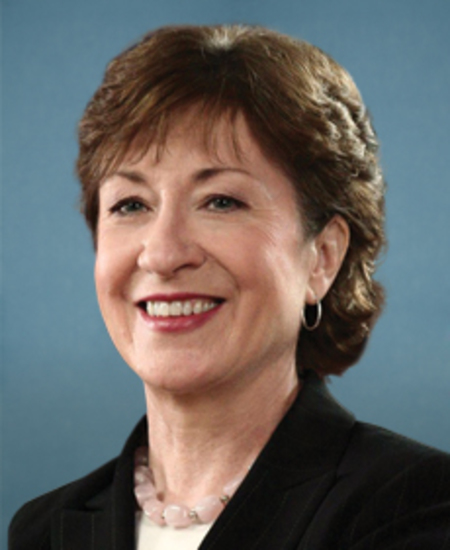
Sen. Susan M. Collins
Sponsored bills
Increase Reliable Services Now Act This bill imposes limits on Internal Revenue Service (IRS) enforcement activities and hiring. The bill prohibits the IRS from hiring any person for enforcement activities until the end of a period in which the IRS has maintained for six consecutive months a level of service for accounts management phone lines of not less than 70%, and an average speed of answering phone calls in five minutes or less. The bill also requires that not less than 90% of regular IRS employees perform work in person at their job sites. The bill prohibits the IRS from auditing taxpayers with taxable incomes below $400,000 at a greater rate than before the enactment of this bill. Further, the IRS may not hire additional personnel (other than for return processing activities and call center operations) until its tax return processing backlog is not in excess of 1 million cases and it issues tax refunds within six weeks or less after receipt of a tax return.
PFAS Intergovernmental Coordination Act This bill directs the Office of Management and Budget (OMB) to establish a working group to address contamination by perfluoroalkyl and polyfluoroalkyl substances, commonly referred to as PFAS. These substances are man-made and may have adverse human health effects. A variety of products contain the compounds, such as nonstick cookware or weatherproof clothing. Specifically, the working group shall facilitate more effective cooperation, coordination, and mutual accountability among the federal government and state, local, and tribal governments on a holistic response to PFAS contamination in communities across the United States. The working group shall terminate two years after its establishment. The OMB must report to Congress, describing any guidelines created in performing its duties and making a recommendation with respect to extending the working group's authorization.
Federal Firefighters Fairness Act of 2022 This bill provides federal workers' compensation to firefighters who contract certain illnesses as a result of their service. Specifically, the bill provides that heart disease, lung disease, and specified cancers of federal employees employed in fire protection activities for at least 5 years are presumed to be proximately caused by such employment if the employee is diagnosed with the disease within 10 years of employment. The Department of Labor must periodically review the bill's listed diseases and conditions and make appropriate additions. An employee in fire protection activities is a firefighter, paramedic, emergency medical technician, rescue worker, ambulance personnel, or hazardous material worker, who (1) is trained in fire suppression; (2) has the legal authority and responsibility to engage in fire suppression; (3) is engaged in the prevention, control, and extinguishment of fires or response to emergency situations where life, property, or the environment is at risk; and (4) performs such activities as a primary responsibility. Additionally, the Department of Interior and the Department of Agriculture must jointly study the long-term health effects experienced by federal wildland firefighters who are eligible for workers' compensation. The bill also requires Labor to revise regulations so as to allow at least 60 days (rather than at least 30 days) for a claimant to submit any additional evidence that is requested by the Office of Workers' Compensation Programs to support a federal workers' compensation claim.
Secure and Fair Enforcement Banking Act of 2021 or the SAFE Banking Act of 2021 This bill generally prohibits a federal banking regulator from penalizing a depository institution for providing banking services to a legitimate cannabis-related business. Prohibited penalties include terminating or limiting the deposit insurance or share insurance of a depository institution solely because the institution provides financial services to a legitimate cannabis-related business and prohibiting or otherwise discouraging a depository institution from offering financial services to such a business. Additionally, proceeds from a transaction involving activities of a legitimate cannabis-related business are not considered proceeds from unlawful activity. Proceeds from unlawful activity are subject to anti-money laundering laws. Furthermore, a depository institution is not, under federal law, liable or subject to asset forfeiture for providing a loan or other financial services to a legitimate cannabis-related business. The bill also provides that a federal banking agency may not request or order a depository institution to terminate a customer account unless (1) the agency has a valid reason for doing so, and (2) that reason is not based solely on reputation risk. Valid reasons for terminating an account include threats to national security and involvement in terrorist financing, including state sponsorship of terrorism.
Simplifying Grants Act of 2022 This bill sets forth procedures for simplifying the grant process for nonurbanized areas, for both existing and new grant programs. Each agency must make publicly available a checklist for covered local governments with respect to each grant program of the agency for which such governments are otherwise eligible that includes each requirement for every step of the grant process. The Office of Management and Budget must report to Congress (1) within 270 days of this bill's enactment, evaluating the extent to which agencies have simplified the requirements and made the checklist available; and (2) each April 1st, evaluating the amount of technical assistance provided and the amount of funds awarded.
John Lewis Civil Rights Fellowship Act of 2022 This bill establishes the John Lewis Civil Rights Fellowship Program within the J. William Fulbright Educational Exchange Program (commonly referred to as the Fulbright Program). The fellowship program shall honor the legacy of Representative John Lewis and promote studies, research, and international exchange in the subject of nonviolent civil rights movements around the world. The J. William Fulbright Foreign Scholarship Board shall annually select at least 25 qualified individuals when feasible to serve as fellows in the fellowship program. Each fellow shall (1) work in an internship or research position with an approved organization in a country with an operational Fulbright U.S. Student Program, and (2) receive an award sufficient to cover the fellow's reasonable costs during the fellowship period and certain travel and lodging expenses related to the program.
Ensuring the Best Schools for Veterans Act of 2022 This act makes adjustments to the process by which the Department of Veterans Affairs (VA) evaluates programs of education for violations of the 85/15 Rule. The rule generally prohibits the VA from approving the enrollment of a veteran in any course at an educational institution where more than 85% of the students are having all or part of their tuition or other charges paid by the institution or the VA. The act adds an exception for tuition or charges paid under a payment plan at an educational institution with a history of offering payment plans that are completed within 180 days after the end of the applicable term, quarter, or semester. The act also requires the VA to establish a process by which an educational institution may request a review of a determination that the institution has more than 85% of enrolled students that have all or part of their tuition or other charges paid by the institution or the VA. The act adjusts the existing 35% exemption by exempting courses from the 85/15 Rule if the majority of courses at the institution are approved by the state approving agency, and the total number of veterans, reservists, or eligible beneficiaries who are enrolled at the institution equals 35% or less of the total student enrollment at the institution. Additionally, the 85/15 Rule does not apply with respect to the enrollment of a veteran in a program of education with fewer than 10 students who are having all or part of their tuition or other charges paid to or for them by the educational institution or the VA.
This resolution expresses that the Senate has heard the announcement of the death of the Honorable Jacqueline R. Walorski, Congresswoman for the Second Congressional District of Indiana. The resolution also honors Representative Walorski for her service to Indiana and the United States. The resolution expresses that when the Senate adjourns today, it stands adjourned as a further mark of respect to the memory of Representative Walorski.
This resolution designates September 25, 2022, as National Lobster Day and encourages the people of the United States to observe the day with appropriate ceremonies and activities.