

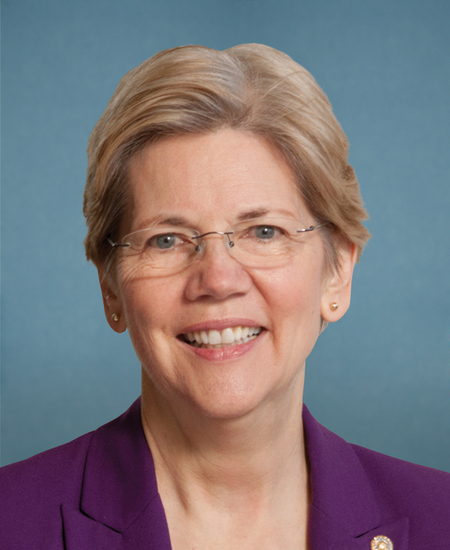
Photo of Elizabeth Warren
D United States Senate · Massachusetts

Sen. Elizabeth Warren

Compare
Total votes
1,054
all sessions
Attendance
100%
2 missed
Higher than 82% of chamber peers
With party
92%
of cast votes
Lower than 94% of chamber peers
Bipartisan score
5%
crosses aisle rarely
Higher than 92% of chamber peers
Sponsored
2,076
bills & resolutions
Higher than 83% of chamber peers
Committees
16
assignments
2,076 bills and resolutions

Sponsored bills

Total
2,076
Primary
275
Co-sponsor
1,801
This page
2,076
matching current filters
Co-sponsor S 5641
In committee · United States Senate · Co-sponsor
Complete America’s Great Trails Act

Maddy summaryThis bill creates a new tax credit for property owners who contribute conservation rights to National Scenic Trails or their designated corridors. It allows taxpayers to claim a credit equal to the fair market value of their contribution, defined as land within 50-2,640 feet of a federally designated trail (like the Appalachian Trail). The credit applies to contributions made after enactment, with specific rules ensuring the land remains usable for recreation or agriculture without harming conservation goals. A study will also be conducted within four years to assess the credit's effectiveness and explore making it refundable or transferable.

In committee Dec 20, 2024 1 co-sponsor
Primary S 5636
In committee · United States Senate · Lead sponsor
Honoring Promises to Native Nations Act

Maddy summary# Summary: Honoring Promises to Native Nations Act This comprehensive legislative document outlines a wide-ranging set of provisions designed to address longstanding infrastructure, economic, and social needs of Native American, Alaska Native, and Native Hawaiian communities. The key provisions include: ## Key Focus Areas 1. **Healthcare Infrastructure**: - Increased funding for Indian Health Service facilities - Medicaid expansion for tribal health programs - Mental health services and tribal health care infrastructure improvements 2. **Housing Development**: - $2.5 billion annually for Indian Housing Block Grant Program (starting 2025) - $47 million annually for Native Hawaiian Housing Block Grant Program - $400 million annually for Bureau of Indian Affairs Housing Improvement Program - $10 million annually for Tribal Uninhabitable Housing Improvement Program 3. **Economic Development & Infrastructure**: - $1 billion annually for Tribal Transportation Program (2025-2027), then $800 million annually - $75 million annually for Tribal Transit Program - $100 million annually for Rural Utilities Service Water and Waste Disposal Program for Tribes - $1.9 billion for Trust Land Consolidation Fund 4. **Broadband & Spectrum Sovereignty**: - Establishment of a $1 billion Tribal Broadband Fund (initially) - Creation of a Tribal Spectrum Market for spectrum leasing and assignment - 5% set-aside for E-rate program support for Tribal schools and libraries - $100 million annually for Tribal Connectivity Fund (2025-2033) - $300 million annually for Tribal broadband deployment 5. **Spectrum Sovereignty**: - Permanent elimination of public availability of spectrum over Tribal lands - Requirements for FCC to notify Tribes about available spectrum - Prohibition on FCC making unused spectrum available without Tribal consent The legislation emphasizes mandatory, non-competitive funding directly to Tribes, tribal consultation requirements, and recognition of tribal sovereignty in managing resources. It addresses critical infrastructure gaps including broadband access (with 65% of Tribal residents lacking fixed broadband), housing conditions, transportation, and utilities, while establishing mechanisms for Tribes to leverage spectrum rights for economic development.

In committee Dec 19, 2024 0 co-sponsors
Primary S 5637
In committee · United States Senate · Lead sponsor
National Biomedical Research Act

Maddy summaryS 5637 establishes the Biomedical Innovation Fund in the Treasury, requiring annual $10 billion transfers from the general fund starting September 1, 2025, through 2034. The fund distributes amounts to the National Institutes of Health (NIH) and Food and Drug Administration (FDA) based on their discretionary appropriations relative to minimum funding levels, with 20% of each annual allocation available for obligation each year over five fiscal years. Funds must support specific research activities including basic disease research, innovative treatments for unmet medical needs, early-career scientist programs, and studies targeting conditions disproportionately affecting Medicare/Medicaid populations. The bill strictly prohibits non-compliant uses and mandates annual reports on fund operations and research outcomes to Congress.

In committee Dec 19, 2024 0 co-sponsors
Primary S 5638
In committee · United States Senate · Lead sponsor
Pharmaceutical Supply Chain Defense and Enhancement Act

Maddy summaryThe Pharmaceutical Supply Chain Defense and Enhancement Act creates a confidential list of drugs critical to public health and national security, requiring manufacturers to report on supply chain dependencies and develop continuity plans. It authorizes $5 billion to boost domestic manufacturing capacity for these critical drugs and their ingredients through contracts with U.S. companies, prioritizing generic drugs and drugs not currently manufactured in the U.S. Federal agencies must prioritize purchasing domestically manufactured drugs from the critical list, with $1 billion annually allocated for this purpose. The bill also mandates annual transparency reports on supply chain reliance and includes oversight of foreign investment in the U.S. pharmaceutical industry.

In committee Dec 19, 2024 0 co-sponsors
Co-sponsor S 2315
In committee · United States Senate · Co-sponsor
Bring Our Heroes Home Act

Maddy summaryThe "Bring Our Heroes Home Act" creates a system to identify, collect, and make publicly available records about missing military personnel and civilian personnel who went missing between December 7, 1941, and the bill's enactment date. It requires federal agencies to identify and transmit these records to the National Archives within 180 days (with full completion within one year), and establishes a Review Board to oversee the process and make decisions about disclosure. The bill creates a presumption that such records should be declassified and made public, with only narrow exceptions for national security or privacy concerns, and mandates periodic reviews of any records that remain withheld. This primarily affects federal agencies that hold records related to missing military personnel and civilian personnel, aiming to provide families and the public with greater access to information about missing individuals.

In committee Dec 19, 2024 1 co-sponsor
Co-sponsor S 1171
In committee · United States Senate · Co-sponsor
Ending Trading and Holdings In Congressional Stocks (ETHICS) Act

Maddy summaryThis bill would require Members of Congress, their spouses, and dependent children to stop trading or holding certain investments (called "covered investments") and instead place them in "qualified blind trusts" or divest them by specific deadlines. It defines covered investments broadly to include stocks, commodities, and derivatives, but excludes diversified mutual funds, government bonds, and some business interests. The bill sets different deadlines for different groups (e.g., 90 days after enactment for existing holdings, 120 days for new holdings) and establishes civil penalties for non-compliance, including penalties equal to 10% of the value of non-compliant holdings. It also requires public reporting of financial disclosures and establishes procedures for oversight by ethics offices.

In committee Dec 19, 2024 1 co-sponsor
Co-sponsor S 608
Passed · United States Senate · Co-sponsor
Deerfield River Wild and Scenic River Study Act of 2023

Maddy summaryThis bill directs the federal government to study whether the Deerfield River (including all its branches and major tributaries like the Green River and North River) in Massachusetts and Vermont should be designated as a Wild and Scenic River. It requires the Secretary of the Interior to complete this study within three years of funding and submit a report to Congress with the findings. The study itself is the primary action; it does not immediately protect the river but would inform future decisions about potential designation. This affects the river watershed and communities along its path by initiating a formal review process.

Passed Dec 19, 2024 1 co-sponsor
Primary S 5577
In committee · United States Senate · Lead sponsor
Consumer Bankruptcy Reform Act of 2024

Maddy summaryThe Consumer Bankruptcy Reform Act of 2024 creates a new Chapter 10 bankruptcy system designed to help individual consumers facing financial hardship by simplifying the process and reducing costs. This new chapter replaces the existing Chapter 13 system for individual debtors and introduces three simplified plan options: a repayment plan for unsecured debts, a residence plan for modifying mortgage loans, and a property plan for other secured debts. The bill also expands protections for consumers by allowing student loan debt to be discharged on equal terms with other debts, prohibiting certain creditor actions that violate consumer financial laws, and establishing a Consumer Bankruptcy Ombuds to assist individual debtors. Additionally, the legislation requires courts to collect demographic data from debtors to identify and address disparities in the bankruptcy system, while maintaining the ability to convert cases to Chapter 11 or 12 if needed.

In committee Dec 18, 2024 0 co-sponsors
Co-sponsor S 5586
In committee · United States Senate · Co-sponsor
Strengthening Loan Forgiveness for Public Servants Act

Maddy summaryThis bill creates a new student loan forgiveness program for public servants who take out federal loans after the law passes. It forgives 15% of the loan balance after 2 years of public service, increasing to 30% after 10 years, based on the loan amount when they started the job. Borrowers must submit an employment certification form to qualify, and the program also cancels interest accrued during the application review period. It directly affects public servants (like teachers, firefighters, and government workers) with new federal student loans who work full-time in qualifying roles for the required years.

In committee Dec 18, 2024 1 co-sponsor
Co-sponsor S 5588
In committee · United States Senate · Co-sponsor
Keep It in the Ground Act of 2024

Maddy summaryS 5588, the Keep It in the Ground Act of 2024, prohibits new oil and gas leasing on all federal lands and waters, including the Gulf of Mexico, Atlantic, Pacific, and Arctic oceans, and bans renewals or extensions of nonproducing leases (leases that haven’t extracted fossil fuels). It directly affects oil and gas companies seeking to develop federal fossil fuel projects. The law requires the Secretary of the Interior to cancel existing leases in the Beaufort, Cook Inlet, and Chukchi Seas within 60 days of enactment. Exceptions only apply for imminent national security threats or to avoid breach-of-contract lawsuits. The bill aims to prevent emissions from federal fossil fuel reserves by keeping 90% of potential emissions underground.

In committee Dec 18, 2024 1 co-sponsor
Showing 621 to 630 of 2,076 bills
Previous 1 … 62 63 64 … 208 Next