

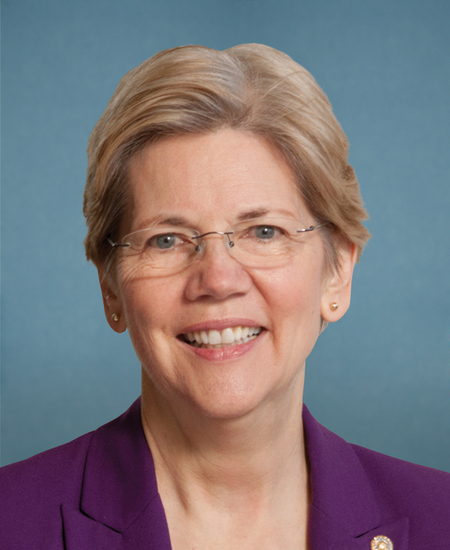
Photo of Elizabeth Warren
D United States Senate · Massachusetts

Sen. Elizabeth Warren

Compare
Total votes
1,044
all sessions
Attendance
100%
2 missed
Higher than 82% of chamber peers
With party
92%
of cast votes
Lower than 94% of chamber peers
Bipartisan score
5%
crosses aisle rarely
Higher than 92% of chamber peers
Sponsored
2,061
bills & resolutions
Higher than 83% of chamber peers
Committees
16
assignments
2,061 bills and resolutions

Sponsored bills

Total
2,061
Primary
272
Co-sponsor
1,789
This page
2,061
matching current filters
Co-sponsor S 3940
In committee · United States Senate · Co-sponsor
Access to Fair Financing for Opportunity and Resilient Development Act

Maddy summaryThis bill amends the Community Development Banking and Financial Institutions Act of 1994 to require the Treasury Secretary to testify annually before Congress about the Fund's operations. It also strengthens the CDFI Bond Guarantee Program by adjusting guarantee limits and extending the program's authorization period. Additionally, the bill expands capital assistance options for community development financial institutions and creates a new lending program specifically for Native community development financial institutions to support homeownership in Tribal and Native communities.

In committee Feb 26, 2026 1 co-sponsor
Primary S 3948
In committee · United States Senate · Lead sponsor
Direct File Act of 2026

Maddy summaryThis bill, known as the Direct File Act of 2026, would establish a government-run online platform for taxpayers to prepare and file their individual income tax returns for free. It requires the Treasury Department to create a user-friendly system that uses IRS data to simplify the process, offers customer support, and is available in multiple languages and on mobile devices. The legislation also prohibits the Treasury from entering into agreements that would limit its ability to provide these tax preparation and filing services. Additionally, the bill allows eligible states to integrate their state tax filing with the federal system and provides funding to states that meet certain standards for doing so.

In committee Feb 26, 2026 0 co-sponsors
Primary S 3904
In committee · United States Senate · Lead sponsor
American Homeownership Act

Maddy summaryThe American Homeownership Act restricts tax deductions for interest and depreciation on residential properties owned by institutional investment entities or "large owners" (defined as those holding 50+ single-family units). It creates exceptions for new construction, rehabilitation of uninhabitable properties, sales to individuals for primary residence, and properties serving affordable housing through tax credit programs. The bill also prohibits federal housing agencies from selling properties or providing mortgage loans to these large investors and allocates savings from these tax changes to fund affordable housing programs. These provisions aim to encourage homeownership by limiting tax benefits for large-scale rental property ownership while directing resources toward affordable housing development.

In committee Feb 24, 2026 0 co-sponsors
Co-sponsor S 3891
In committee · United States Senate · Co-sponsor
ICE Accountability Act

Maddy summaryThe ICE Accountability Act establishes an independent Commission to monitor U.S. immigration enforcement agencies (including ICE and CBP) for compliance with civil rights and liberties laws. The Commission will observe operations, review records like body camera footage, accept public complaints, and issue monthly public reports; it can issue findings of serious violations and refer cases to prosecutors for potential criminal charges. The Commission has subpoena power to access agency records and can take legal action against noncompliant agencies, imposing daily penalties of $500,000 for ongoing violations. The Commission, staffed by four non-governmental monitors appointed by congressional leaders, will operate for up to four years or until agencies achieve sustained compliance with oversight requirements.

In committee Feb 12, 2026 1 co-sponsor
Co-sponsor S 3869
In committee · United States Senate · Co-sponsor
Healthy Families Act

Maddy summaryThe Healthy Families Act would require most private employers and certain government entities to provide employees with earned paid sick time, allowing workers to take up to 56 hours per year for their own health needs, caring for family members, or addressing domestic violence, sexual assault, or stalking. Employees would earn 1 hour of paid sick time for every 30 hours worked, with the ability to use it for medical appointments, caring for family members with health needs, or seeking safety from violence. The bill prohibits employers from retaliating against workers who use this time and requires employers to post clear notices about the policy. It applies to most private employers, with specific provisions for government entities like the Library of Congress and Government Accountability Office.

In committee Feb 12, 2026 1 co-sponsor
Co-sponsor S 3875
In committee · United States Senate · Co-sponsor
Responsible Firearms Marketing Act

Maddy summaryThis bill requires the Federal Trade Commission (FTC) to study firearm advertising and marketing for unfair or deceptive practices, such as ads targeting people under 18, implying illegal use, or promoting semiautomatic assault weapons. Within two years, the FTC must report findings to Congress and then create regulations to ban these practices within 18 months of the report. These regulations would apply to firearm manufacturers, dealers, and importers, prohibiting specific deceptive marketing tactics. Violations would be enforced under existing FTC authority, with penalties matching current unfair business practice violations.

In committee Feb 12, 2026 1 co-sponsor
Co-sponsor S 3892
In committee · United States Senate · Co-sponsor
Stop Price Gouging in Grocery Stores Act of 2026

Maddy summaryThis bill prohibits grocery stores from charging unreasonably high prices (defined as 120% or more of a product’s average price over the prior six months) unless they prove the increase stems from uncontrollable costs like supply chain issues. It bans using personal data - such as facial recognition or purchase history - to set different prices for individual shoppers and requires clear signage about facial recognition use at store entrances. Large grocery stores (over 10,000 sq ft) must replace electronic shelf labels with physical price tags. The Federal Trade Commission enforces these rules, allowing states and consumers to seek $3,000 per violation in court for price gouging or data misuse.

In committee Feb 12, 2026 1 co-sponsor
Co-sponsor S 3864
In committee · United States Senate · Co-sponsor
Federal Jobs Guarantee Development Act of 2026

Maddy summaryThe Federal Jobs Guarantee Development Act of 2026 establishes a 3-year pilot program providing competitive grants to up to 15 eligible entities (such as states, tribes, or rural areas with unemployment at least 150% of the national rate) to create job guarantee programs. These programs must offer jobs to all residents aged 18+ in the service area, with wages meeting or exceeding federal/state minimums, health coverage comparable to federal employee benefits, and mandated paid leave. The bill requires grantees to provide training support, report demographic data, and comply with specific job access standards for individuals with disabilities and criminal records. Funds are limited to new jobs not displacing existing workers, with annual audits to ensure proper use of resources.

In committee Feb 12, 2026 1 co-sponsor
Co-sponsor S 3886
In committee · United States Senate · Co-sponsor
Nurses Belong in Nursing Homes Act

Maddy summaryThis bill establishes minimum nurse staffing requirements for nursing homes participating in Medicare and Medicaid. It requires facilities to provide 24-hour registered nurse coverage (transitioning from 8-hour daily coverage within 180 days of enactment) and maintain a minimum of 3.48 hours of nursing care per resident daily. The bill mandates a study every four years to review staffing standards based on resident needs and safety data, with findings informing future regulations. Additionally, it directs states to use a portion of collected civil penalties to fund workforce programs like student loan repayment and career pathway development for nursing home staff.

In committee Feb 12, 2026 1 co-sponsor
Co-sponsor S 3865
In committee · United States Senate · Co-sponsor
BE HEARD in the Workplace Act

Maddy summary# Summary of Workplace Discrimination and Harassment Legislation This comprehensive bill expands protections against workplace discrimination and harassment while strengthening enforcement mechanisms for workers. Key provisions include: 1. **Expanded Protections (Section 301)**: - Extends anti-discrimination protections to independent contractors, interns, fellows, volunteers, and trainees under major civil rights laws - Creates "covered establishment" definition for entities engaging these workers 2. **Nondisclosure/Nondisparagement Clause Ban (Section 302)**: - Prohibits employers from requiring workers to sign nondisclosure or nondisparagement clauses covering harassment or discrimination - Establishes strict requirements for settlement agreements (including 21-day consideration period, 7-day revocation period, and clear written disclosure) - Protects workers' right to report harassment to the EEOC without penalty 3. **Arbitration Restrictions (Section 303)**: - Bans mandatory pre-dispute arbitration agreements that prevent class or collective actions - Establishes new requirements for post-dispute arbitration agreements - Allows workers to sue employers who violate these provisions 4. **Federal Contractor Compliance (Section 304)**: - Requires federal contractors to disclose past violations of labor and civil rights laws - Establishes Labor Compliance Advisors at executive agencies - Creates a system for monitoring contractor compliance with labor laws 5. **Grant Programs (Sections 401-436)**: - Creates national grants to prevent and address employment discrimination - Establishes grants for legal assistance for low-income workers facing discrimination - Creates a system of state advocacy for workers' rights through state-level systems The bill aims to strengthen worker protections against discrimination and harassment while expanding access to legal remedies and creating new mechanisms for enforcement and prevention. It also includes provisions to ensure federal contractors comply with labor and civil rights laws and establishes new reporting requirements for contractors with past violations.

In committee Feb 12, 2026 1 co-sponsor
Showing 211 to 220 of 2,061 bills
Previous 1 … 21 22 23 … 207 Next