

Ensuring Access to General Surgery Act of 2021 This bill requires the Health Resources and Services Administration (HRSA) to study access by underserved populations to general surgeons. Specifically, HRSA must study (1) whether the health professional shortage area designation under the National Health Service Corps (NHSC) program accurately assesses adequacy of access to general surgeons, (2) whether another measure would be more accurate, and (3) potential methodologies for designating general surgery shortage areas. (The NHSC provides scholarships and student loan repayment awards to primary care, dental care, and mental health care providers who agree to work in areas that HRSA designates as having a shortage of those particular types of providers.) HRSA must also publish data comparing the availability and need of general surgery services in urban, suburban, and rural areas. On the basis of its study, HRSA may establish a methodology for designating general surgery shortage areas and make such designations. If any designations are made, HRSA must publish a list of general surgery shortage areas.
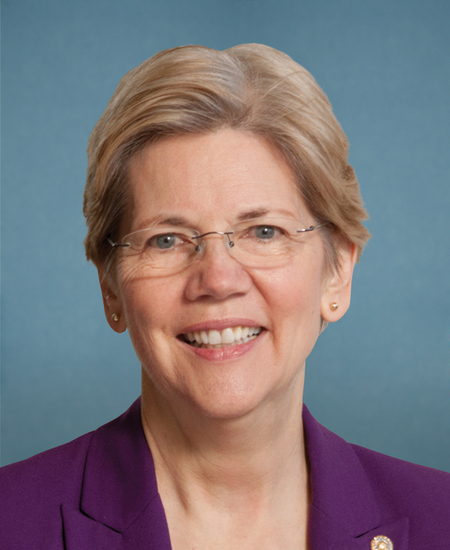
Sen. Elizabeth Warren
Sponsored bills
Carried Interest Fairness Act of 2021 This bill modifies the tax treatment of carried interest, which is compensation that is typically received by a partner of a private equity or hedge fund and is based on a share of the fund's profits. (Under current law, carried interest is taxed as investment income rather than at ordinary income tax rates.) This bill includes provisions that set forth a special rule for the inclusion in gross income of partnership interests transferred in connection with the performance of services, treat as ordinary income the net capital gain with respect to an investment services partnership interest except to the extent such gain is attributable to a partner's qualified capital interest, exempt income from investment services partnership interests from treatment as qualifying income of a publicly traded partnership, exempt certain family partnerships from the application of this bill, increase the penalty for underpayments of tax resulting from failure to treat income from an investment services partnership interest as ordinary income, and include income and loss from an investment services partnership interest for purposes of determining net earnings from self-employment and applicable self-employment taxes. The bill defines investment services partnership interest as any interest in a partnership held by a person who provides services to a partnership by (1) advising the partnership about investing in, purchasing, or selling specified assets; (2) managing, acquiring, or disposing of specified assets; or (3) arranging financing with respect to acquiring specified assets.
Citizenship for Essential Workers Act This bill establishes a mechanism for eligible aliens who worked as essential workers during the declared COVID-19 (i.e., coronavirus disease 2019) public health emergency to apply for and obtain permanent resident status. The bill also narrows certain grounds for deportability and inadmissibility. To be eligible for permanent resident status under this bill, an alien must have earned income at any point during the COVID-19 emergency period doing work deemed essential by the Department of Homeland Security (DHS) or a state or local government. An alien may also be eligible if that alien is a parent, spouse, or child of (1) an eligible alien who died from COVID-19, or (2) a member of the Armed Forces. Certain aliens shall be ineligible, such as an alien who was a refugee on January 1, 2021. To obtain permanent resident status under this bill, an applying alien must satisfy additional requirements, including by passing a background check. Furthermore, the bill repeals provisions providing for three-year bars and permanent bars to admission into the United States. (Generally, these bars apply to aliens who were previously removed or unlawfully present in the United States.) The bill also narrows the scope of certain crime-based grounds for inadmissibility or deportability, such as by redefining the term conviction to exclude expunged convictions. The Department of Justice or DHS may waive certain grounds of inadmissibility or deportability (1) for humanitarian purposes, (2) to ensure family unity, or (3) for the public interest.
Student Food Security Act of 2021 This bill expands the Supplemental Nutrition Assistance Program (SNAP) and establishes programs to address food insecurity among college students. Specifically, the bill permanently modifies the eligibility requirements to allow additional college students to receive SNAP benefits, and it establishes a demonstration program to allow college students to use SNAP benefits on college campuses instead of meal plans. The bill also advances implementation of certain data-sharing agreements and notifications to help students who apply for federal financial aid to also apply for and receive other federal means-tested benefits (e.g., Section 8 tenant-based housing assistance, Medicaid, and Supplemental Security Income). In addition, the bill (1) requires questions about food and housing insecurity to be incorporated into the National Postsecondary Student Aid Study, and (2) establishes a grant program to support research and address incidences of food and housing insecurity among college students.
Untraceable Firearms Act of 2021 This bill establishes a federal statutory framework to regulate the manufacture, sale, offer to sell, transfer, purchase, and receipt of ghost guns (i.e., guns without serial numbers). Additionally, the bill revises the federal statutory framework regulating the manufacture, possession, sale, import, shipment, delivery, receipt, and transfer of undetectable firearms. Among the revisions, the bill defines undetectable firearm as a firearm without a major component wholly made of detectable material.
Nurse Staffing Standards for Patient Safety and Quality Care Act of 2021 This bill requires hospitals to implement and submit to the Department of Health and Human Services (HHS) a staffing plan that complies with specified minimum nurse-to-patient ratios by unit. Hospitals must post a notice regarding nurse-to-patient ratios in each unit and maintain records of actual ratios for each shift in each unit. The bill also requires hospitals to follow certain procedures regarding how ratios are determined and other staff are prohibited from performing nurse functions unless specifically authorized within a state's scope of practice rules, among other requirements. HHS must adjust Medicare payments to hospitals to cover additional costs attributable to compliance with these ratios. Nurses may object to, or refuse to participate in, an assignment if it would violate minimum ratios or if they are not prepared by education or experience to fulfill the assignment without compromising the safety of a patient or jeopardizing their nurse's license. Hospitals may not (1) take adverse actions against a nurse based on the nurse's reasonable refusal to accept an assignment; or (2) discriminate against individuals for good faith complaints relating to the care, services, or conditions of the hospital or related facilities. HHS may impose civil monetary penalties on hospitals violating the ratio requirements and must publish the names of such hospitals. The bill provides stipends to the nurse workforce loan repayment and scholarship program and expands the nurse retention grant program to include nurse preceptorship and mentorship projects.
Andrew Kearse Accountability for Denial of Medical Care Act of 2021 This bill establishes a new federal criminal offense for failing to obtain medical attention for an individual in federal custody who displays medical distress. Specifically, the bill requires federal law enforcement officers and the Bureau of Prisons' personnel to provide or obtain immediate medical attention for an individual in federal custody who displays medical distress. It criminalizes the negligent failure to obtain or provide such medical attention that results in unnecessary pain, injury, or death. A violator is subject to criminal penalties—a fine, a prison term of up to one year, or both.
Technical Reset to Advance the Instruction of Nurses Act or the TRAIN Act This bill modifies the methodology and application of Medicare Advantage nursing and allied health education payments for hospitals. Specifically, for 2010-2019, the bill eliminates the annual cap on total payments and excludes any resulting increase from factoring into calculations for graduate medical education payments for such hospitals. (The Centers for Medicare & Medicaid Services recently issued guidance providing for the recalculation and correction of certain payments to account for the annual payment cap.)
Locality Pay Equity Act of 2021 This bill (1) prohibits the Office of Personnel Management (OPM) from defining more than one local wage area for prevailing rate employees within a pay locality, except with respect to the pay locality designated as Rest of United States ; and (2) requires the OPM to ensure that this bill shall not have the effect of reducing the rate of basic pay for an individual serving as a prevailing rate employee.
Universal School Meals Program Act of 2021 This bill revises requirements under the food and nutrition programs of the Department of Agriculture, such as the school lunch and breakfast programs. For example, the bill permanently provides free meals to all school children regardless of income. The bill increases the reimbursement rate for school food authorities participating in the food and nutrition programs. The bill also prohibits school food authorities from (1) physically segregating or otherwise discriminating against any child participating in the free breakfast program, or (2) overtly identifying a child participating in the program with a special token or announcement. Additionally, the bill expands the summer food service program by making all children eligible for participation in the program. Further, the bill revises eligibility determinations for measuring poverty to include runaway or homeless youth, foster children, migratory children, and children participating in specified programs (e.g., Head Start).