

Safe Schools Improvement Act of 2021 This bill requires states to direct their local educational agencies (LEAs) to establish policies that prevent and prohibit bullying and harassment of elementary and secondary school students. In particular, these policies must prohibit bullying and harassment based on race, color, national origin, sex, sexual orientation, gender identity, disability, or religion. Further, LEAs must provide (1) students, parents, and educational professionals with annual notice of the conduct prohibited in their disciplinary policies; (2) students and parents with grievance procedures that target such conduct; and (3) the public with annual data on the incidence and frequency of that conduct at the school and LEA level. The Department of Education must conduct and report on an independent biennial evaluation of programs and policies to combat bullying and harassment in elementary and secondary schools. The National Center for Education Statistics must collect state data to determine the incidence and frequency of the conduct prohibited by LEA disciplinary policies.
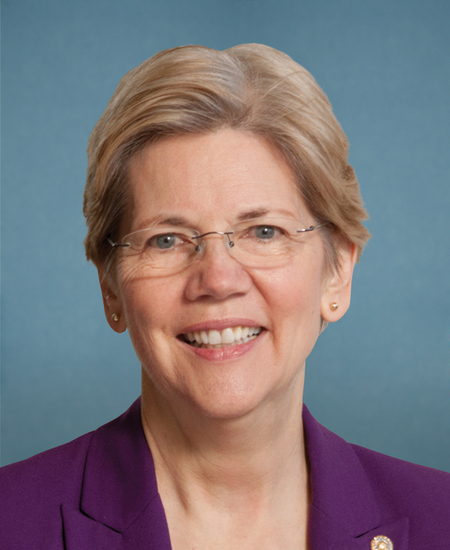
Sen. Elizabeth Warren
Sponsored bills
Protecting Access to Lifesaving Screenings Act of 2021 or the PALS Act This bill makes a series of changes relating to health insurance coverage of screening mammography. Specifically, the bill requires that any provision of law referring to current recommendations of the U.S. Preventive Services Task Force (USPSTF) with respect to breast cancer screening mammography be administered as if (1) the provision referred to USPSTF recommendations last issued before 2009; and (2) those recommendations applied to any screening mammography modality, including any digital modality of such a procedure. This requirement shall also apply to the Veterans Health Administration's policy on mammography screening for veterans. In addition, the bill preserves Medicare coverage for screening mammography, without a requirement for coinsurance, and expands the definition of screening mammography to include any digital modality of such a procedure. Further, the Centers for Medicare & Medicaid Services may not decrease the frequency with which screening mammography may be paid by Medicare for a woman over 39 years of age. In 2009, the USPSTF updated its guidelines to recommend against routine screening mammography for women between 40 to 49 years of age and to recommend biennial, instead of annual, screening mammography for most women between 50 to 74 years of age. In 2015, through the appropriations process, a three-year moratorium was placed on implementing the guidelines; the moratorium was subsequently renewed until January 1, 2023.
Urban Indian Health Providers Facilities Improvement Act This bill expands the authority of the Indian Health Service (IHS) to make funds available for urban Indian organizations to renovate, construct, or expand urban Indian health facilities. Specifically, the bill authorizes the IHS to (1) make funds available for renovations even if the renovations are not minor, and (2) make funds available for purposes other than assisting the organizations in meeting certain accreditation standards.
Department of Defense Ethics and Anti-Corruption Act of 2021 This bill addresses the conduct of Department of Defense (DOD) officials and military personnel regarding relationships with contractors.
National Security Powers Act of 2021 This bill limits presidential authorities related to, and increases congressional oversight of, introducing U.S. armed forces into hostilities, arms transactions, and national emergencies. The bill limits presidential authority to introduce U.S. forces into hostilities absent a declaration of war, specific statutory authorization, or when necessary to repel a sudden attack (or imminent threat of an attack). It also establishes procedures for the President to notify Congress of and obtain authorization for the introduction of U.S. forces into hostilities (or the risk of them). Additionally, the bill repeals laws authorizing the use of force abroad and the War Powers Resolution, which provides procedures for Congress and the President to participate in decisions to send U.S. forces into hostilities. For a treaty or other international obligation to authorize the introduction or retention of U.S. forces, Congress must specifically enact implementing legislation to that effect. The President must seek congressional approval before entering, renewing, or extending an arms sale or related transaction if the transaction exceeds specified dollar thresholds. This does not apply to transactions with NATO and its member countries, Australia, Japan, South Korea, Israel, New Zealand, or Taiwan. The bill restricts presidential authorities related to national emergencies, including by limiting the period of a declared emergency to 30 days unless Congress authorizes an extension. The bill also establishes procedures for approving or disapproving an extension, requires the President to provide more detailed reports to Congress about national emergencies, and sets out specific provisions for terminating an emergency.
Reconciliation in Place Names Act This bill directs the Department of the Interior to establish the Advisory Committee on Reconciliation in Place Names to advise the Board on Geographic Names with regard to renaming geographic features with offensive place names. The board shall rename a geographic feature with an offensive name in accordance with a recommendation of the committee unless the board determines that (1) there is a compelling reason and substantial public interest in rejecting the recommendation, or (2) approving the recommendation would violate federal law. The board shall accept or reject a recommendation within three years of receiving the recommendation.
Support Through Loss Act This bill provides employees with 24 hours of paid leave time each year for an absence resulting from a pregnancy loss or other specified circumstance related to pregnancy, fertility, or an unsuccessful assisted reproductive procedure or adoption match. Employers must notify each employee about the availability of this paid leave and may not discriminate or discharge an employee for exercising or attempting to exercise the right to such paid leave. The bill provides for enforcement of this requirement by the Department of Labor and through civil action brought by an employee or individual. Further, the bill requires specified federal agencies to conduct research and publish information about pregnancy loss and related evidence-based treatment options.
This bill authorizes a three-year pilot program under which the Department of Defense may use noncompetitive procedures for awarding follow-on contracts to qualified businesses wholly-owned through an ESOP (i.e., an S corporation for which 100% of the outstanding stock is held through an employee stock ownership plan) if the prior contract was rated as satisfactory or better. The Government Accountability Office must report on the individual and aggregate uses of the authority provided under this bill.
Reverse Transfer Efficiency Act of 2021 This bill allows the release of a transfer student's educational records from an institution of postsecondary education where a student earned credit for coursework to an institution of postsecondary education where the student was previously enrolled in order to apply the student's coursework and credits toward completion of a recognized postsecondary credential, such as an associate's degree. Specifically, the bill allows the Department of Education to provide funding to an institution of postsecondary education that releases a student's records of postsecondary coursework and credits without the consent of the student or the student's parents if the student provides written consent prior to receiving the credential.
Uyghur Forced Labor Prevention Act This bill imposes importation limits on goods produced using forced labor in China, especially the Xinjiang Uyghur Autonomous Region, and imposes sanctions related to such forced labor. The Department of Homeland Security shall report to Congress a strategy for preventing the importation of goods produced in China using forced labor. The strategy must contain certain information, including a list of entities working with the government in Xinjiang to move forced labor or Uyghurs, Kazakhs, Kyrgyz, or members of other persecuted groups out of Xinjiang. The U.S. Customs and Border Protection shall generally presume that goods produced by these entities and certain other entities, generally those sourcing material from Xinjiang or involved with Chinese government forced labor programs, are barred from importation into the United States. The bill also expands existing asset- and visa-blocking sanctions related to Xinjiang to cover foreign individuals and entities responsible for serious human rights abuses in connection with forced labor. The Department of State shall report to Congress a strategy to enhance international awareness of forced labor in Xinjiang and to address such forced labor.