Fiscal Analysis by Income and Race Scoring Act or the FAIR Scoring Act This bill requires the Congressional Budget Office's (CBO's) cost estimates for legislation to include a distributional analysis by race and income if the legislation will have a gross budgetary effect of at least 0.1% of gross domestic product in any fiscal year during the 10-year budget window. CBO's analysis must show the transfers that would result by race and income level, and the effects must be shown both in dollars and as a percent change in after-tax-and-transfer-income. The bill also requires CBO to report to Congress on methods for conducting such a distributional analysis by gender.
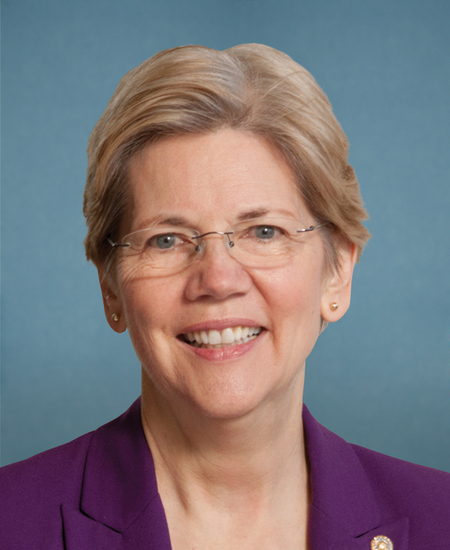
Sen. Elizabeth Warren
Sponsored bills
For the People Act of 2021 This bill addresses voter access, election integrity and security, campaign finance, and ethics for the three branches of government. Specifically, the bill expands voter registration (e.g., automatic and same-day registration) and voting access (e.g., vote-by-mail and early voting). It also limits removing voters from voter rolls. The bill requires states to establish independent redistricting commissions to carry out congressional redistricting. Additionally, the bill sets forth provisions related to election security, including sharing intelligence information with state election officials, supporting states in securing their election systems, developing a national strategy to protect U.S. democratic institutions, establishing in the legislative branch the National Commission to Protect United States Democratic Institutions, and other provisions to improve the cybersecurity of election systems. Further, the bill addresses campaign finance, including by expanding the prohibition on campaign spending by foreign nationals, requiring additional disclosure of campaign-related fundraising and spending, requiring additional disclaimers regarding certain political advertising, and establishing an alternative campaign funding system for certain federal offices. The bill addresses ethics in all three branches of government, including by requiring a code of conduct for Supreme Court Justices, prohibiting Members of the House from serving on the board of a for-profit entity, and establishing additional conflict-of-interest and ethics provisions for federal employees and the White House. The bill requires the President, the Vice President, and certain candidates for those offices to disclose 10 years of tax returns.

Korean War Divided Families Reunification Act This bill directs the Department of State to periodically report to Congress on its consultations with South Korea on potential opportunities to reunite Korean Americans with family in North Korea. The State Department's Special Envoy on North Korean Human Rights Issues shall periodically report to Congress on its consultations with representatives of Korean Americans with family in North Korea on reunification efforts.
Frank Harrison, Elizabeth Peratrovich, and Miguel Trujillo Native American Voting Rights Act of 2021 This bill addresses the voting rights of Native American and Alaska Native voters and voting access on tribal lands. The bill includes provisions expanding the types of facilities that can be used as voter registration agencies; increasing polling site accessibility, including by expanding early in-person voting and providing ballot drop boxes; providing enforcement power to citizens and attorneys general; requiring approval for actions like moving a polling place; validating certain tribal identification for voting or registering to vote; permitting voters to designate another individual to return a ballot on their behalf; and expanding requirements for bilingual voting accessibility. In addition, the bill establishes a Native American voting task force grant program for the purpose of increasing voter outreach, education, registration, turnout, and accessibility for Native American communities. The bill also directs the Government Accountability Office to study and report on (1) the prevalence of nontraditional or nonexistent mailing addresses among Indians, members of tribes, and individuals residing on Indian lands; and (2) the alternatives for removing barriers to voter registration, receipt of voter information and materials, and receipt of ballots.
Tribal Wildlife Corridors Act of 2021 This bill authorizes tribal wildlife corridors. Specifically, the bill permits an Indian tribe to nominate a corridor within the land of such tribe as a tribal wildlife corridor. The Department of the Interior must establish criteria for determining whether such a corridor qualifies as a tribal wildlife corridor, including criteria for restoring historical habitat. Interior must provide tribes with technical assistance to establish, manage, or expand a tribal wildlife corridor. Such assistance must include support with accessing wildlife data and working with voluntary private landowners to access programs for facilitating connectivity on nonfederal land. Additionally, Interior must (1) establish a program to award grants to tribes to increase connectivity through tribal wildlife corridors, and (2) consult with tribes to determine whether a tribal wildlife corridor may be expanded into public lands or otherwise benefit connectivity between public lands and such corridor.
This resolution addresses issues related to individuals with disabilities. Specifically, the resolution recognizes the importance of independent living for individuals with disabilities made possible by the enactment of the Americans with Disabilities Act of 1990 and encourages all Americans to celebrate the advancement of inclusion and equality of opportunity made possible by its enactment; pledges to continue to work on a bipartisan basis to identify and address the remaining barriers that undermine the national goals of equality of opportunity, independent living, economic self-sufficiency, and full participation for individuals with disabilities; pledges to work with states to improve access to home- and community-based services for individuals with disabilities; calls on the Department of Labor to provide information, resources, and technical assistance to enable individuals with disabilities to achieve economic self-sufficiency; and calls on the Department of Health and Human Services to provide information, resources, and technical assistance regarding such services that enable individuals with disabilities to live independently.
This resolution expresses the condolences of the Senate regarding the death of the Honorable Maurice Robert Gravel, former Senator from Alaska.
Real Corporate Profits Tax Act of 2021 This bill imposes an additional 7% tax on the adjusted net book income of a corporation that exceeds $100 million. It also allows a credit for a taxpayer, other than an S corporation, for a specified percentage of the taxpayer's net regular tax liability.
Disaster Relief Medicaid Act This bill establishes a series of programs and requirements relating to Medicaid coverage of individuals affected by a federally declared major disaster. In particular, the bill provides for specific disaster relief coverage under Medicaid for individuals who meet specified income eligibility standards and, during the seven-day period preceding the disaster, were either residents of the impacted area or were employed in the impacted area (and subsequently lost employment). Coverage is effective for two years after the date of the disaster declaration. State Medicaid programs must provide disaster relief coverage that is at least as comprehensive as the state's Medicaid coverage and the Medicaid coverage of the individual's home state, as applicable. The bill applies a 100% Federal Medical Assistance Percentage (i.e., federal matching rate) to such coverage and related administrative expenses.
Real Emergency Access for Aging and Disability Inclusion for Disasters Act or the REAADI for Disasters Act This bill establishes programs and requirements to assist individuals with disabilities and older adults (age 50 or older) with disaster preparedness. Among other provisions, the bill requires the establishment of an advisory committee that includes disabled individuals and older adults to oversee the use of funds made available by this bill; allows states to contract with Centers for Independent Living to provide services and support to disabled individuals in preparing for hazards; requires the Department of Health and Human Services to award grants to carry out projects of national significance that, among other things, create opportunities for disabled individuals and older adults to directly contribute to disaster preparedness, recovery, and mitigation; modifies and expands the membership of the National Advisory Committee on Individuals with Disabilities and Disasters to ensure that it represents the diversity of the disabled and older adult communities; and establishes the Disability and Disaster Preparedness Advisory Commission to review settlement agreements involving potential violations of the Rehabilitation Act of 1973 and the Americans with Disabilities Act of 1990. The Government Accountability Office must study the compliance of federal agencies with such enactments in expending funds to support disabled individuals and older adults in responding to, recovering from, and mitigating disasters.