

Veteran Deportation Prevention and Reform Act This bill limits the deportation of noncitizen veterans and addresses related issues. No federal agency may initiate removal proceedings without asking the individual facing removal whether the individual is a member of the Armed Forces, a veteran, or a spouse, parent, or minor child of such an individual. If an individual responds in the affirmative, that individual may not be removed until (1) the relevant Department of Homeland Security (DHS) agency has transferred that individual's case files to an advisory committee created under this bill, and (2) that committee has provided recommendations as to the outcome of the case. DHS must create a system to share information across various agencies about noncitizen veterans who may be subject to removal to ensure that such a veteran's military service is taken into consideration in immigration-related cases. DHS shall also create a system for (1) identifying noncitizens who are or may be veterans, and (2) collecting data relating to such noncitizens who are in removal proceedings or may have been removed. DHS and the Department of Defense must jointly carry out a program to naturalize a noncitizen (and certain family members) if the noncitizen serves on active duty in the Armed Forces and is not otherwise ineligible for citizenship if that noncitizen submits an application. DHS must also establish a program for eligible noncitizen veterans (generally those not convicted for certain serious crimes) to obtain permanent resident status. Similarly, the Department of Justice must provide permanent resident status to such eligible veterans in removal proceedings.
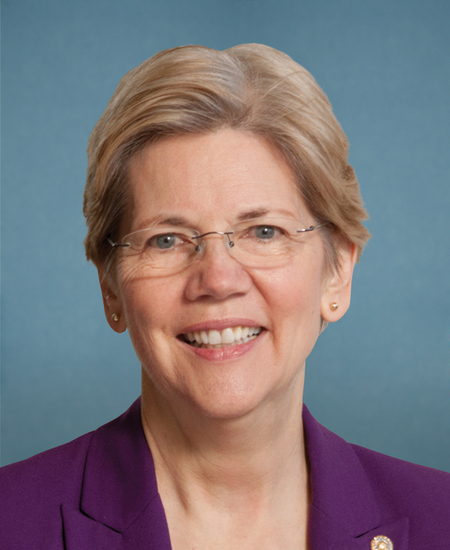
Sen. Elizabeth Warren
Sponsored bills
This resolution recognizes November 2021 as National Native American Heritage Month and the Friday after Thanksgiving as Native American Heritage Day.
Maddy summarySRES 441 designates November 6, 2021, as National Bison Day to recognize the historical, cultural, and economic significance of bison in the United States. The resolution encourages the American public to observe the day with ceremonies and activities, building on an annual tradition that began in 2012. It highlights bison's role in Native American heritage, conservation efforts, and contributions to rural economies, without creating new legal requirements or funding.
Protection of Social Security Benefits Restoration Act This bill prohibits the application of, and repeals authority for, administrative offsets to Social Security, railroad retirement, and black lung benefits. (An administrative offset is the withholding of funds payable by or held by the United States to satisfy a debt.)
Private Prison Information Act of 2021 This bill specifies that a record related to a nonfederal prison, correctional, or detention facility must be considered a federal agency record for purposes of the Freedom of Information Act (FOIA). A nonfederal prison, correctional, or detention facility must disclose information under FOIA unless the information is exempt from disclosure or the disclosure is prohibited by law. The term nonfederal prison, correctional, or detention facility means (1) a private prison, correctional, or detention facility; or (2) a state or local prison, jail, or other correctional or detention facility.
Strengthening Supply Chains for Servicemembers and Security Act This bill addresses Department of Defense (DOD) supply chain risk management, specifically risk management related to pharmaceuticals. The bill requires the Office of the Under Secretary of Defense for Acquisition and Sustainment within DOD to develop and issue implementing guidance for risk management for DOD supply chains for materiel (e.g., pharmaceuticals) and identify supply chain information gaps regarding reliance on foreign suppliers of drugs. After such guidance is issued, the Defense Health Agency must develop and publish implementing guidance for risk management for DOD's supply chain for pharmaceuticals and establish a working group to assess risks to the pharmaceutical supply chain, identify the pharmaceuticals most critical to beneficiary care at military treatment facilities, and establish policies for allocating scarce pharmaceutical resources. Finally, the Defense Logistics Agency must modify Defense Logistics Agency Instructions 5025.03 and 3110.01 to require Defense Logistics Agency Troop Support to coordinate annually with customers in the military departments to test responsiveness of the agency's contingency contracts for pharmaceuticals and to include the results of the testing in the annual Warstopper Program reports.
Zeroing Out Money for Buying Influence after Elections (ZOMBIE) Act This bill establishes certain requirements for disbursing unused funds after a federal election. The bill also requires former candidates serving as registered lobbyists or foreign agents to comply with disbursement requirements. Specifically, the bill requires each authorized committee or leadership political action committee (PAC) of a candidate to disburse all unused funds within a specified time period beginning after an election or before the candidate registers as a lobbyist or foreign agent, unless the candidate files to run for office again before the disbursement period begins. A committee or PAC disbursing unspent funds shall first pay any obligations incurred. If funds are left over, the committee or PAC may only disburse the remaining funds for the following purposes: (1) returning funds to donors; and (2) making contributions to nonprofit organizations. The bill generally prohibits disbursements to relatives of the candidate or certain nonprofit organizations related to the candidate. A former candidate must, in order to register as a lobbyist or foreign agent, comply with the disbursement requirements outlined by this bill.
Foreign and Domestic Emoluments Enforcement Ac t This bill establishes statutory prohibitions, investigatory mechanisms, and enforcement provisions regarding the receipt from a foreign or domestic government of profits, gains, advantages, or payments (i.e., emoluments) by U.S. officeholders. Specifically, the bill prohibits any U.S. officeholder from accepting, directly or indirectly, emoluments from a foreign government without consent of Congress. The prohibition is enforceable through a civil action filed by the House of Representatives or Senate. Additionally, the bill prohibits the President from accepting emoluments from a domestic government other than compensation for his or her services as President. Both foreign and domestic emolument prohibitions are enforceable through administrative fines and civil actions by the Office of Government Ethics. The Office of Special Counsel must investigate violations of the bill.
This resolution (1) expresses support for the designation of the week of November 1-November 5, 2021, as National Family Service Learning Week, (2) recognizes the importance of family service learning in cultivating civic engagement and community investment, and (3) encourages the public to support family service learning and community development programs. Family service learning is a multigenerational problem-solving approach that utilizes active participation to meet community needs and develop the skillsets of children and families.
Border Accountability, Oversight, and Community Engagement Act This bill establishes various bodies and policies related to border security operations. The bill establishes the independent Department of Homeland Security (DHS) Border Oversight Commission. The commission's duties shall include recommending policies to protect civil rights and improve the safety of U.S. Customs and Border Protection (CBP) officers. The bill establishes the Office of the Ombudsman for Border and Immigration-Related Concerns. The office shall independently receive and resolve complaints and requests for assistance regarding border security and immigration activities. The office shall have the power to provide redress, including immigration relief and monetary damages. The bill establishes the Border Community Liaison Office. The office's duties include consulting with communities in sectors on the northern and southern borders when developing policies and programs. DHS must ensure CBP officers receive continual education and training each year on topics including interaction with vulnerable populations and professional conduct standards. The bill imposes data collection requirements on law enforcement officials conducting border and immigration-related stops and searches. The bill requires various reports, including a Government Accountability Office report on the use of force by the CBP.