

Maddy summaryThis bill restricts donations to presidential libraries and centers by prohibiting contributions from certain categories of donors, including registered lobbyists, foreign nationals, federal contractors, and individuals seeking pardons, during a president's term and for two years after leaving office. It also sets a $10,000 annual limit on individual donations (adjusted for inflation) and requires libraries to report all donations over $200, including donor details, to the National Archives. Donations must be reported quarterly, with reports published online for public access. The bill aims to increase transparency and prevent potential conflicts of interest in fundraising for these institutions.
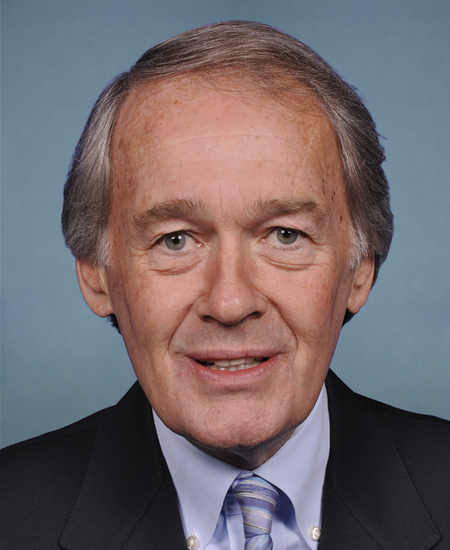
Sen. Edward J. Markey
Sponsored bills
Maddy summaryThis bill establishes a framework for states to create their own universal health care systems by applying for waivers to replace or supplement federal health programs. States would need to demonstrate they can provide comprehensive coverage that meets or exceeds federal standards, cover at least 95% of residents within 5 years, and include specific protections for Indian health care. The federal government would redirect funds that would have gone to federal programs to the states for implementation, with states required to submit annual reports and undergo a 5-year review to maintain the waiver.
Maddy summaryThis bill creates a federal program providing child care assistance to working families with children under age 6 through direct child care certificates that parents can use to pay for high-quality child care services. States must develop plans with payment rates covering provider costs and wages, sliding fee scales based on family income (with no copayment for families earning under 85% of state median income), and policies prioritizing vulnerable children including those with disabilities, experiencing homelessness, or from low-income families. The program requires providers to meet quality standards, prohibit suspensions/expulsions, and implement quality improvement activities while ensuring accessibility for underserved populations. It is funded through significant federal appropriations for fiscal years 2026-2031.
Maddy summaryThis Senate resolution (SRES 283) designates July 6, 2025 - the 90th birthday of the 14th Dalai Lama - as "A Day of Compassion." It affirms U.S. support for the Tibetan people’s human rights, including their distinct religious, cultural, linguistic, and historical identity. The resolution references the 2020 Tibetan Policy and Support Act, emphasizing that decisions about Tibetan Buddhist leadership (including future Dalai Lamas) must be determined by religious authorities within Tibetan Buddhism, not by the Chinese government. As a ceremonial resolution, it expresses symbolic support but does not create new legal obligations.
Maddy summaryThe Tribal Access to Clean Water Act of 2025 provides federal funding to improve water infrastructure on Tribal lands and for the Native Hawaiian community. The bill authorizes $100 million annually for water and waste facility loans and grants, $500 million for sanitation facilities construction through the Indian Health Service, and $100 million for operation and maintenance of water systems, all from fiscal years 2026 through 2030. It also provides $30 million annually for technical assistance to help Tribes access funding and develop sustainable water systems. The bill aims to address the lack of clean water access, which affects nearly half of all households on Tribal lands. The funding requires no matching contribution from Tribes and prioritizes facilities most in need of assistance.
Maddy summaryThis bill authorizes the minting of commemorative coins for the 2028 Los Angeles Olympic and Paralympic Games and the 2034 Salt Lake City Olympic and Paralympic Winter Games. It specifies four coin types ($5 gold, $1 silver, half-dollar, and proof silver $1) with defined quantities and designs reflecting U.S. athletic participation. A surcharge on each coin sale (e.g., $35 for $5 coins) funds the respective Olympic committees' legacy programs, including youth sports initiatives. The coins are legal tender but intended solely for commemoration, with surcharges directed to the organizing committees after covering minting costs.
Maddy summaryThis symbolic resolution (SCONRES 16) recognizes the persistent wage gap affecting Black women in the U.S., specifically noting they earn just 66 cents for every dollar paid to White, non-Hispanic men for full-time work. It highlights that Black women face compounded racial and gender-based pay discrimination, with data showing the gap would take over 200 years to close at current rates. The resolution does not create new laws but formally acknowledges the economic impact on Black women - such as lost lifetime earnings and reduced family financial security - and reaffirms congressional support for equal pay principles. It was introduced to coincide with Black Women’s Equal Pay Day (July 10, 2025), using Census and EEOC data to underscore the disparity.
Maddy summaryThis non-binding resolution recognizes climate change as a growing public health threat and urges the Department of Health and Human Services (HHS) to prioritize climate resilience in healthcare. It recommends specific actions, including reinstating the Office of Climate Change and Health Equity, directing funding toward underserved communities for infrastructure upgrades, establishing worker heat protection standards, and requiring annual progress reports on health equity outcomes. The resolution directly affects HHS agencies, healthcare providers (especially in rural, Tribal, and low-income areas), and workers facing climate-related health risks. It does not create new laws but calls for coordinated federal action to address climate-driven health impacts like heat-related illnesses, mental health strain, and disease spread.
Maddy summaryThis resolution expresses the U.S. Senate's support for designating July 10, 2025, as Journeyman Lineworkers Recognition Day. It honors journeyman lineworkers who maintain the nation’s power grid 24/7, restore electricity during disasters, and work in hazardous conditions. The resolution specifically recognizes the 129th anniversary of Henry Miller, the first president of the International Brotherhood of Electrical Workers, who died while restoring power in 1901. The Senate encourages the public to observe this day to reflect on lineworkers’ contributions and sacrifices. (Note: This is a symbolic resolution with no legal force or funding impact.)
Maddy summaryThis bill prohibits the Small Business Administration (SBA) from implementing staff reductions at offices providing critical services like business counseling, loan oversight, disaster relief, or small business contracting certifications. It directly affects SBA employees in these specific offices and requires the SBA Administrator to re-employ all staff removed during layoffs between January 20, 2025, and the bill’s enactment date. The bill mandates re-employment within 60 days, restoring employees to their previous positions with identical pay and back pay for the period they were removed. These provisions apply to all covered SBA offices and aim to reverse recent staffing cuts affecting core small business support functions.