

National Climate Emergency Act of 2021 or the Climate Emergency Act of 2021 This bill directs the President to declare a national emergency relating to climate change. Further, the President must ensure that the federal government invests in projects to mitigate the emergency and reduce greenhouse gas emissions. At least 40% of such investments must be for historically disadvantaged communities. In addition, the President must ensure that the federal government reinvests in existing public sector institutions and creates new public sector institutions to strategically mobilize and channel investments at the scale and pace required by the emergency.
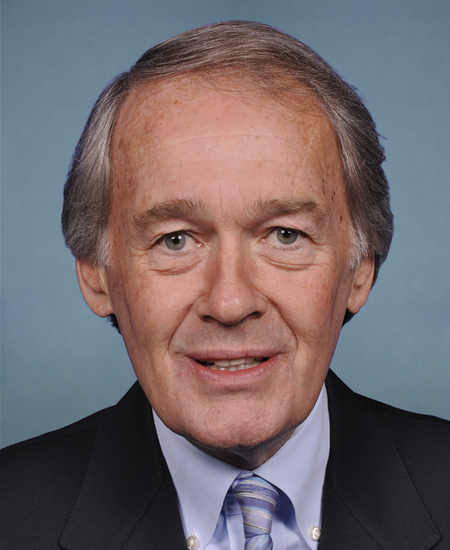
Sen. Edward J. Markey
Sponsored bills
Data Care Act of 20 21 This bill imposes various duties on online service providers with respect to their handling of individual-identifying data that can be reasonably linked to a specific user. Specifically, online service providers have a duty to (1) reasonably secure such data from unauthorized access, (2) refrain from using such data in a way that will result in reasonably foreseeable harm to the end user, and (3) not disclose such data to another party unless that party is also bound by the duties established in this bill. The bill authorizes the Federal Trade Commission and specified state officials to take enforcement actions with respect to breaches of such duties.
Funding Attorneys for Indigent Removal Proceedings Act or the FAIR Proceedings Act This bill expands access to counsel for aliens in immigration proceedings and provides for protections related to such proceedings. An alien shall have the privilege of being represented by counsel in any immigration proceeding, whereas currently this privilege is statutorily provided for only in removal proceedings. Similarly, the Department of Justice (DOJ) may provide counsel at government expense to aliens in any immigration proceeding, whereas currently DOJ is statutorily authorized to provide counsel to aliens only in removal proceedings and at no expense to the government. Under this bill, DOJ shall provide counsel to children and vulnerable individuals in such proceedings, at government expense if necessary. If DOJ fails to do so, certain limits on filing a motion to reopen removal proceedings (such as the time limit for filing) shall not apply, and the alien's removal shall be stayed upon the motion's filing. The Department of Homeland Security (DHS) shall provide each alien, generally at the beginning of proceedings, a complete copy of the alien's case file in DHS possession, unless the alien waives this right in writing. Failure to provide such documents shall delay the alien's removal proceeding. DHS shall facilitate for all detained aliens access to counsel and programs that inform such aliens of their immigration-related rights and obligations.
Survivors' Access to Supportive Care Act or SASCA This bill sets out programs and requirements to address access and quality issues related to sexual-assault examinations. Specifically, the bill establishes training and technical assistance programs for health care providers on conducting sexual-assault examinations and treating survivors of sexual assault, including in rural and tribal settings; grants for states to assess the availability of trained providers to perform sexual-assault examinations; and a task force to assist state-level efforts to improve medical forensic evidence collection related to sexual assault. The bill also requires institutions of higher education to provide information about the availability of sexual-assault examinations to survivors of sexual assault. Additionally, hospitals and specified components of the Department of Health and Human Services (HHS) must report on access and quality issues concerning sexual-assault examinations and related services. Furthermore, HHS must address access to, and the quality of, trained health care providers who conduct sexual-assault examinations in the National Quality Strategy. This is a national effort to align public-sector and private-sector stakeholders to achieve better health and health care.
Creating a Respectful and Open World for Natural Hair Act of 2021 or the CROWN Act of 2021 This bill prohibits discrimination based on a person's hair texture or hairstyle if that style or texture is commonly associated with a particular race or national origin. Specifically, the bill prohibits this type of discrimination against those participating in federally assisted programs, housing programs, public accommodations, and employment. Persons shall not be deprived of equal rights under the law and shall not be subjected to prohibited practices based on their hair texture or style. The bill provides for enforcement procedures under the applicable laws.
Roadless Area Conservation Act of 2021 This bill bars the Department of Agriculture from allowing the construction of roads, the reconstruction of roads, or logging in an inventoried roadless area where those activities are prohibited by the Roadless Rule (i.e., certain federal regulations relating to roadless area management).
This resolution condemns the crackdown on pro-democracy activists carried out by the governments of Hong Kong and China and the Chinese Communist Party under the illegitimate and arbitrary pretext of national security. The resolution also states that the crackdown violates (1) the 1984 agreement between the United Kingdom and China relating to Hong Kong; and (2) Hong Kong's Basic Law, the territory's constitutional document.
Huntington's Disease Disability Insurance Access Act of 2021 This bill expedites payment of Social Security Disability Insurance (SSDI) benefits and eligibility for Medicare coverage for those with Huntington's disease. This is an inherited disorder that causes brain cells to die, including in areas of the brain that help to control voluntary movement. Specifically, the bill eliminates the 5-month waiting period for SSDI benefits and the subsequent 24-month waiting period for Medicare coverage for individuals with Huntington's disease. Under current law, individuals generally must wait five months after the onset of disability to begin receiving SSDI benefits and an additional 24 months to become eligible for Medicare.
Protect DREAMer Confidentiality Act of 2021 This bill directs the Department of Homeland Security (DHS) to prevent disclosing information from applications to the Deferred Action for Childhood Arrivals (DACA) program to U.S. Immigration and Customs Enforcement (ICE) or U.S. Customs and Border Protection (CBP), except to implement the program. Application information may be shared only to identify or prevent fraudulent claims, for particularized national security purposes relating to the applicant, or to investigate or prosecute a felony not related to immigration status. The bill also prohibits DHS from referring any individual with deferred action status to ICE, CBP, the Department of Justice, or any law enforcement agency.
Environmental Justice For All Act This bill establishes several environmental justice requirements, advisory bodies, and programs to address the disproportionate adverse human health or environmental effects of federal laws or programs on communities of color, low-income communities, or tribal and indigenous communities. Specifically, the bill prohibits disparate impacts on the basis of race, color, or national origin as discrimination. Aggrieved persons may seek legal remedy when faced with such discrimination. In addition, the bill directs agencies to follow certain requirements concerning environmental justice. For example, agencies must prepare community impact reports that assess the potential impacts of their actions on environmental justice communities under certain circumstances. Further, it creates a variety of advisory bodies and positions, such as the White House Environmental Justice Interagency Council. Among other things, the council must issue an environmental justice strategy. It also establishes requirements and programs concerning chemicals or toxic ingredients in certain products. For example, the bill (1) requires certain products (e.g., cosmetics) to include a list of ingredients or warnings; and (2) provides grants for research on designing safer alternatives to chemicals in certain consumer, cleaning, toy, or baby products that have an inherent toxicity or that are associated with chronic adverse health effects. Finally, it creates a variety of funding programs, such as a grant program to enhance access to park and recreational opportunities in an urban areas.