

Combating Sexual Harassment in Science Act This bill addresses sexual harassment in the science, technology, engineering, and mathematics (STEM) fields by supporting research regarding sexual harassment and efforts to prevent and respond to sexual harassment. This bill directs the National Science Foundation (NSF) to award grants to institutions of higher education or nonprofit organizations (or their consortia) to expand research into the factors contributing to, and consequences of, sexual harassment affecting individuals in the STEM workforce, including students and trainees; and examine interventions for reducing the incidence and negative consequences of sexual harassment. The NSF must convene a working group to gather national data on the prevalence, nature, and implications of such harassment in institutions of higher education. The NSF shall enter into agreements with the National Academies of Sciences, Engineering, and Medicine to (1) update a responsible conduct guide issued by the National Academies to include, among other things, evidence-based practices for fostering a climate that is intolerant of sexual harassment; and (2) study the influence of sexual harassment in institutions of higher education on the career advancement of individuals in the STEM workforce. The National Science and Technology Council shall establish an interagency working group to coordinate the federal science agencies' efforts to reduce the prevalence of sexual harassment involving grant personnel. The Office of Science and Technology Policy must develop policy guidelines for such agencies to prevent and respond to reports of sexual harassment and gender harassment.
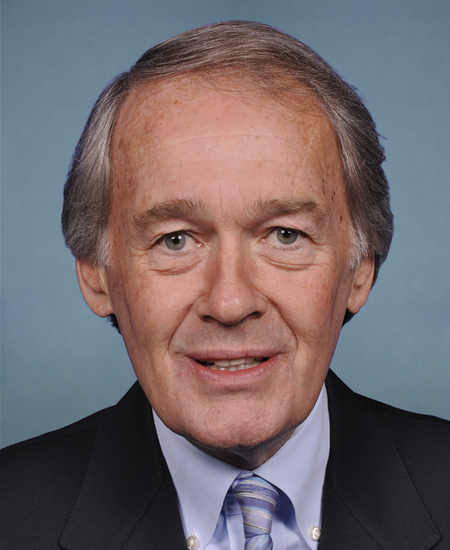
Sen. Edward J. Markey
Sponsored bills
National Climate Bank Act This bill establishes and capitalizes a National Climate Bank. The independent, nonprofit bank must invest in clean energy technologies and infrastructure to reduce greenhouse gas emissions. The national bank's investments and procurements division must seek to facilitate affordable investment and procurement, including in low-income communities and communities of color, in key project areas (e.g., renewable energy or climate resiliency measures). The national bank's start-up division must support the creation of new green banks by states or other political subdivisions. The new banks must be public or nonprofit specialized finance entities that use finance tools to mitigate climate change. The national bank may provide financing for such entities. In addition, the bank must explore the establishment of a cash for carbon program to remove greenhouse gas emissions from the power system. The program may use market mechanisms to expedite the retirement of carbon-intensive power generation facilities (e.g., coal-fired power generation facilities), acquire carbon assets for the purpose of reducing emissions, and invest in communities negatively affected by the loss of those facilities or assets.
Extending Tribal Broadband Priority Act of 2021 This bill requires the Federal Communications Commission (FCC) to, within 30 days, establish a new tribal priority window for the 2.5 gigahertz band, through which tribes in rural areas may apply for unassigned spectrum. The new window is subject to the same terms and conditions as the tribal priority window that was adopted by the FCC on July 10, 2019, and that closed on September 2, 2020.
This concurrent resolution calls for renewed U.S. leadership in addressing the climate crisis that is disproportionately affecting the health, economic opportunity, and fundamental rights of children. It also recognizes the need for the departments and agencies of the executive branch with delegated authority over energy and climate policy to prepare a climate recovery plan that puts the United States on a trajectory consistent with reducing global atmospheric carbon dioxide to below 350 parts per million by the year 2100.
This resolution declares racism a public health crisis and supports efforts to address health disparities and inequities across all sectors.
This bill generally addresses the adverse effects of climate change with a particular focus on immigration. Specifically, the bill establishes an immigration pathway to admit climate-displaced persons into the United States. These are individuals (1) who need durable resettlement because of an environmental change that adversely affects their living conditions, and (2) whose government cannot or will not provide a resettlement solution. Persons admitted to the United States under this pathway are entitled to the same resettlement assistance and benefits available to refugees. Additionally, the bill authorizes the President to provide foreign assistance for promoting resilience and reducing vulnerability among communities facing adverse effects of climate change. It also creates the position of Coordinator of Climate Change Resiliency in the Department of State. Moreover, the State Department must implement, and periodically report on, a strategy to mitigate the impact of climate change on displacement and humanitarian emergencies. The State Department must also provide (1) training on climate displacement to foreign service officers assigned to countries from which climate-displaced persons originated, and (2) guidance on the humanitarian impacts associated with climate change to all U.S. diplomatic missions. The bill also requires the President to report on displacement caused by climate change.
Lymphedema Treatment Act This bill provides for Medicare coverage of lymphedema compression treatment items. Specifically, the bill provides for coverage of (1) standard and custom fitted gradient compression garments that are prescribed by a physician or other specified health care professional to treat lymphedema, and (2) other devices determined to be effective in the prevention or treatment of lymphedema.
Federal Reserve Racial and Economic Equity Act This bill requires the Federal Reserve Board to carry out its duties in a manner that supports the elimination of racial and ethnic disparities in employment, income, wealth, and access to affordable credit. The board must report on disparities in labor force trends as well as on plans and activities of the board to minimize and eliminate these disparities.
Water Resources Research Amendments Act This bill reauthorizes through FY2025 the Water Resources Research Act Program and otherwise revises the program, including by increasing the federal share of grant funding under the program for water resources research and technology institutes.
Protecting the Rights Of Towns against federal Enforcement contrary to Constitutional Tenets for Immigration Act or the PROTECT Immigration Act This bill establishes that the authority to investigate, apprehend, or detain aliens for the purposes of immigration enforcement is limited to immigration officers and authorized Department of Homeland Security employees, except when such authority is provided to other individuals under specified statutes. Specifically, this restriction does not apply in certain instances involving (1) an actual or imminent mass influx of aliens, (2) persons bringing in and harboring aliens in violation of immigration laws, or (3) an alien illegally present in the United States who had previously left or was deported after being convicted of a felony. The bill repeals the authority allowing the Department of Justice to enter into agreements authorizing state or local government employees to perform immigration enforcement functions.