This resolution requests that the Department of the Interior recognize the crash site of Roberto Clemente's airplane near Piñones in Loíza, Puerto Rico, and the adjacent land by adding the site to the National Register of Historic Places. Roberto Clemente was a renowned baseball player who played for the Pittsburg Pirates baseball team.
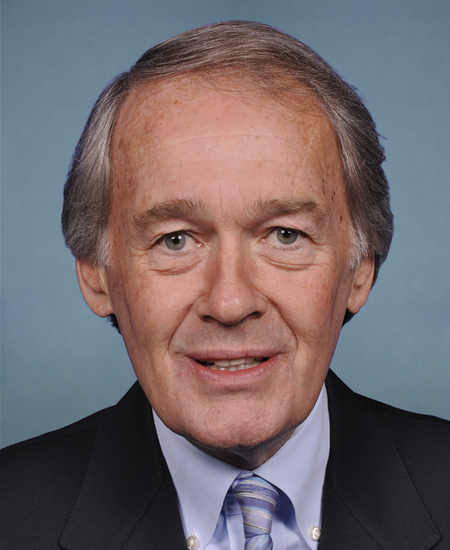
Sen. Edward J. Markey
Sponsored bills
Comprehensive Addiction Resources Emergency Act of 2021 This bill establishes programs, grants, and other activities to address substance use disorders. Specifically, the Department of Health and Human Services (HHS) must establish a program for purchasing and distributing opioid overdose reversal drugs for states and Indian tribes. HHS must also award grants for and otherwise support addressing substance use, particularly in states, tribes, territories, and localities with disproportionately high drug overdose rates; increasing access to preventive, medical, recovery, and related services; developing innovative models of delivering treatment and harm reduction services; and expanding the treatment capacity of Medicaid providers. In addition, HHS must issue model standards of care for treatment services and recovery residences and may award grants for training health care professionals. The bill also supports prevention and treatment services for workers, addiction and pain management research, and data collection on substance use disorders. Further, dispensers, distributors, and manufacturers of schedule II controlled substances (e.g., oxycodone), with the exception of opioid treatment programs, must certify that they maintain effective drug diversion controls. Violators are subject to specified civil and criminal penalties. Collected penalties shall be used for the grant programs and other substance use disorder activities established under the bill.
Department of State Inclusivity Act of 2021 This bill establishes measures at the State Department to promote diversity and to prevent and respond to harassment, discrimination, sexual assault, and retaliation. The bill requires the State Department to develop a comprehensive policy for responding to harassment, discrimination, sexual assault, and retaliation; expand anti-harassment, antidiscrimination, implicit bias, and whistleblower training; establish the Office of Employee Advocacy; survey employees regarding harassment, discrimination, sexual, assault, retaliation, and issues affecting employee retention and diversity; report on the diversity of its workforce; develop a pilot program to use gender-neutral terms in evaluation forms; investigate and report wrongful terminations based on sexual orientation; establish a board to address issues faced by LGBTI+ Foreign Service employees and their families; report on countries that refuse to issue spousal visas for Foreign Service employee spouses due to sexual orientation and recommend how to address this issue; establish a permanent exhibit on the so-called Lavender Scare , which involved the wrongful dismissal of at least 1,000 people from the State Department for alleged homosexuality in the 1950s and 1960s; and make other changes related to anti-harassment, antidiscrimination, diversity, and recruitment. The bill also establishes the Office of the Chief Diversity and Inclusion Officer at the State Department; offers a formal apology from Congress for encouraging the Lavender Scare; and prohibits the use by federal employers of nondisclosure and non-disparagement provisions that cover prohibited discrimination, harassment, or related retaliation.

Latonya Reeves Freedom Act of 2021 This bill prohibits government entities and insurance providers from denying community-based services to individuals with disabilities that require long-term service or support that would enable such individuals to live in the community and lead an independent life. Specifically, these entities may not discriminate against such individuals in the provision of community-based services by such actions as imposing prohibited eligibility criteria, cost caps, or waiting lists or failing to provide a specific community-based service. Additionally, community-based services must be offered to individuals with such disabilities prior to institutionalization. Institutionalized individuals must be notified regularly of community-based alternatives. The bill requires the Department of Justice to issue regulations requiring government entities and insurance providers to offer community-based long-term services to individuals with such disabilities who would otherwise qualify for institutional placement. Government entities must ensure sufficient availability of affordable, accessible, and integrated housing that is not a disability-specific residential setting or a setting where services are tied to tenancy. Regulations shall also (1) require government entities and insurance providers to perform self-evaluation on current services, policies, and practices and concerning compliance with requirements of this bill; and (2) require government entities to submit a transition plan. The bill provides funds for FY2022 for the Department of Health and Human Services to provide technical assistance with respect to transition plans. The bill allows civil actions by individuals subjected to, or about to be subjected to, a violation of its requirements.
Reconnecting Communities Act This bill establishes a grant program to remove, retrofit, or otherwise address infrastructural barriers (e.g., highways, railways, or viaducts) that impede mobility and connectivity, with a particular focus on communities of color and low-income communities. Under this program, the Department of Transportation (DOT) must award three types of grants: community engagement, education, and capacity-building grants to educate and involve community members in transportation and economic development planning; planning and feasibility study grants to develop designs, conduct environmental reviews, and carry out other preliminary activities required to remove, retrofit, or mitigate an infrastructural barrier; and capital construction grants to remove, retrofit, or mitigate an infrastructure barrier. DOT must award the community engagement, education, and capacity-building grants and the planning and feasibility study grants to state, tribal, and local governments; metropolitan planning organizations; and nonprofits. An eligible entity may apply for and receive funding from more than one type of grant. DOT must award the capital construction grants to the owner of an infrastructure barrier. The owner may, if applicable, partner with other eligible entities.
United States Climate Leadership in International Mitigation, Adaptation, and Technology Enhancement Act of 2021 This bill sets out priorities for climate action, clean energy, energy diplomacy, reduced deforestation, and related U.S. foreign policy. The Department of State must incorporate climate action and climate diplomacy across all bureaus and U.S. missions abroad. In addition, the bill directs increased U.S. involvement in international climate change agreements and activities, including the Paris Agreement (a climate treaty adopted in 2015), the Kigali Amendment to the Montreal Protocol (amends a treaty on reducing ozone-depleting compounds to include hydrofluorocarbons) and efforts to reduce short-lived climate pollutants, the Carbon Offset and Reduction Scheme for International Aviation, and Mission Innovation and the Clean Energy Ministerial (global initiatives to advance clean energy technologies and policies). In addition, the bill directs (1) increased U.S. engagement in international economic forums (e.g., G-7 and the World Economic Forum) related to climate action, including with a specific focus on China; and (2) efforts by the U.S. International Finance Development Corporation and U.S. representatives at international financial institutions to prioritize renewable energy projects and advance other climate-related policy objectives. The bill also establishes foreign assistance, financing mechanisms, and other programs to support developing countries transition to renewable energy and reduce carbon emissions. Furthermore, the bill outlines climate-related foreign policy and programs for particular regions (the Arctic, sub-Saharan Africa, the Caribbean, Europe, and North America) and countries (China, India, Brazil, and Indonesia). The bill also addresses climate change and its effects on women and girls.
Protecting Medicare and American Farmers from Sequester Cuts Act This bill makes several budgetary, technical, and procedural changes, particularly in relation to Medicare and increasing the debt limit. Specifically, the bill continues to exempt Medicare from sequestration until March 31, 2022. (Sequestration is a process of automatic, usually across-the-board spending reductions under which budgetary resources are permanently cancelled to enforce specific budget policy goals.) The bill also establishes expedited Senate procedures for considering legislation to increase the debt limit. The procedures limit debate, waive points of order, and prohibit amendments. The procedures may only be used once and expire after January 16, 2022. Additionally, the bill (1) temporarily extends other provisions under Medicare, including a payment increase under the physician fee schedule; and (2) requires any debits recorded for FY2022 on the statutory pay-as-you-go (PAYGO) scorecards to be deducted from the scorecards for 2022 and added to the scorecards for 2023.
Forbidding Airlines from Imposing Ridiculous Fees Act of 2021 or the FAIR Fees Act of 2021 This bill directs the Department of Transportation to prescribe regulations (1) prohibiting an air carrier from imposing specified fees relating to a flight in passenger air transportation that are unreasonable or disproportional to the costs it incurs, and (2) establishing standards for assessing whether such fees are reasonable and proportional to those costs.
Protecting Community Television Act This bill revises the definition of a franchise fee that is paid by a cable operator or cable subscriber to encompass only a tax, fee, or other monetary assessment that is imposed by a franchising authority or other governmental entity.
Maddy summaryThis is a ceremonial Senate resolution (SRES 470) commemorating the death of former U.S. Senator Bob Dole of Kansas. It formally expresses the Senate's sorrow, requests the Secretary of the Senate transmit a copy to Dole's family, and directs the Senate to adjourn as a mark of respect. The resolution has no policy or legal effect - it solely serves as a symbolic tribute to Dole's public service career. It does not affect any individuals or enact new laws.