

Stop Anti-Abortion Disinformation Act or the SAD Act This bill prohibits advertisements that use deceptive or misleading statements related to the provision of abortion services. Abortion services include (1) surgical and non-surgical procedures to terminate a pregnancy, or (2) providing referrals for such procedures. The Federal Trade Commission must promulgate rules to implement the prohibition, and the bill provides for enforcement by the commission.
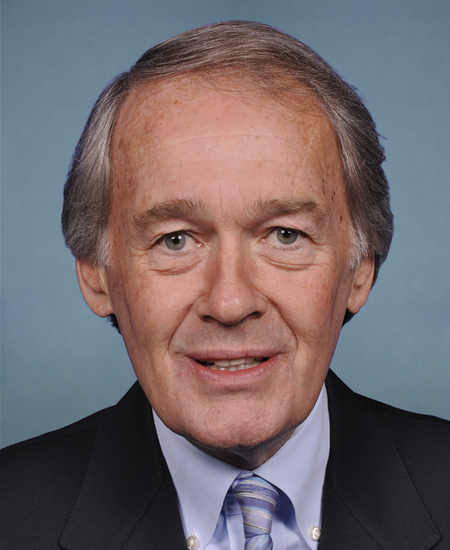
Sen. Edward J. Markey
Sponsored bills
Fairness for Farm Workers Act This bill extends overtime pay protections to agricultural workers. The bill requires employers, beginning in 2023, to compensate agricultural workers for hours worked in excess of their regular hours (i.e., 55 hours in 2023, 50 hours in 2024, 45 hours in 2025, and 40 hours in 2026) at not less than one and one-half times the employee's regular rate. For employers with 25 or fewer employees, the overtime pay requirements begin in 2026. These overtime pay requirements do not apply, as under current law, to employees who are the parent, spouse, child, or other member of the employer's immediate family. The bill also repeals the exemption from overtime pay requirements for employers in various agriculture-related industries, including certain small farms, irrigation projects, sugar processing, and cotton ginning and compressing.
Truth and Healing Commission on Indian Boarding School Policies Act This bill establishes the Truth and Healing Commission on Indian Boarding School Policies in the United States and sets forth its powers, duties, and membership. Among other duties, the commission must investigate the impacts and ongoing effects of the Indian Boarding School Policies (federal policies under which American Indian, Alaska Native, and Native Hawaiian children were forcibly removed from their family homes and placed in boarding schools). Further, the commission must develop recommendations on ways to (1) protect unmarked graves and accompanying land protections; (2) support repatriation and identify the tribal nations from which children were taken; and (3) discontinue the removal of American Indian, Alaska Native, and Native Hawaiian children from their families and tribal communities by state social service departments, foster care agencies, and adoption agencies.
Protecting the Right to Organize Act of 20 21 This bill expands various labor protections related to employees' rights to organize and collectively bargain in the workplace. Among other things, it revises the definitions of employee , supervisor , and employer to broaden the scope of individuals covered by the fair labor standards; permits labor organizations to encourage participation of union members in strikes initiated by employees represented by a different labor organization (i.e., secondary strikes); and prohibits employers from bringing claims against unions that conduct such secondary strikes. The bill also allows collective bargaining agreements to require all employees represented by the bargaining unit to contribute fees to the labor organization for the cost of such representation, notwithstanding a state law to the contrary; and expands unfair labor practices to include prohibitions against replacement of, or discrimination against, workers who participate in strikes. The bill makes it an unfair labor practice to require or coerce employees to attend employer meetings designed to discourage union membership and prohibits employers from entering into agreements with employees under which employees waive the right to pursue or a join collective or class-action litigation. Finally, the bill addresses the procedures for union representation elections, modifies the protections against unfair labor practices that result in serious economic harm, and establishes penalties and permits injunctive relief against entities that fail to comply with National Labor Relations Board orders.
This resolution reaffirms the goals of World Refugee Day and the commitment of the United States to promote the safety and well-being of refugees and asylum seekers.
Maddy summaryThe Sea Turtle Rescue Assistance Act of 2022 establishes a federal grant program administered by the Secretary of Commerce to fund coordinated sea turtle rescue efforts along U.S. coasts. It provides $5 million annually (2023-2028) for grants to organizations that rescue, rehabilitate, and study stranded marine turtles, prioritizing groups with proven experience in these activities. Grants cover recovery, medical care, data collection, and facility costs directly tied to rescuing turtles, with funds distributed equitably based on historical stranding rates and conservation needs in designated coastal regions. The program aims to support existing rescue networks rather than create new government operations, directly benefiting coastal communities and marine conservation groups working with threatened or endangered sea turtle species.
Good Jobs for Good Airports Act This bill addresses pay, benefits, and labor standards for certain airport service workers. Airport service workers include security officers, food service workers, cleaning staff, ticketing agents, and retail service workers. Specifically, the bill establishes a minimum wage and benefit standard for such airport service workers at large, medium, and small hub airports. It also prohibits small, medium, and large hub airports from accessing federal funds for airport development projects unless the airports certify that such airport service workers are paid no less than the higher of $15 per hour, the applicable state or local minimum wage and fringe benefits, or the prevailing wage and fringe benefits required under the Service Contract Act as established by the Department of Labor.
This resolution recognizes June 2022 as Immigrant Heritage Month in honor of the contributions immigrants and their children have made to the United States. It also welcomes immigrants presently in the United States and individuals seeking to immigrate to the United States to contribute to the health, safety, diversity, and prosperity of the United States.
Reducing Racial and Ethnic Disparities in the Juvenile Justice System Act of 2022 This bill modifies provisions under the Juvenile Justice and Delinquency Prevention Program in order to more specifically address racial and ethnic disparities with respect to arrests, secure detentions, and other decision points.
Military Vehicle Fleet Electrification Act This bill requires that not less than 75% of the total number of contracted non-tactical vehicles purchased, leased by, or for use of the Department of Defense (DOD) must be electric or zero emission vehicles (or a federally authorized alternative) and use a charging connector type that meets applicable industry accepted standards for interoperability and safety. The bill also authorizes DOD to furnish electric vehicle charging stations at a commissary store or MWR retail facility (i.e., exchange stores and other revenue-generating facilities operated by nonappropriated fund activities of DOD) for commercial use by individuals authorized to access such facilities.