

Cambodia Democracy and Human Rights Act of 2022 This bill directs the President to impose sanctions on foreign persons (i.e., entities and individuals) responsible for acts to undermine democracy in Cambodia, including acts that constitute serious human rights violations and acts to support the establishment of facilities in Cambodia that could be used by China's military. The sanctions shall be directed at foreign persons, including current or former Cambodian government, military, and security forces officials, responsible for such actions, as well as entities controlled or owned by such persons. The sanctions shall include blocking the assets of sanctioned persons and restricting the entry of sanctioned individuals into the United States, and shall not apply to the importation of goods. The President may waive the sanctions with respect to a person if it is in the national interest of the United States. The President may suspend the sanctions if Cambodia makes meaningful progress toward ending government efforts to undermine democracy, ending human rights violations, and meeting other specified conditions. The President must report to Congress on the presence of China's military in Cambodia, including the involvement of China's military in upgrading or constructing certain facilities in Cambodia.
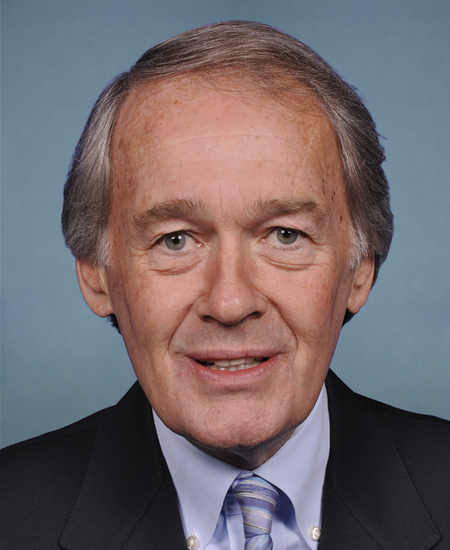
Sen. Edward J. Markey
Sponsored bills
This resolution (1) recognizes the importance of the Americans with Disabilities Act of 1990 in advancing independent living for individuals with disabilities; (2) pledges continued efforts to address remaining barriers for individuals with disabilities; and (3) calls on federal agencies to provide additional resources for individuals with disabilities with respect to economic self-sufficiency, community-based services, housing, and transportation.
This resolution remembers former Prime Minister of Japan Shinzo Abe and his work to strengthen the alliance between the United States and Japan. It also extends condolences to his family and the people of Japan.
This resolution condemns the use of hunger, including the starvation of civilians, as a weapon of warfare. It also calls on the U.S. government to prioritize diplomatic efforts to call out and address instances where hunger and intentional deprivation of food is being utilized as a weapon of war, including through efforts to ensure that security operations minimize civilian harm and do not undermine livelihoods of civilian populations.
Right to Contraception Act This bill sets out statutory protections for an individual's right to access and a health care provider's right to provide contraception and related information. Contraception refers to an action taken to prevent pregnancy, including the use of contraceptives (i.e., a device or medication used to prevent pregnancy), fertility-awareness based methods, and sterilization procedures. Generally, the bill prohibits measures that single out and impede access to contraception and related information. However, a party may defend against a claim that a measure violates the bill's prohibitions by demonstrating, through clear and convincing evidence, that the measure significantly advances access to contraception and cannot be achieved through less restrictive means. The Department of Justice, individuals, or health care providers may bring a lawsuit to enforce this bill, and states are not immune from suits for violations.
Respect for Marriage Act This bill provides statutory authority for same-sex and interracial marriages. Specifically, the bill repeals and replaces provisions that define, for purposes of federal law, marriage as between a man and a woman and spouse as a person of the opposite sex with provisions that recognize any marriage that is valid under state law. (The Supreme Court held that the current provisions were unconstitutional in United States v. Windsor in 2013.) The bill also repeals and replaces provisions that do not require states to recognize same-sex marriages from other states with provisions that prohibit the denial of full faith and credit or any right or claim relating to out-of-state marriages on the basis of sex, gender, race, ethnicity, or national origin. (The Supreme Court held that state laws barring same-sex marriages were unconstitutional in Obergefell v. Hodges in 2015; the Court held that state laws barring interracial marriages were unconstitutional in Loving v. Virginia in 1967.) The bill allows the Department of Justice to bring a civil action and establishes a private right of action for violations.
Expanding Access to Family Planning Act This bill provides, subject to specified conditions, funding through FY2032 for federally funded family planning services and clinics. In particular, the funds must be used for (1) grants and contracts that support the provision of family planning services, and (2) clinic infrastructure (e.g., construction and renovation of clinics). Clinics that receive funding to provide family planning services must offer each patient with a positive pregnancy test the opportunity for nondirective counseling on (1) prenatal care and delivery; (2) infant care, foster care, and adoption; and (3) pregnancy termination. This counseling must include referrals if requested by a patient. Additionally, if a funding recipient makes subawards for the provision of family planning services, the recipient may not prohibit an entity from participating in a subaward program for reasons other than the entity's inability to provide family planning services.
Democracy Is Strengthened by Casting Light On Spending in Elections Act of 2021 or the DISCLOSE Act of 2021 This bill addresses campaign finance, including by expanding the prohibition on campaign spending by foreign nationals, requiring additional disclosures of campaign expenditures, and requiring additional disclosures regarding certain political advertisements. First, the bill prohibits foreign nationals from participating in the decision-making process regarding an election expenditure. Additionally, the bill expands existing foreign money prohibitions to include disbursements for paid web-based or digital communications and federal judicial nomination communications. It also prohibits foreign nationals from contributing to campaigns related to ballot initiatives and referenda. The Federal Election Commission (FEC) must conduct an audit after each federal election cycle to determine the incidence of illicit foreign money. Next, the bill makes it unlawful to establish or use a corporation, company, or other entity with the intent to conceal an election contribution or donation by a foreign national. A violator is subject to criminal penalties—a fine, a prison term of up to five years, or both. Covered organizations (e.g., corporations, labor organizations, and political organizations) must, within 24 hours, file reports with the FEC to disclose campaign expenditures of more than $10,000 during an election cycle. Finally, the bill requires organizations to provide additional disclosures regarding political advertisements, including the donors who contributed the most money to that organization in the last year.
This joint resolution directs the President to remove U.S. Armed Forces from hostilities against the Houthis in Yemen within 30 days of the enactment of this joint resolution unless Congress authorizes a later withdrawal date, issues a declaration of war, or specifically authorizes the use of the Armed Forces. Prohibited activities include sharing intelligence or providing logistical support to enable offensive strikes by the coalition led by Saudi Arabia. This joint resolution shall not affect any military operations directed at Al Qaeda or forces associated with Al Qaeda.
This resolution expresses that the Senate continues to refuse to recognize Alyaksandr Lukashenka as the legitimately elected leader of Belarus; condemns the ongoing harassment and persecution of opposition leaders, civil society activists, human rights defenders, and independent media carried out by the Lukashenka regime; urges the immediate release, without preconditions, of all political prisoners in Belarus; calls for new presidential and parliamentary elections to be held in Belarus and conducted in a manner that meets international standards and includes independent election monitoring; and encourages President Biden to swiftly appoint a new Special Envoy for Belarus to support the pro-democracy movement in Belarus.