

Better Utilizing Investments to Leverage Development and Generating Renewable Energy to Electrify the Nation's Infrastructure and Jobs Act or the BUILD GREEN Infrastructure and Jobs Act This bill directs the Department of Transportation (DOT) to establish a green transportation infrastructure program to provide competitive grants to states, local governments, and other entities for capital investments in electrified surface transportation infrastructure projects. DOT must select projects that maximize sustainability, including projects that (1) promote the electrification of all public transportation, (2) contribute to climate resilience and mitigation, (3) reduce air pollution and greenhouse gas emissions, and (4) achieve energy savings and reduce energy usage compared to other eligible projects. Additionally, DOT must prioritize projects that (1) serve a frontline, vulnerable, or disadvantaged community; (2) are located in an area that has experienced high adverse health and environmental impacts on minority and low-income populations; (3) require federal funds in order to complete an overall financing package; or (4) add a new green space or new state or local park units and outdoor recreational areas. Grants issued under the program may not be less than $2 million, with the exception of grants for project planning, preparation, or design, which are not subject to a minimum amount. The federal share of the cost of a project may not exceed 85% for planning, design, and construction purposes and 50% of the operation and maintenance costs of the project for its first 10 years.
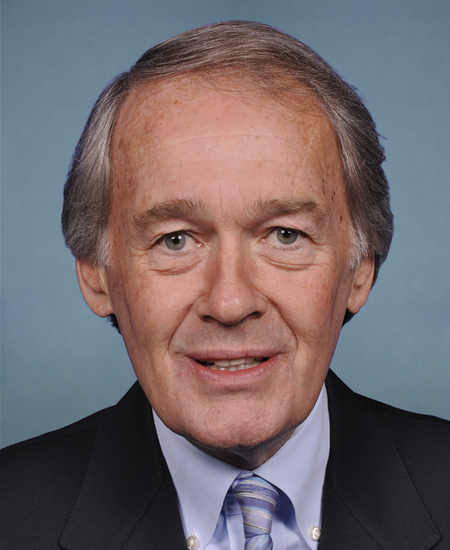
Sen. Edward J. Markey
Sponsored bills
This resolution designates September 25, 2022, as National Lobster Day and encourages the people of the United States to observe the day with appropriate ceremonies and activities.
Preventing a Patronage System Act of 2022 or the PPSA Act of 2022 This bill prohibits executive agency positions in the competitive service from being placed in the excepted service, unless such positions are placed in Schedules A through E as in effect on September 30, 2020. The bill also prohibits positions in the excepted service from being placed in any schedule other than the aforementioned schedules. On October 21, 2020, former President Donald Trump issued an executive order titled Creating Schedule F in the Excepted Service . The order placed executive agency positions that are of a confidential, policy-determining, policy-making, or policy-advocating character, and that are not normally subject to change as a result of a presidential transition, under a new schedule in the excepted service (Schedule F) instead of the competitive service. The order also required any such positions in the excepted service to be reclassified to Schedule F. The order was revoked by President Joe Biden on January 22, 2021.
Let Doctors Provide Reproductive Health Care Act This bill sets out protections for and establishes programs to support health care providers (and those who assist such providers) who offer reproductive health care services that are lawful in the state where the services are provided. Reproductive health care services refer to abortion services; contraceptive services; in vitro fertilization; or other reproductive care, education, and counseling that is provided (1) at a health care site or via telehealth, and (2) in a medically accurate manner. The bill prohibits individuals, entities, and states from preventing, restricting, or otherwise interfering with the provision of lawful reproductive health care services by health care providers. The Department of Justice, individuals, or providers may bring a lawsuit to enforce this bill, and states are not immune from suits for violations. Furthermore, states may not use federal funds to pursue legal cases or similar proceedings (e.g., adverse licensing proceedings) against health care providers, individuals, or entities that offer or assist with lawful reproductive health care services. Additionally, medical malpractice insurers may not deny coverage to or sue a health care provider because the provider offers or assists with lawful reproductive health care services. The bill also funds grants to assist health care providers who offer or refer for abortion services and face legal issues relating to their provision of reproductive health care services with legal matters and improving security.
Strengthening Welfare in Marine Settings Act of 2022 or as the SWIMS Act of 2022 This bill establishes prohibitions on capturing, importing, exporting, or breeding of orcas, beluga whales, false killer whales, or pilot whales for the purpose of public display. Specifically, the bill prohibits the National Oceanic and Atmospheric Administration from issuing any permit under the Marine Mammal Protection Act of 1972 that authorizes the taking (e.g., capturing) or importation of such orcas or whales for the purpose of public display. The bill further revises the act to make it unlawful to export such orcas or whales, unless they are being transported to marine mammal sanctuaries or for release into the wild. Further, the bill makes it unlawful under the Animal Welfare Act for any person to breed or artificially inseminate such marine mammals for purposes of using their progeny for public display.
This resolution designates the month of July 2022 as Muslim-American Heritage Month. The resolution also recognizes the need for public education, awareness, and policies that are culturally competent when describing, discussing, or addressing the impacts of being Muslim American in all aspects of the society of the United States, including in discourse and policy. Finally, the resolution also honors the contributions and integral role of Muslim Americans in the economy, culture, and identity of the United States.
Cash Refunds for Flight Cancellations Act of 2022 This bill requires air carriers and ticket agents to offer full cash refunds for airline tickets if (1) an airline cancels or significantly delays a flight, or (2) a passenger cancels their ticket for a flight up until 48 hours of the scheduled departure time. The bill permits air carriers and tickets agents to offer alternative forms of compensation, including credit, or vouchers, provided that such offer is valid indefinitely and the offer includes a clear and conspicuous notice of the passenger's right to a cash refund. Additionally, the bill requires air carriers and ticket agents to disclose to passengers, prior to the sale of airline tickets, that they can cancel their tickets and receive a full refund.
Net Neutrality and Broadband Justice Act of 2022 This bill expressly classifies broadband internet as a telecommunications service rather than an information service for purposes of regulation by the Federal Communications Commission. (Current law treats providers of telecommunications services as common carriers and subjects them to more stringent requirements.)
Global Food Security Reauthorization Act of 2022 This bill reauthorizes through FY2028 activities to implement the Global Food Security Strategy, a whole-of-government strategy to promote global food security, resilience, and nutrition. The bill also modifies aspects of the strategy, such as requiring the strategy to seek to improve the efficiency and resilience of agricultural production. The bill also reauthorizes through FY2028 activities related to the Emergency Food Security Program, an international market-based assistance program.
Deerfield River Wild and Scenic River Study Act of 2022 This bill designates the Deerfield River in Massachusetts and Vermont for potential addition to the national wild and scenic rivers system.