

This joint resolution nullifies a Department of Labor rule concerning the fiduciary duties with respect to employee benefit plans. Under the rule issued on December 1, 2022, plan fiduciaries may consider climate change and other environmental, social, and governance factors when they make investment decisions and when they exercise shareholder rights, including voting on shareholder resolutions and board nominations.
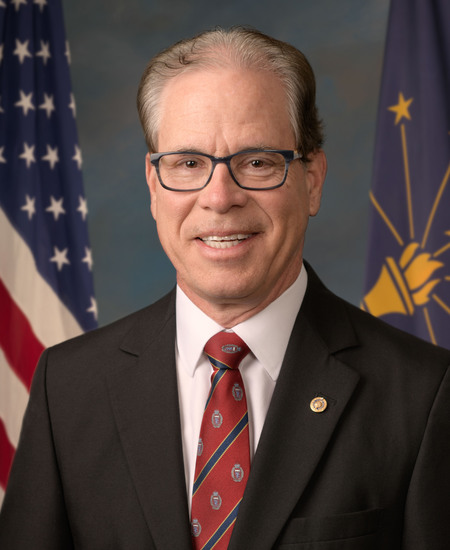
Sen. Mike Braun
Sponsored bills
Access for Veterans to Records Act of 2022 This bill directs the Office of the Archivist of the United States to submit to Congress a comprehensive plan for eliminating the backlog of requests for records from, and improving the efficiency and responsiveness of operations at, the National Personnel Records Center. Such plan must include the number and percentage of unresolved veteran record requests that have been pending for more than 20 days, 90 days, and one year; target time frames to eliminate the backlog; a detailed plan for using existing funds to improve technology infrastructure, including secure access to appropriate agency federal records, to prevent future backlogs; actions to improve customer service for requesters; measurable goals with respect to the comprehensive plan and metrics for tracking progress toward such goals; and strategies to prevent future record request backlogs, including backlogs caused by an event that prevents employees of the center from reporting to work in person. The office must submit updates of such plan at specified intervals.
Eradicating Narcotic Drugs and Formulating Effective New Tools to Address National Yearly Losses of life Act or the END FENTANYL Act This bill requires U.S. Customs and Border Protection to review and update, as necessary, manuals and policies related to inspections at ports of entry to ensure the uniformity of inspection practices to effectively detect illegal activity along the border, such as the smuggling of drugs and humans.
Identifying and Eliminating Wasteful Programs Act This bill requires each federal agency to compile a list of unnecessary programs. Specifically, each agency must compile a list of such programs, based on guidance provided by the Office of Management and Budget, that are unnecessary, defunct, or unnecessarily duplicative federal programs; another agency could administer more effectively; or could operate more effectively if the program or activity were consolidated with other programs or activities. Additionally, the President must include the list of identified programs or program activities in the annual budget submitted to Congress. An agency may submit to Congress recommendations for statutory changes to eliminate or consolidate programs or program activities identified in the list.
This joint resolution nullifies a Department of Education rule published on July 6, 2022, concerning final priorities, requirements, definitions, and selection criteria for the Charter Schools Program.
This resolution supports the annual recognition of Interscholastic Athletic Administrators' Day on December 14, 2022. In addition, the resolution commends (1) athletic administrators for their commitment to secondary school student athletes, and (2) the National Interscholastic Athletic Administrators Association for providing continuous learning and preparation to athletic administrators.
Streamline Pentagon Budgeting Act of 2022 This bill repeals reporting requirements related to the unfunded priorities of the (1) armed force or forces or combatant command, and (2) the Missile Defense Agency.
Continuing Appropriations and Health Extenders Act of 2022 This bill provides continuing FY2023 appropriations to federal agencies through February 3, 2023. It is known as a continuing resolution (CR) and prevents a government shutdown that would otherwise occur if the FY2023 appropriations bills have not been enacted when the existing CR expires on December 16, 2022. The bill also extends several expiring programs and authorities, including several health programs.
Pharmacy Benefit Manager Transparency Act of 2022 This bill generally prohibits pharmacy benefit managers (PBMs) from engaging in certain practices when managing the prescription drug benefits under a health insurance plan, including charging the plan a different amount than the PBM reimburses the pharmacy. The bill also prohibits PBMs from arbitrarily, unfairly, or deceptively (1) clawing back reimbursement payments, or (2) increasing fees or lowering reimbursements to pharmacies to offset changes to federally funded health plans. PBMs are not subject to these prohibitions if they (1) pass along 100% of any price concession or discount to the health plan, and (2) disclose specified costs, prices, reimbursements, fees, markups, discounts, and aggregate payments received with respect to their PBM services. Further, PBMs must report annually to the Federal Trade Commission (FTC) certain information about payments received from health plans and fees charged to pharmacies. The FTC and state attorneys general are authorized to enforce the provisions of the bill.
Tipped Employee Protection Act This bill modifies the definition of a tipped employee under the Fair Labor Standards Act of 1938 to exclude consideration of an employee's duties when determining the combined amount of tips and direct wages an employee receives for the purpose of an employer meeting the minimum wage requirements. Under the bill, an employer may pay a tipped employee the tipped minimum wage for tasks that are not related to tipped work as long as the employee's combined tips and direct wages total at least the $7.25 federal minimum wage. Current Department of Labor rules prohibit an employer from paying the tipped minimum wage for tasks that are not related to tipped work.