

Maddy summaryThis bill creates a new federal crime for individuals who transmit money, property, or other value across state lines with the intent to finance illegal border crossings under existing immigration laws. It imposes penalties including fines equal to the value sent, up to one year in prison, or both for those convicted. The law also adds new grounds for denying entry (inadmissibility) or deporting immigrants who are convicted of this offense, affecting both the financiers and immigrants involved in such activities. The bill directly targets those facilitating unlawful border entry through financial means, with clear penalties and immigration consequences.
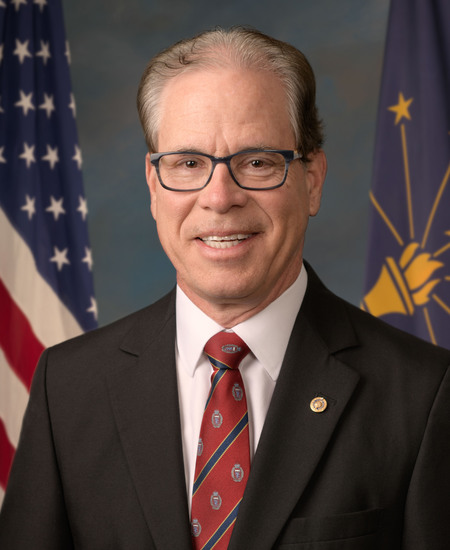
Sen. Mike Braun
Sponsored bills
Maddy summaryThis bill expands the Committee on Foreign Investment in the United States (CFIUS) review process to cover foreign purchases or leases of real estate near military sites. It specifically requires CFIUS review for transactions involving property within 100 miles of military installations or 50 miles of military training routes, special use airspace, controlled firing areas, or military operations areas - particularly when the foreign buyer is linked to Russia, China, Iran, or North Korea. The bill also links energy project approvals to CFIUS reviews, requiring the Defense Secretary to delay project reviews until CFIUS concludes its assessment of related real estate transactions. This directly affects foreign entities seeking to acquire property near military infrastructure and federal agencies managing energy project permits.
Maddy summaryThis joint resolution seeks congressional disapproval of a Department of Labor rule published in the Federal Register on December 1, 2022 (87 Fed. Reg. 73822), which addressed "Prudence and Loyalty in Selecting Plan Investments and Exercising Shareholder Rights." If enacted, it would block the rule from taking effect, directly affecting retirement plan fiduciaries (such as those managing 401(k) plans) who must follow these standards. The resolution uses a specific disapproval process under Chapter 8 of Title 5, U.S. Code, to nullify the rule without altering its content. This is a procedural action targeting the rule's implementation, not a new policy.
Maddy summaryS 293, the Fair Access to Banking Act, prohibits large financial institutions (with $10 billion+ in assets) from denying banking services to lawful businesses based on political reasons, bias, or industry category. It requires these "covered banks" to justify service denials using documented, objective risk assessments - not subjective political judgments - and to provide written explanations for denials. The bill directly affects businesses operating legally in industries often targeted by banks (like cannabis or firearms), ensuring equal access to services like loans, credit cards, or payment processing. Violations allow affected businesses to sue for treble damages and attorney fees, with payment networks and credit unions also barred from blocking access based on "reputational risk."
Maddy summaryThis Senate resolution (SRES 25) recognizes January 2023 as "National Mentoring Month" to highlight the importance of mentoring relationships for young people. It acknowledges that one in three U.S. youth lacks a mentor outside their home and emphasizes mentoring's role in improving academic success, mental health, career development, and reducing delinquency. The resolution promotes expanding quality mentoring programs nationwide but does not create new laws or allocate funding. It serves as a symbolic gesture to encourage community, school, and workplace efforts supporting youth development through mentoring.
Maddy summaryThis bill (S 256) terminates existing U.S. sanctions waivers that permitted specific nuclear activities in Iran under the 2015 Iran nuclear deal (JCPOA). It ends exemptions for activities like modernizing Iran's Arak reactor, modifying centrifuges at Fordow, operating the Bushehr nuclear plant, and transferring uranium or heavy water. The bill takes effect upon enactment, prohibiting the President from issuing new waivers for these activities. It directly affects Iran's nuclear program by reinstating sanctions on these specific cooperation areas. The legislation targets the JCPOA-related waivers, not broader sanctions.
Maddy summaryThe CHOICE Act creates three education programs: (1) it updates DC opportunity scholarships for low-income students to require enrollment in public or private schools for the next school year; (2) it expands parental choice under IDEA for children with disabilities by allowing public or private funds (including tax credits) to cover school costs, while protecting religious school autonomy; and (3) it launches a 5-year military scholarship pilot for dependents living on installations, providing up to $12,000 annually per secondary student (with inflation adjustments) to attend chosen public or private schools, funded at $10 million yearly. The military program uses random selection for oversubscribed applications and requires participating schools to comply with anti-discrimination rules except for religiously affiliated institutions. All programs aim to increase educational options for specific student groups while maintaining state accreditation and parental choice.
Maddy summaryThe Cattle Price Discovery and Transparency Act of 2023 requires large cattle packers to report detailed information about their cattle purchases and contracts to improve market transparency. The bill establishes mandatory minimums requiring packers to purchase a certain percentage of cattle through transparent pricing mechanisms like negotiated deals, rather than private contracts. Packers must also report daily slaughter schedules and carcass weights more frequently, and create a public library of all cattle purchase contracts. These requirements directly affect major cattle packers and aim to give cattle producers more information about market prices.
Maddy summaryS 244, the STOVE Act, prohibits federal agencies from proposing, implementing, or finalizing any rule or guidance that categorically bans natural gas-powered appliances, including stoves, in the United States. This bill directly affects homeowners purchasing gas appliances and manufacturers producing them by blocking potential federal restrictions. The key provision prevents agencies from creating regulations that would restrict or ban the use or purchase of natural gas appliances nationwide. It does not impact state or local regulations but specifically targets federal rulemaking.
Maddy summaryThis bill clarifies that food products made from North American bison (specifically plains bison and wood bison) may legally use "buffalo" as a common name on labels. It explicitly allows "buffalo" for Bison bison bison (plains bison) and Bison bison athabascae (wood bison), while requiring "water buffalo" for other animals in the genus Bubalus. The bill directly affects food manufacturers and distributors who label bison meat products, ensuring compliance with the Federal Food, Drug, and Cosmetic Act. It resolves labeling confusion without changing existing food safety standards.