

Protecting Our Kids from Harmful Research Act This bill prohibits the use of federal funds for research or publications concerning gender transitions in individuals under the age of 18.
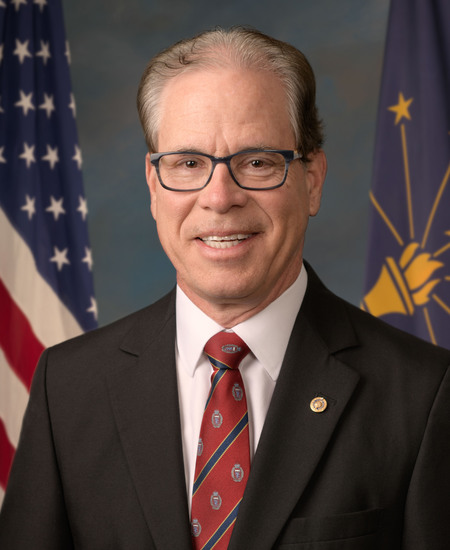
Sen. Mike Braun
Sponsored bills
COVID-19 Vaccine Dishonorable Discharge Prevention Act This bill provides that a member of the Armed Forces who was discharged on the basis of choosing not to receive a COVID-19 vaccine may only receive an honorable discharge.
No Budget, No Pay Act This bill prohibits Members of Congress from being paid in a fiscal year until both chambers approve the budget resolution and pass all regular appropriations bills for that fiscal year. Retroactive pay is prohibited for such a period.
End Government Shutdowns Act This bill provides continuing appropriations to prevent a government shutdown if any appropriations measure for a fiscal year has not been enacted before the fiscal year begins or a joint resolution making continuing appropriations is not in effect. For an initial 120-day period, the bill provides appropriations to continue programs, projects, and activities for which funds were provided in the preceding fiscal year. The bill reduces the continuing appropriations by 1% after the first 120-day period and by an additional 1% for each subsequent 90-day period until the applicable appropriations legislation is enacted.
This bill posthumously provides for the award of a Congressional Gold Medal in commemoration of the 13 service members who died on August 26, 2021, while stationed at Hamid Karzai International Airport in Afghanistan.
This resolution states that the Senate stands with the Afghan people now living under the Afghan Taliban regime. It calls on the Department of State to designate the Afghan Taliban as a foreign terrorist organization. It also states that the Afghan Taliban regime must be denied access to funds held by the U.S. government.
Prevent Government Shutdowns Act of 2021 This bill provides continuing appropriations to prevent a government shutdown if any of the appropriations bills for a fiscal year have not been enacted before the fiscal year begins and continuing appropriations are not in effect. The bill also limits official travel, congressional recesses or adjournments, and the consideration of legislation that is unrelated to appropriations after the beginning of a fiscal year if the appropriations process has not been completed.
Restraining Emergency War Spending Act This bill establishes (1) a statutory definition for emergency war funding , and (2) a budget point of order that may be raised in the Senate against legislation that provides new funding for a contingency operation that does not meet the requirements for emergency war funding. Funding for Overseas Contingency Operations (OCO) is exempt from discretionary spending limits. If this point of order is successfully raised against a provision that provides OCO funding that does not meet the requirements for emergency war spending, the bill requires the provision to be stricken from the legislation and prohibits it from being offered as a floor amendment.
Restoring Trust in Public Health Act This bill requires the Senate to confirm the appointment of the Director of the Centers for Disease Control and Prevention.
This bill requires the Internal Revenue Service (IRS) to report to Congress on projections of the estimated tax gap (i.e., the difference between tax liabilities owed to the IRS and those liabilities that the IRS actually collects). The IRS may use artificial intelligence and related data analysis tools to calculate a tax gap projection. The bill also requires the Joint Committee on Taxation to issue periodic reports to the congressional tax committees on the tax gap projection. The bill restricts IRS funding to FY2021 levels for audits and enforcement until it publishes an updated tax gap projection. Funding is also restricted for certain purposes, including (1) targeting U.S. citizens who exercise their First Amendment rights, (2) targeting a group for regulatory scrutiny based on its ideological beliefs, and (3) auditing individual taxpayers with an adjusted gross income of less than $400,000. The bill directs the IRS to establish a fellowship program to recruit private sector tax experts to join the IRS to create and participate in the audit task force. The purposes of the tax force include performing audit case selection, educating IRS employees on emerging issues, auditing selected taxpayers, addressing offshore tax evasion, and identifying, mentoring, and training IRS junior employees with respect to audits.