

Anyone But China Safe Drug Act or the ABC Safe Drug Act This bill requires the federal government to maintain a registry of certain foreign-sourced drugs, prohibits federal health care programs from purchasing drugs containing ingredients manufactured in China, and requires drugs to be labeled for country of origin. The Food and Drug Administration shall maintain (1) a list of foreign-sourced drugs and active ingredients that are critical for consumer health and safety, and (2) another list identifying such drugs that are produced exclusively in China or use ingredients produced in China. The bill phases in a restriction on federal health care programs purchasing drugs with active ingredients manufactured in China. By January 1, 2026, such programs may not purchase a drug with any active ingredients from China. The Department of Health and Human Services may issue a waiver for an agency or program that is unable to meet this requirement, but no waiver may apply to drugs purchased in or after 2027. Each drug must have labeling listing the country of origin of each active ingredient, and a drug without this labeling shall be deemed misbranded.
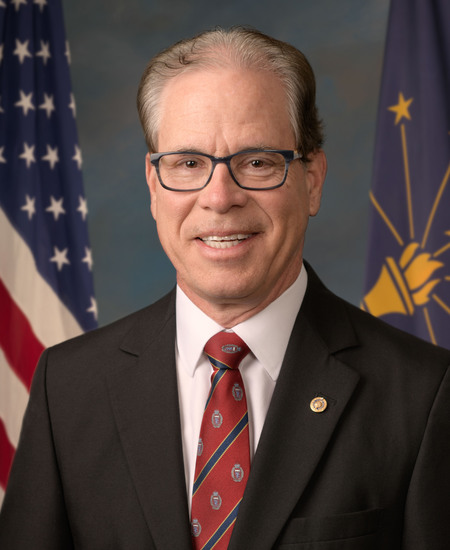
Sen. Mike Braun
Sponsored bills
GI Bill National Emergency Extended Deadline Act of 2021 This bill amends various provisions related to educational assistance benefits provided by the Department of Veterans Affairs (VA). First, the bill extends the time limitation for using educational assistance under the Montgomery GI Bill and the Post-9/11 GI Bill, and for eligibility under the Veteran Readiness and Employment program, when educational institutions are temporarily or permanently closed due to an emergency situation, or there is another reason that prevents an individual from participating. Next, the bill requires the VA to disapprove courses of education provided by public institutions of higher learning that charge higher tuition and fees than in-state tuition for individuals who are entitled to educational assistance under the Survivors' and Dependents' Educational Assistance program. The bill also makes adjustments to the time limitation for using educational assistance under this program. The VA must implement an information technology service using one or more commercial software systems to process claims for VA educational assistance benefits. Finally, the bill requires the Veterans' Employment and Training Service within the Department of Labor to implement a pilot program under which states may use grants or contracts to carry out a short-term fellowship program to provide veterans with opportunities for long-term employment.
Emergency Use Transparency Act This bill expands existing statutory provisions requiring the Food and Drug Administration (FDA) to publish notices of authorizations, terminations, or revocations of emergency use authorizations for medical products. Specifically, the bill requires the FDA to publish such notices on its website. The bill also allows the FDA's disclosures to include a summary of data or information from additional types of submissions.
Protecting Access to Credit for Small Businesses Act This bill prohibits the Small Business Administration from directly making a loan under the 7(a) Program, which authorizes loans and loan guaranties to small businesses that meet certain requirements.
Congressional Review of Agency Legal Settlements Act of 2021 This bill requires federal agencies to submit certain settlement agreements to Congress and allows Congress to disapprove of such agreements. The bill applies to proposed voluntary compromise settlements that include (1) a financial award paid by an agency that is more than $10 million aggregated across all similarly situated cases or legal claims against the agency, or (2) an agreement to modify or alter an agency rule. Before an agency may enter into such an agreement, the agency must submit to Congress a report that includes specified information, such as the terms and class of claimants covered by the agreement. The bill (1) specifies the effect of passage of a joint resolution of disapproval related to such an agreement, and (2) provides for an expedited procedure for such resolutions.
This joint resolution nullifies a Department of Labor emergency temporary standard for preventing the transmission of COVID-19 in employment settings. Under the standard issued on November 5, 2021, employers with 100 or more employees must require their onsite employees to either be fully vaccinated against COVID-19 or undergo weekly COVID-19 testing.
This resolution applauds the actions of the Women's Tennis Association to seek the security and safety of Peng Shuai, and hold the Communist Party of China (CPC) accountable for its authoritarian censorship of Peng. The resolution condemns the International Olympic Committee for cooperating in the CPC's suppression of Peng. The resolution condemns the CPC's violation of Peng's basic human rights to freedom of speech and movement. Finally, the resolution demands that the CPC prove that Peng is free from censorship, coercion, and intimidation; and fully investigate Peng's sexual assault allegation against former Vice Premier Zhang Gaoli.
Maddy summaryThis is a ceremonial Senate resolution (SRES 470) commemorating the death of former U.S. Senator Bob Dole of Kansas. It formally expresses the Senate's sorrow, requests the Secretary of the Senate transmit a copy to Dole's family, and directs the Senate to adjourn as a mark of respect. The resolution has no policy or legal effect - it solely serves as a symbolic tribute to Dole's public service career. It does not affect any individuals or enact new laws.
VA Electronic Health Record Transparency Act of 2021 This bill requires the Department of Veterans Affairs to report on the costs of its Electronic Health Record Modernization Program, including by describing all expenses driven by the program.
Stop Significant and Time-wasting Abuse Limiting Legitimate Innovation of New Generics Act or the Stop STALLING Act This bill makes it an unfair method of competition to submit an objectively baseless petition to the Food and Drug Administration (FDA) in an attempt to interfere with a competitor's application for market approval of a drug. The bill authorizes the Federal Trade Commission to sue an individual or entity that submits such a petition to the FDA. A party found liable in such a lawsuit shall be subject to civil penalties, such as a fine of up to $50,000 for each day that the FDA spent reviewing the baseless petition.