This resolution supports the designation of February 2022 as Career and Technical Education Month to celebrate career and technical education across the United States.
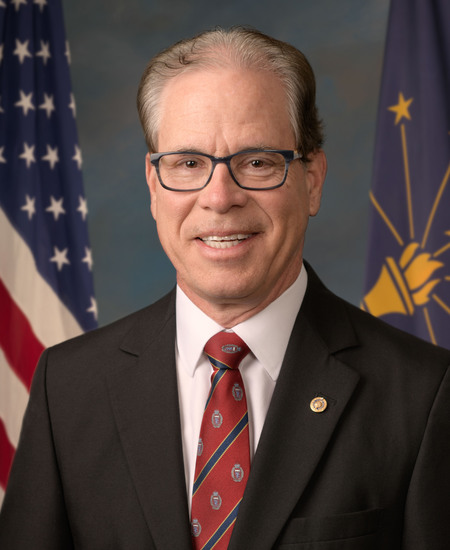
Sen. Mike Braun
Sponsored bills
Providing Reports on Inflation Costs and Economic Impact Act or the PRICE Act This bill establishes a point of order that prohibits the Senate from considering legislation that provides discretionary appropriations unless a Congressional Budget Office (CBO) report regarding the impact of the legislation on inflation has been submitted for publication in the Congressional Record. The CBO report must include an analysis of the impact the legislation would have on the Consumer Price Index for all Urban Consumers, the Employment Cost Index for private industry workers, and the purchasing power of consumers. The point of order may be waived or suspended by an affirmative vote of three-fifths of the Senate.
Cutting Rampant Access to Crack Kits Act of 2022 or the CRACK Act of 2022 This bill prohibits community-based overdose prevention programs, syringe services programs, and other harm reduction programs from using funds made available through the American Rescue Plan Act of 2021 to procure or distribute pipes or other paraphernalia that can be used to smoke, inhale, or ingest narcotics.
Opioid Treatment Access Act of 2022 This bill expands access to substance use disorder treatment by modifying the regulation of opioid treatment programs and narcotic drugs used for treatment, including with respect to a patient's unsupervised use of such drugs. Specifically, the Department of Health and Human Services (HHS) must issue regulations to further increase patients' access to unsupervised use or handling of drugs for treatment. The Substance Abuse and Mental Health Services Administration (SAMHSA) must study the effects of these revisions, and HHS must, as appropriate, promulgate additional regulations based on the study's findings. SAMHSA must also study the impact of certain exemptions from certification requirements for opioid treatment programs that were granted as part of COVID-19 response efforts, including any additional costs or savings that resulted from the exemptions. The bill also (1) allows specified types of health care providers to prescribe (subject to certain requirements) methadone that is dispensed through pharmacies for a patient's unsupervised use, and (2) provides statutory authority for a regulation that allows registered opioid treatment programs to operate mobile medication units without separately registering the unit.
Veterans Health Care Freedom Act This bill requires the Center for Innovation for Care and Payment within the Department of Veterans Affairs (VA) to implement a three-year pilot program to improve the ability of veterans who are enrolled in the VA health care system to access hospital care, medical services, and extended care services through the covered care system by providing such veterans with the ability to choose health care providers. Under the bill, the covered care system includes VA medical facilities, health care providers participating in the Veterans Community Care Program (VCCP), and eligible entities or providers that have entered into a Veterans Care Agreement. A veteran participating in the program may elect to receive care at any provider in the covered care system. The pilot program removes certain requirements (e.g., location of the veteran) to access care at VA and non-VA facilities. After four years, the bill eliminates the requirements for accessing care under the VCCP and Veterans Care Agreements and requires the VA to provide such care under the same conditions of the pilot program. Additionally, after four years, veterans may receive care at a VA medical facility regardless of whether the facility is in the same Veterans Integrated Service Network as the veteran.
Strengthening Enforcement to Curtail Unlawful, Risky Entrance to Flights Act of 2022 or the SECURE Flights Act of 2022 This bill prohibits the use of warrants and other documents issued by U.S. Immigration and Customs Enforcement (ICE) as proof of identification at airport security checkpoints unless the individual is leaving the United States pursuant to immigration laws. If an individual uses prohibited documents as a proof of identification, the Transportation Security Administration (TSA) must (1) inform ICE and local law enforcement to determine whether the individual is in violation of any term of release, and (2) collect the individual's biometric information unless the TSA can verify the individual is a U.S. national. The TSA must also submit the biometric information to a national biometric identification system.
Delivering Essentials to Mothers Amid Natural Disasters Act of 2022 or the DEMAND Act of 2022 This bill directs the Federal Emergency Management Agency (FEMA) to designate breast pumps and certain lactation supplies as eligible for financial assistance under major disaster relief provisions.
Ban IRS Biometrics Act This bill prohibits the Department of the Treasury from requiring taxpayers to provide biometric information as a condition of filing any tax return, receiving any service, or accessing taxpayer information. The bill defines biometric information as any information regarding any measurable physical characteristic or personal behavioral trait used to recognize the identity, or verify the claimed identity or location, of an individual, including facial images, fingerprints, and iris scans. Treasury must also develop a plan for the safe and secure destruction and disposal of any biometric information collected or used prior to the enactment of this bill.
Natural Immunity Transparency Act This bill requires the Department of Health and Human Services to report within 30 days of the bill's enactment to Congress concerning natural immunity to COVID-19. In particular, the report must compare certain outcomes for individuals who recovered from a COVID-19 infection without having received the vaccination and individuals who received the vaccination.
Accelerated Drug Approval for Prescription Therapies 2.0 Act or the ADAPT 2.0 Act This bill allows applicants seeking Food and Drug Administration (FDA) approval to market a new drug to rely on investigations conducted in certain other countries and addresses related issues. If an applicant seeks market approval for a new drug with an application that relies on at least one investigation that the applicant did not conduct and did not obtain approval to use, the applicant may rely on an investigation that was conducted in certain foreign countries if the drug in question has already been approved in that country. The investigation must have been conducted in Australia, Canada, Israel, Japan, New Zealand, Switzerland, South Africa, the United Kingdom, the European Union, a country in the European Economic Area, or another country that the FDA has found to meet certain requirements. The FDA must make a decision on such an application within 90 days of the application's filing. If the FDA does not take certain actions within that period, the application shall be considered approved. The FDA may require the applicant to conduct postapproval studies of the drug and to submit copies of all promotional materials. The bill also establishes an advisory committee to provide the FDA with recommendations as to each application that relies on a foreign investigation. The FDA must make available on its public website each decision on such an application, including the rationale for the decision and the advisory committee's recommendations.