

Say No to the Silk Road Act This bill requires various actions pertaining to China's sovereign digital currency. Specifically, the bill requires (1) the Office of Management and Budget to develop guidance for executive agencies pertaining to security requirements for the use of China's sovereign digital currency, (2) countries accepting assistance through the Foreign Military Financing Program to disclose any use of such currency as a settlement or reserve currency, and (3) the Department of State to include on its public website a warning for travelers about the dangers of such currency.
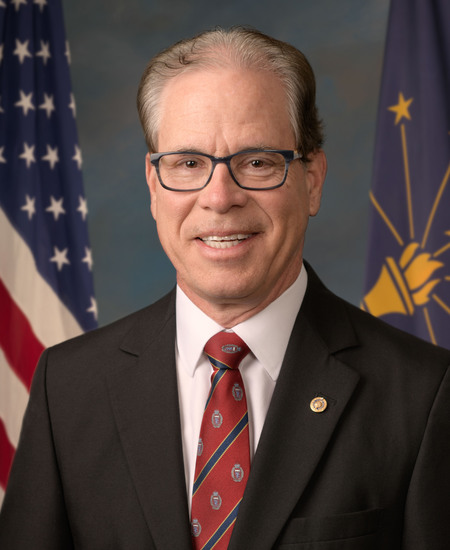
Sen. Mike Braun
Sponsored bills
Changing Age-Determined Eligibility To Student Incentive Payments Act or the CADETS Act This bill expands age requirements for the Student Incentive Payments Program, which provides financial support to cadets who attend one of six state maritime academies and commit to a post-graduation service obligation. Specifically, the bill expands the eligibility age to include any qualified student who will meet the age requirements for enlistment in the Navy Reserve at the time of their graduation. Current age requirements prohibit cadets older than 25 from participating in the program.
Susan Muffley Act of 2022 This bill restores the full vested monthly benefits for eligible participants of certain pension plans that were sponsored by Delphi Corporation and terminated as a result of General Motors' bankruptcy in 2009. The Pension Benefit Guaranty Corporation (PBGC) must recalculate and adjust each plan participant's monthly benefits payment. The PBGC must also apply the recalculation to previously-made monthly payments and make a lump-sum payment for any additional benefits based on the recalculation. The bill establishes and provides appropriations to a fund for the payment of these benefits and specifies how the lump-sum payments are treated for tax purposes.
Stop Russian Government and Oligarchs from Limiting Democracy Act of 2022 or the Stop Russian GOLD Act of 2022 This bill prohibits a U.S. person from engaging in a transaction with a foreign person who purchases, transacts in, or transports Russian gold.
Maddy summarySJRES 38 is a joint resolution that terminates the national emergency declared by the President on March 13, 2020, under the National Emergencies Act. This resolution ends the special authorities and regulatory flexibilities granted during the emergency, requiring federal agencies to revert to standard operating procedures. Introduced by Senators Marshall, Braun, Lee, Johnson, Cruz, and Paul, it was referred to the Senate Committee on Finance. The termination removes the legal basis for emergency-related policies that had been in effect since March 2020.
This resolution condemns violence and threats of violence against historically Black colleges and universities (HBCUs) and reaffirms the federal government's commitment to combating violence against HBCU students, faculty, and staff.
This joint resolution nullifies the rule titled Medicare and Medicaid Programs; Omnibus COVID-19 Health Care Staff Vaccination , which was issued by the Centers for Medicare & Medicaid Services on November 5, 2021. The rule requires health care providers, as a condition of Medicare and Medicaid participation, to ensure that staff are fully vaccinated against COVID-19.
Maddy summaryThis resolution designates March 4, 2022, as "National Speech and Debate Education Day" to recognize the value of speech and debate programs in schools. It does not create new laws or allocate funds but encourages schools, communities, and individuals to celebrate these educational activities. The resolution highlights how speech and debate develop critical skills like communication, critical thinking, and civic engagement for students. It is a symbolic gesture with no direct impact on policy or affected populations.
This resolution supports reopening the U.S. Capitol Building and Senate Office Buildings to visitors under the public visitation policies that were in place before the COVID-19 pandemic.
This bill exempts until June 30, 2025, certain contractors that receive federal highway or public transportation funding from having to adjust costs associated with their contracts to account for loan forgiveness through the Paycheck Protection Program (PPP). (The PPP provided small businesses with loans for payroll and other costs to respond to the COVID-19 emergency with loan forgiveness under certain conditions.) Under current law, a contractor with a cost-reimbursable contract must reduce costs or provide cash refunds to the Department of Transportation (or a state department of transportation) if the contractor receives or accrues any income, rebate, allowance, or other credit relating to an allowable contract cost, which includes PPP loan forgiveness.