This resolution condemns the February 1, 2021, military coup in Burma (Myanmar) and calls on Burmese authorities to allow journalists, human rights organizations, United Nations monitors, and humanitarian actors full and safe access to every part of the country. The resolution also asks neighboring countries to provide immediate and direct cross-border assistance to address the humanitarian needs of refugees.
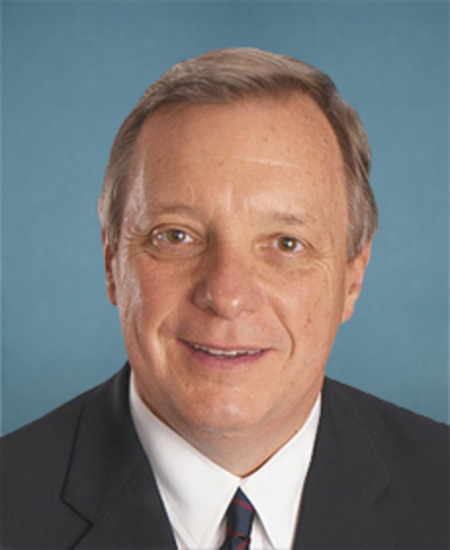
Sen. Richard J. Durbin
Sponsored bills
Assault Weapons Ban of 2021 This bill makes it a crime to knowingly import, sell, manufacture, transfer, or possess a semiautomatic assault weapon (SAW) or large capacity ammunition feeding device (LCAFD). The prohibition does not apply to a firearm that is (1) manually operated by bolt, pump, lever, or slide action; (2) permanently inoperable; (3) an antique; or (4) a rifle or shotgun specifically identified by make and model. The bill also exempts from the prohibition the following, with respect to a SAW or LCAFD: importation, sale, manufacture, transfer, or possession related to certain law enforcement efforts, or authorized tests or experiments; importation, sale, transfer, or possession related to securing nuclear materials; and possession by a retired law enforcement officer. The bill permits continued possession, sale, or transfer of a grandfathered SAW, which must be securely stored. A licensed gun dealer must conduct a background check prior to the sale or transfer of a grandfathered SAW between private parties. The bill permits continued possession of, but prohibits sale or transfer of, a grandfathered LCAFD. Newly manufactured LCAFDs must display serial number identification. Newly manufactured SAWs and LCAFDs must display the date of manufacture. The bill also allows a state or local government to use Edward Byrne Memorial Justice Assistance Grant Program funds to compensate individuals who surrender a SAW or LCAFD under a buy-back program.

COVID - 19 Hate Crimes Act This bill requires a designated officer or employee of the Department of Justice (DOJ) to facilitate the expedited review of COVID-19 (i.e., coronavirus disease 2019) hate crimes and reports of COVID-19 hate crimes. It defines COVID-19 hate crime as a violent crime that is motivated by two things: (1) the actual or perceived characteristic (e.g., race or ethnicity) of any person, and (2) the actual or perceived relationship to the spread of COVID-19 of any person because of that characteristic. The bill requires DOJ to issue guidance for state and local law enforcement agencies on how to establish online hate crime reporting processes in multiple languages and how to expand culturally competent education campaigns. Additionally, DOJ and the Department of Health and Human Services must issue guidance on best practices for mitigating racially discriminatory language in describing the COVID-19 pandemic.
No Tax Breaks for Outsourcing Act This bill modifies the tax treatment of the foreign source income of domestic corporations. The bill includes provisions that modify calculations of the gross income of U.S. shareholders to include net CFC tested income in the current taxable year, apply limitations on the foreign tax credit on a country-by-country basis, limit the tax deduction for the interest expense of a U.S. corporation that is a member of a financial reporting group (i.e., a group that prepares consolidated financial statements according to generally accepted accounting principles or international financial reporting standards), modify the rules for the taxation of inverted corporations (i.e., U.S. corporations that acquire foreign companies to reincorporate in a foreign jurisdiction with income tax rates lower than the United States), and treat certain foreign corporations managed and controlled primarily in the United States as domestic corporations for tax purposes.
This resolution recognizes the centennial of the Tulsa Race Massacre of 1921. The resolution acknowledges the historical significance of this event as one of the largest single instances of state-sanctioned violence against Black people in American history; honors the lives and legacies of the estimated 300 Black individuals who were killed during the massacre and the nearly 9,000 who were left homeless and penniless; condemns efforts to cover up the truth and shield the white community, especially government officials, from accountability; condemns the continued legacy of racism and white supremacy against Black people in the United States, particularly in the form of police brutality; encourages education about the massacre, the history of white supremacy that fueled the massacre, and subsequent attempts to deny or cover up the massacre, in all elementary and secondary education settings and in institutions of higher education; and recognizes the commitment of Congress to acknowledge and learn from the history of racism and racial violence to reverse the legacy of white supremacy and fight for racial justice.
America's Clean Future Fund Act This bill establishes requirements and incentives to reduce greenhouse gas emissions and assist industries, communities, and workers transition to a low-carbon economy, including by establishing (1) the Climate Change Finance Corporation (C2FC); (2) the America's Clean Future Fund; and (3) a carbon fee on the use, sale, or transfer of certain fuels by covered entities. The bill provides appropriations to the C2FC, an independent agency, which must finance clean energy and climate change resiliency activities in order to meet the goal of eliminating greenhouse gas emissions by 2050. The bill also provides appropriations for the America's Clean Future Fund. Amounts in the fund may be used for the C2FC, stimulus payments (i.e., tax rebates) to individuals whose gross incomes do not exceed specified thresholds, decarbonization transition payments to the agricultural sector, and grants to help certain communities and workers transition to a low-carbon economy. Revenues generated from the carbon fee must also be deposited into the America's Clean Future Fund. Beginning in 2023, covered entities (e.g., entities that use, sell, or transfer fossil fuels) must pay a carbon fee of $25 per metric ton of carbon dioxide or carbon dioxide equivalent. The fee increases by $10 each year, multiplied by the cost-of-living adjustment. The fees further increase if the entities miss cumulative greenhouse gas emission targets established by the bill. Refund payments may be provided for carbon capture, sequestration, and utilization.
NICS Denial Notification Act of 2021 This bill requires the Department of Justice to notify state and local law enforcement authorities following a firearms-related background check that results in a denial.
Retaining Educators Takes Added Investment Now Act or the RETAIN Act This bill allows a refundable tax credit for the employment of early childhood educators, teachers, early childhood education program directors, school leaders, and school-based mental health services providers that is based upon the number of school years for which such individuals have been continuously employed.
This bill directs the Joint Committee on the Library to accept from the Harriet Tubman Statue Commission of Maryland the donation of a statue of Harriet Tubman, which the Architect of the Capitol shall place in a prominent, permanent location in the U.S. Capitol.
Public Health Infrastructure Saves Lives Act This bill provides annual funding for the Centers for Disease Control and Prevention (CDC) to strengthen core public health infrastructure. Core public health infrastructure includes the elements and workforce capabilities that enable health departments to perform critical functions such as disease surveillance and emergency response. Specifically, the CDC must award grants to health departments for their core infrastructure needs. In addition, the CDC must support the development of accreditation standards for health departments that emphasize core public health infrastructure. Health departments must meet those (or similar) standards as a condition of receiving grants beginning in FY2025. The CDC must also take steps to expand and improve its own public health infrastructure.