

Increasing American Jobs Through Greater Exports to Africa Act of 2021 This bill requires the President and specified agencies to take certain actions to increase U.S. exports to Africa. Specifically, the bill directs the President to establish a comprehensive U.S. strategy for public and private investment, trade, and development in Africa. The focus of this strategy must include (1) increasing exports of U.S. goods and services to Africa by at least 200% in real dollar value within 10 years, (2) promoting the alignment of U.S. commercial interests with development priorities in Africa, and (3) improving the competitiveness of U.S. businesses in Africa. Additionally, the bill directs the President to designate a Special Africa Export Strategy Coordinator; develop a plan for standardized training of foreign service and economic officers; and explore opportunities to negotiate bilateral, subregional, and regional agreements to encourage trade and eliminate nontariff barriers to trade between countries. The bill requires the Department of Commerce to ensure specified levels of United States and Foreign Commercial Service officers in Africa. The bill directs the Export-Import Bank to increase the amount of financing for projects in Africa. The bank must also make capitalization available annually for loans that compete against certain foreign loans. The Small Business Administration's Office of International Trade must work closely with the Trade Promotion Coordinating Committee, among others, in maintaining a trade distribution network.
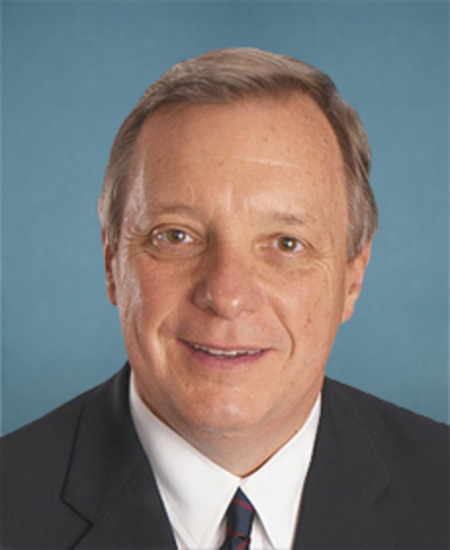
Sen. Richard J. Durbin
Sponsored bills
Gun Records Restoration and Preservation Act This bill amends several appropriations laws to remove limitations on the authority of the Bureau of Alcohol, Tobacco, Firearms and Explosives to conduct activities related to the administration of federal firearms laws. Specifically, the bill removes provisions that limit the use of firearms tracing data, limit the disclosure of data under the Freedom of Information Act, prohibit imposing a requirement that gun dealers conduct a physical inventory, prohibit consolidating or centralizing records maintained by federal firearm licensees (e.g., gun dealers), and require national instant criminal background check records to be destroyed within 24 hours.
Healthcare Workforce Resilience Act This bill makes previously unused immigrant visas available to nurses and physicians who petition for such a visa before the date that is 90 days after the end of the declared national emergency relating to the COVID-19 (i.e., coronavirus disease 2019) outbreak. The number of visas available shall be the total number of unused employment-based immigrant visas from FY1992-FY2020, up to 40,000. Of such visas, 25,000 shall be reserved for nurses and 15,000 for physicians. Certain family members may accompany the principal beneficiary of a visa provided under this bill, and visas for such family members shall (1) be made available from the unused visas from FY1992-FY2020, and (2) not be counted against the 40,000 cap. Visas provided under this bill shall be exempt from per-country limitations.
Domestic Terrorism and Hate Crimes Prevention Act of 2021 This bill establishes new requirements to expand the availability of information on domestic terrorism, as well as the relationship between domestic terrorism and hate crimes. The bill also facilitates the expedited review of COVID-19 hate crimes and reports of COVID-19 hate crimes. It authorizes domestic terrorism components within the Department of Homeland Security, the Department of Justice (DOJ), and the Federal Bureau of Investigation (FBI) to monitor, analyze, investigate, and prosecute domestic terrorism. The bill creates an interagency task force to analyze and combat white supremacist and neo-Nazi infiltration of the uniformed services and federal law enforcement agencies. It directs the FBI to assign a special agent or hate crimes liaison to each field office to investigate hate crimes incidents with a nexus to domestic terrorism. Finally, the bill requires a designated officer or employee of DOJ to facilitate the expedited review of COVID-19 hate crimes and reports of COVID-19 hate crimes. It defines COVID-19 hate crime as a violent crime that is motivated by two things: (1) the actual or perceived characteristic (e.g., race or ethnicity) of any person, and (2) the actual or perceived relationship to the spread of COVID-19 of any person because of that characteristic.
This resolution condemns and denounces all forms of anti-Asian sentiment, including those related to COVID-19 (i.e., coronavirus disease 2019), and calls on federal law enforcement officials, working with state and local agencies, to take specified steps. The resolution calls on federal officials to expeditiously investigate and document all credible reports of hate crimes, harassment, bullying, and threats against the Asian American and Pacific Islander communities; the Attorney General to work with state and local agencies and Asian American and Pacific Islander community-based organizations to prevent discrimination and to expand culturally competent and linguistically appropriate education campaigns on public reporting of hate crimes; and the Department of Health and Human Services to issue guidance describing best practices to mitigate racially discriminatory language in describing the pandemic. The resolution recommits the United States to serving as a model for the world in building a more inclusive, diverse, and tolerant society by (1) prioritizing language access and inclusivity in communication practices, and (2) combating misinformation and discrimination that puts Asian Americans and Pacific Islanders at risk.
This resolution celebrates the successes and contributions of Latinas in the United States and recognizes the changes still to be made to ensure that Latinas can realize their full potential as equal members of society.
This resolution observes the 10th anniversary of the Syrian uprising wherein hundreds of Syrians assembled to call on their leadership for democratic reforms and respect for their fundamental freedoms. Further, the resolution commends the bravery of Syrian human rights defenders, affirms U.S. policy with respect to Syria, and calls on the United States to reinvigorate diplomatic efforts to resolve the conflict in Syria and to expand humanitarian aid to the Syrian people.
This resolution denounces the Nicolás Maduro regime's most recent legislative elections as fraudulent and illegitimate, does not recognize the legitimacy of the new Venezuelan National Assembly, and joins members of the international community in rejecting the elections. Further, it urges that elections in Venezuela be conducted as soon as possible according to international standards for free, fair, and transparent electoral processes. Additionally, the resolution calls on the Maduro regime to cease its persecution of Venezuala's independent political parties and release all political prisoners, and it calls for Nicolás Maduro and senior members of his regime to be held accountable for their actions.
Domestic Terrorism Prevention Act of 2021 This bill establishes new requirements to expand the availability of information on domestic terrorism, as well as the relationship between domestic terrorism and hate crimes. It authorizes domestic terrorism components within the Department of Homeland Security (DHS), the Department of Justice (DOJ), and the Federal Bureau of Investigation (FBI) to monitor, analyze, investigate, and prosecute domestic terrorism. The domestic terrorism components of DHS, DOJ, and the FBI must jointly report on domestic terrorism, including white-supremacist-related incidents or attempted incidents. DHS, DOJ, and the FBI must review the anti-terrorism training and resource programs of their agencies that are provided to federal, state, local, and tribal law enforcement agencies. It creates an interagency task force to analyze and combat white supremacist and neo-Nazi infiltration of the uniformed services and federal law enforcement agencies. Finally, it directs the FBI to assign a special agent or hate crimes liaison to each field office to investigate hate crimes incidents with a nexus to domestic terrorism.
American Cures Act This bill permanently funds several federal agencies and programs that perform biomedical research. The bill provides specified funding for the National Institutes of Health, the Centers for Disease Control and Prevention, the Department of Defense health program, and the Department of Veterans Affairs medical and prosthetics research program. The bill exempts the funding from sequestration, which is a process of automatic, usually across-the-board spending reductions under which budgetary resources are permanently cancelled to enforce specific budget policy goals. It also exempts the budgetary effects of the funding from the Statutory Pay-As-You-Go Act of 2010 (PAYGO) and the Senate PAYGO rule.