

Safe Schools Improvement Act of 2021 This bill requires states to direct their local educational agencies (LEAs) to establish policies that prevent and prohibit bullying and harassment of elementary and secondary school students. In particular, these policies must prohibit bullying and harassment based on race, color, national origin, sex, sexual orientation, gender identity, disability, or religion. Further, LEAs must provide (1) students, parents, and educational professionals with annual notice of the conduct prohibited in their disciplinary policies; (2) students and parents with grievance procedures that target such conduct; and (3) the public with annual data on the incidence and frequency of that conduct at the school and LEA level. The Department of Education must conduct and report on an independent biennial evaluation of programs and policies to combat bullying and harassment in elementary and secondary schools. The National Center for Education Statistics must collect state data to determine the incidence and frequency of the conduct prohibited by LEA disciplinary policies.
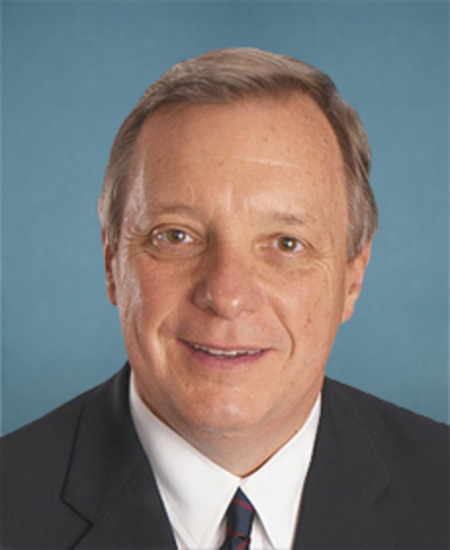
Sen. Richard J. Durbin
Sponsored bills
Uyghur Forced Labor Prevention Act This bill imposes importation limits on goods produced using forced labor in China, especially the Xinjiang Uyghur Autonomous Region, and imposes sanctions related to such forced labor. The Department of Homeland Security shall report to Congress a strategy for preventing the importation of goods produced in China using forced labor. The strategy must contain certain information, including a list of entities working with the government in Xinjiang to move forced labor or Uyghurs, Kazakhs, Kyrgyz, or members of other persecuted groups out of Xinjiang. The U.S. Customs and Border Protection shall generally presume that goods produced by these entities and certain other entities, generally those sourcing material from Xinjiang or involved with Chinese government forced labor programs, are barred from importation into the United States. The bill also expands existing asset- and visa-blocking sanctions related to Xinjiang to cover foreign individuals and entities responsible for serious human rights abuses in connection with forced labor. The Department of State shall report to Congress a strategy to enhance international awareness of forced labor in Xinjiang and to address such forced labor.
This resolution designates June 2021 as African-American Music Appreciation Month. The resolution also recognizes the contributions of African Americans to the musical heritage of the United States. Finally, the resolution recognizes Black History Month and African-American Music Appreciation Month as important times to celebrate this impact and to encourage greater access to music education.
Fairness in Federal Disaster Declarations Act of 2021 This bill requires the Federal Emergency Management Agency (FEMA) to amend the rules concerning the factors it considers when evaluating a governor's request for a major disaster declaration. FEMA must (1) provide that, with respect to the evaluation of the need for public assistance, specific weighted valuations shall be assigned to the estimated cost of the assistance (10%), localized impacts (40%), insurance coverage in force (10%), hazard mitigation (10%), recent multiple disasters (10%), programs of other federal assistance (10%), and economic circumstances (10%); and (2) consider the economic circumstances of both the local economy of the affected area (including the local assessable tax base and local sales tax, median income, and poverty rate) and the state economy (including the unemployment rate). Such rules are applicable to any disaster for which a governor requested a major disaster declaration and was denied on or after January 1, 2012.
This resolution recognizes the 75th anniversary of the Fulbright Program, which promotes international goodwill through the exchange of students in the fields of education, culture, and science.
This resolution congratulates and honors Argonne National Laboratory on the 75th anniversary of its charter and wishes the laboratory continued success in helping the people of the United States unlock new scientific and technological frontiers that secure their energy future.
Consumer and Fuel Retailer Choice Act This bill amends the Clean Air Act to address the limitations on Reid vapor pressure (a measure of gasoline's volatility) that are placed on gasoline during the summer ozone season. The bill applies the Reid vapor pressure requirements that are applicable to gasoline blended with 10% ethanol (E10) to gasoline blended with more than 10% ethanol. Thus, the waiver given to E10 gasoline, which allows an increase in the Reid Vapor Pressure volatility, is extended to gasoline blended with more than 10% ethanol.
Protecting Consumers from Unreasonable Credit Rates Act of 2021 This bill prohibits a creditor from extending credit to a consumer under an open end consumer credit plan (i.e., credit card) for which the fee and interest rate exceeds 36%. The bill also sets forth criminal penalties for violations and empowers state Attorneys General to enforce the bill. Credit card billing statements must include the fee and interest rate, displayed as FAIR , instead of the total finance charge expressed as an annual percentage rate (APR).
3D Printed Gun Safety Act of 2021 This bill makes it unlawful to intentionally publish digital instructions for programming a three-dimensional printer to make a firearm.
First Step Implementation Act of 2021 This bill makes various changes related to federal sentencing law and requires the Department of Justice (DOJ) to establish procedures to ensure the prompt release and accuracy of employment-related background check records. The bill allows certain reduced mandatory minimum sentences for drug offenses to be applied retroactively to offenders who committed their offenses on or before December 21, 2018; permits a court, in certain circumstances, to grant safety valve relief (i.e., impose a sentence without regard to the statutory mandatory minimum penalty for certain drug offenses) for an otherwise eligible defendant who does not meet the requirement pertaining to criminal history; permits a court to reduce a sentence imposed on a defendant convicted as an adult for an offense committed as a juvenile if the defendant has served at least 20 years of the sentence; establishes a process to seal and expunge certain records of juvenile nonviolent offenses; and requires DOJ to establish and enforce procedures to ensure that records exchanged for employment-related background checks are promptly released and accurate.