

Frank Harrison, Elizabeth Peratrovich, and Miguel Trujillo Native American Voting Rights Act of 2021 This bill addresses the voting rights of Native American and Alaska Native voters and voting access on tribal lands. The bill includes provisions expanding the types of facilities that can be used as voter registration agencies; increasing polling site accessibility, including by expanding early in-person voting and providing ballot drop boxes; providing enforcement power to citizens and attorneys general; requiring approval for actions like moving a polling place; validating certain tribal identification for voting or registering to vote; permitting voters to designate another individual to return a ballot on their behalf; and expanding requirements for bilingual voting accessibility. In addition, the bill establishes a Native American voting task force grant program for the purpose of increasing voter outreach, education, registration, turnout, and accessibility for Native American communities. The bill also directs the Government Accountability Office to study and report on (1) the prevalence of nontraditional or nonexistent mailing addresses among Indians, members of tribes, and individuals residing on Indian lands; and (2) the alternatives for removing barriers to voter registration, receipt of voter information and materials, and receipt of ballots.
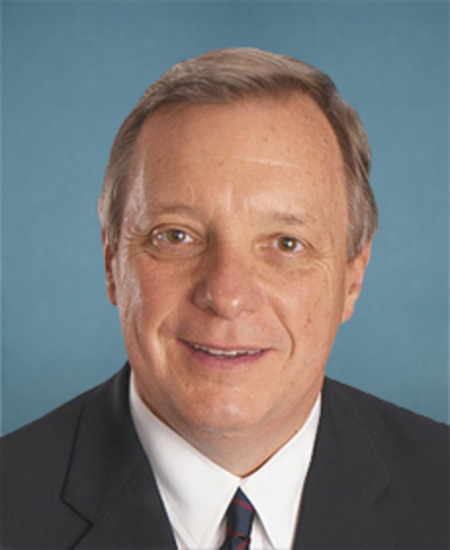
Sen. Richard J. Durbin
Sponsored bills
Reinforcing Nicaragua's Adherence to Conditions for Electoral Reform Act of 2021 or the RENACER Act This bill establishes measures to monitor, report on, and address corruption and human rights abuses in Nicaragua. Specifically, the bill directs U.S. leadership at international financial institutions to advocate for oversight with respect to any loan or financial or technical assistance for projects in Nicaragua. The Department of State and the Department of the Treasury must establish a strategy to align diplomatic engagement with implementing sanctions to facilitate free, fair, and transparent elections in Nicaragua. Pursuant to this strategy, the President must prioritize implementing targeted sanctions on persons obstructing such elections. The State Department must also engage in diplomatic efforts with partner countries to impose targeted sanctions on such individuals. The bill adds Nicaragua to a list of countries whose citizens are subject to visa-blocking sanctions for knowingly engaging in (1) actions undermining democratic processes or institutions, or (2) significant corruption or obstruction of investigations into such corruption. Further, the bill requires the State Department to report on the involvement of President Daniel Ortega, members of his family, and senior government officials in significant acts of public corruption; Russian activities in Nicaragua; and gross human rights violations by the Ortega government against campesinos (i.e., natives of Latin American rural areas, especially Latin American Indian farmers or farm laborers) and indigenous communities. In addition, the State Department must report on obstacles to news and information about domestic and international affairs and submit a strategy for strengthening independent broadcasting, information distribution, and media platforms in Nicaragua.
This joint resolution repeals the 2001 Authorization for Use of Military Force, effective one year after the date of enactment of the resolution. The 2001 Authorization for Use of Military Force authorized the President to use all necessary and appropriate force against the nations, organizations, or persons determined to have taken part in carrying out the terrorist attacks of September 11, 2001.
This resolution designates September 2021 as National Workforce Development Month.
This resolution expresses the condolences of the Senate regarding the death of the Honorable Maurice Robert Gravel, former Senator from Alaska.
This resolution honors the Radium Girls and recognizes their contribution to the development of workplace safety laws and standards. The Radium Girls were factory workers who contracted radiation poisoning from occupational exposure to radium.
This resolution designates May 7, 2021, as United States Foreign Service Day and honors the men and women who serve in the Foreign Service.
9/11 Responder and Survivor Health Funding Correction Act This bill increases funding for and otherwise modifies a federal program that provides medical monitoring and treatment to responders and survivors who suffer from health conditions related to the September 11, 2001, attacks on the World Trade Center. Among the changes, the bill allows certain health care providers other than physicians to determine whether an individual's health condition is related to the attacks, and it establishes a research program to study the impacts of the attacks on health and educational outcomes of individuals who were 21 years of age or younger when the attacks occurred.
Making Essentials Available and Lawful (MEAL) Act of 2021 This bill repeals a lifetime ban that prohibits individuals convicted of certain offenses related to the possession, use, or distribution of a controlled substance from receiving Supplemental Nutrition Assistance Program (SNAP) benefits or assistance under programs funded by Temporary Assistance for Needy Families (TANF) block grants. Any state law that imposes conditions on eligibility for SNAP benefits or TANF assistance based on an individual's conviction of such an offense shall have no force or effect. In addition, individuals who are incarcerated and scheduled to be released within 30 days shall qualify as individual households for purposes of SNAP eligibility. Under current law, unless specifically excepted, individuals residing in institutions do not constitute a household.
Beyond the Box for Higher Education Act of 2021 This bill requires the Department of Education to issue guidance and recommendations for institutions of higher education to remove criminal and juvenile justice questions from their admission applications.