

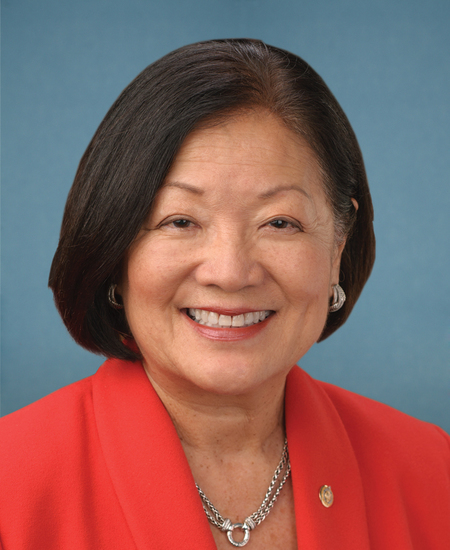
Photo of Mazie K. Hirono
D United States Senate · Hawaii

Sen. Mazie K. Hirono

Compare
Total votes
1,054
all sessions
Attendance
100%
of floor votes
Higher than 92% of chamber peers
With party
97%
of cast votes
Near the chamber average
Bipartisan score
2%
crosses aisle rarely
Near the chamber average
Sponsored
1,735
bills & resolutions
Higher than 82% of chamber peers
Committees
15
assignments
1,735 bills and resolutions

Sponsored bills

Total
1,735
Primary
192
Co-sponsor
1,543
This page
1,735
matching current filters
Co-sponsor S 199
In committee · United States Senate · Co-sponsor
A bill to amend the Internal Revenue Code of 1986 to provide special rules for the taxation of certain residents of Taiwan with income from sources within the United States.

Maddy summaryS 199 would create special tax rules for "qualified residents of Taiwan" with income from U.S. sources. It would lower tax rates on interest, dividends, and royalties from 30% to 10% (15% for some dividends), provide tax relief for certain wages paid to Taiwan residents working in the U.S., and exempt income from entertainment or athletic activities up to $30,000. The bill establishes specific requirements for entities to qualify for these benefits, including ownership and income criteria. It also creates a process for the U.S. to negotiate a formal tax agreement with Taiwan to further address double taxation concerns.

In committee Jan 23, 2025 1 co-sponsor
Co-sponsor S 232
In committee · United States Senate · Co-sponsor
Preventing Algorithmic Collusion Act of 2025

Maddy summaryThis bill prohibits businesses from using pricing algorithms that rely on nonpublic competitor data (like unpublicized prices or terms). It requires companies to disclose when algorithms set prices for customers or workers, and mandates audits of such algorithms upon request by the FTC or Justice Department. Violations could trigger daily fines of up to $10,000. The bill also presumes collusion if algorithms are shared between competitors, potentially leading to joint liability.

In committee Jan 23, 2025 1 co-sponsor
Primary S 193
In committee · United States Senate · Lead sponsor
Neighbors Not Enemies Act

Maddy summaryThe Neighbors Not Enemies Act repeals the Alien Enemies Act, a 19th-century law that allowed the president to detain or deport non-citizens during wartime. This removes a historical legal authority that targeted non-citizens based on nationality during declared wars. The repeal affects how the government could act against non-citizens in wartime scenarios but does not change current immigration or detention policies in peacetime. The bill makes no other policy changes beyond this specific repeal.

In committee Jan 22, 2025 0 co-sponsors
Co-sponsor SRES 28
In committee · United States Senate · Co-sponsor
A resolution honoring the service of women in combat roles in the Armed Forces.

Maddy summaryThis Senate resolution (SRES 28) honors women who have served in combat roles in the U.S. Armed Forces. It recognizes their contributions, bravery, and sacrifices, specifically highlighting their service since 9/11 - including over 3,000 women earning combat badges - and acknowledges the Department of Defense opening all military roles to women in 2015. The resolution has no binding policy effect; it is a symbolic gesture to celebrate their service and inspire future generations.

In committee Jan 16, 2025 1 co-sponsor
Co-sponsor S 110
In committee · United States Senate · Co-sponsor
Veterans Member Business Loan Act

Maddy summaryS 110, the Veterans Member Business Loan Act, amends the Federal Credit Union Act to explicitly include loans made to veterans as eligible "member business loans" at credit unions. This change directly affects veterans seeking business loans and credit unions offering such loans, by expanding eligibility under existing federal credit union rules. The bill adds a new definition in the law specifying that "veteran" means the term defined in Title 38 of the U.S. Code. The amendment takes effect 180 days after the bill becomes law.

In committee Jan 16, 2025 1 co-sponsor
Co-sponsor S 120
In committee · United States Senate · Co-sponsor
Disaster Housing Reform for American Families Act

Disaster Housing Reform for American Families Act This bill requires the Federal Emergency Management Agency (FEMA) to establish a five-year pilot program under the Individuals and Households Program (IHP) through which FEMA contracts to provide factory-built housing to serve disaster survivors until the disaster declaration terminates and then be utilized for affordable housing. It also authorizes FEMA to provide IHP grants for closing costs associated with obtaining certain mortgages.  Specifically, FEMA must enter into a contract with a producer or seller of manufactured or modular homes to construct such housing as a type of temporary housing assistance under IHP. The bill requires the housing to meet specified criteria, including that it must be available within 90 days (unless extended to 120 days) after the disaster declaration, have no more than four units, and provide a minimum level of protection from natural hazards. The housing must conform to various specified standards, but the bill authorizes the Department of Housing and Urban Development to waive any such requirement for construction under the pilot program. Also, the bill requires FEMA to establish guidelines for transferring the housing to an affordable housing program after the termination of the relevant disaster declaration. However, the bill also authorizes it to become permanent housing after the declaration terminates. In addition, the bill authorizes FEMA to provide IHP grants to disaster-impacted individuals or households purchasing residential property for closing costs associated with obtaining a mortgage from a federal program providing affordable financing options.

In committee Jan 16, 2025 1 co-sponsor
Co-sponsor S 126
In committee · United States Senate · Co-sponsor
FAIR Act

Federal Adjustment of Income Rates Act or the FAIR Act This bill modifies pay rates for federal employees in 2026. Specifically, the bill increases rates under the statutory pay systems and for prevailing rate employees by 3.3% and increases locality pay by 1%.

In committee Jan 16, 2025 1 co-sponsor
Co-sponsor S 130
In committee · United States Senate · Co-sponsor
Competition and Antitrust Law Enforcement Reform Act of 2025

Maddy summaryThis bill would strengthen antitrust enforcement by revising the standard for evaluating mergers to consider more than just price increases, including quality, choice, innovation, and entry barriers. It establishes a new Office of Competition Advocate within the Federal Trade Commission to monitor competition and recommend enforcement actions, and it allows the Department of Justice and Federal Trade Commission to seek civil monetary penalties for antitrust violations. The bill also creates stronger whistleblower protections for employees reporting anticompetitive conduct and requires companies to report on the competitive effects of acquisitions. These changes aim to address growing market concentration and anticompetitive practices by large corporations.

In committee Jan 16, 2025 1 co-sponsor
Co-sponsor S 134
In committee · United States Senate · Co-sponsor
Saving the Civil Service Act

Saving the Civil Service Act This bill generally prohibits changes to the classification of positions in the competitive service and excepted service unless certain conditions are met. (Competitive service positions are subject to competitive examination while excepted service positions are appointed under one of five schedules. Competitive service positions have notice and appeal requirements for adverse actions that are not applicable to most excepted positions, including those of a confidential, policy-determining, policy-making, or policy-advocating character under Schedule C.) On October 21, 2020, President Donald Trump issued an executive order that placed executive agency positions that are of a confidential, policy-determining, policy-making, or policy-advocating character, and that are not normally subject to change as a result of a presidential transition, under a new Schedule F in the excepted service. The order was subsequently revoked by President Joe Biden. The bill prohibits executive agency positions in the competitive service from being placed in the excepted service, unless such positions are placed in a schedule in the excepted service as in effect on September 30, 2020. The bill also prohibits positions in the excepted service from being placed in any schedule other than the aforementioned schedules. Additionally, agencies may not (1) transfer occupied positions from the competitive or excepted service into Schedule C without the consent of the Office of Personnel Management, or (2) transfer employees in the excepted service to another schedule or transfer employees in the competitive service to the excepted service without employee consent.

In committee Jan 16, 2025 1 co-sponsor
Co-sponsor S 139
In committee · United States Senate · Co-sponsor
FASD Respect Act

Maddy summaryThe FASD Respect Act (S 139) establishes a federal program within the Public Health Service Act to improve support for individuals with fetal alcohol spectrum disorders (FASD) and their families. It creates FASD Centers for Excellence to expand diagnostic capacity, develop culturally appropriate interventions, and build state/Tribal partnerships for prevention, screening, and treatment. The law requires funding for public awareness campaigns, training for healthcare and social service professionals, and a national directory of FASD resources. This directly affects individuals with FASD, their families, healthcare providers, and state/Tribal health programs through new federal grants and coordination requirements.

In committee Jan 16, 2025 1 co-sponsor
Showing 591 to 600 of 1,735 bills
Previous 1 … 59 60 61 … 174 Next