

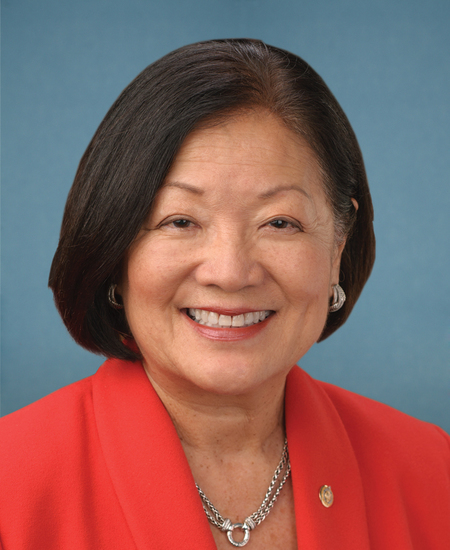
Photo of Mazie K. Hirono
D United States Senate · Hawaii

Sen. Mazie K. Hirono

Compare
Total votes
1,054
all sessions
Attendance
100%
of floor votes
Higher than 92% of chamber peers
With party
97%
of cast votes
Near the chamber average
Bipartisan score
2%
crosses aisle rarely
Near the chamber average
Sponsored
1,735
bills & resolutions
Higher than 82% of chamber peers
Committees
15
assignments
1,735 bills and resolutions

Sponsored bills

Total
1,735
Primary
192
Co-sponsor
1,543
This page
1,735
matching current filters
Co-sponsor S 366
In committee · United States Senate · Co-sponsor
Democracy in Design Act

Maddy summaryThe Democracy in Design Act requires the General Services Administration (GSA) to ensure all new federal public buildings adhere to the "Guiding Principles for Federal Architecture" established in a 1962 report. It mandates the GSA to create new design regulations within 180 days of enactment, setting minimum standards for federal building aesthetics and functionality. These regulations must be developed through a standard federal process, including public notice and comment periods. The bill directly affects the GSA's design decisions for government buildings nationwide.

In committee Feb 9, 2023 1 co-sponsor
Co-sponsor S 320
In committee · United States Senate · Co-sponsor
Stop the Wait Act of 2023

Maddy summaryThe Stop the Wait Act of 2023 shortens the waiting period for Social Security Disability Insurance (SSDI) benefits and improves Medicare access for people with disabilities. It phases out the current 5-month SSDI waiting period: reducing it to 3 months for applications filed in 2023-2025, 2 months for 2026, and 1 month for 2027, with full elimination by January 1, 2028. The bill also allows individuals under 65 who qualify for SSDI to receive Medicare coverage retroactively from their first month of SSDI eligibility, rather than waiting 24 months. This directly affects millions of SSDI applicants and beneficiaries who would otherwise face extended delays in accessing critical financial and health benefits.

In committee Feb 9, 2023 1 co-sponsor
Primary S 371
In committee · United States Senate · Lead sponsor
Coffee Plant Health Initiative Amendments Act of 2023

Maddy summaryThis bill updates the Coffee Plant Health Initiative to fund research grants focused on protecting coffee crops. It directs funding for developing pest-fighting tools, creating area-wide pest management programs, collecting coffee production data, and studying coffee plant biology and threats like pesticide effects. The legislation extends the funding authorization period through 2035. These provisions directly support coffee farmers, researchers, and growers in coffee-producing regions by advancing science-based solutions for plant health.

In committee Feb 9, 2023 0 co-sponsors
Co-sponsor S 357
In committee · United States Senate · Co-sponsor
No Tax Breaks for Outsourcing Act

Maddy summaryThe No Tax Breaks for Outsourcing Act modifies corporate tax rules to prevent companies from avoiding U.S. taxes on income generated through foreign operations. It requires country-by-country reporting of income for multinational corporations, closes loopholes related to "inverted corporations" (foreign companies acquiring U.S. firms to benefit from lower tax rates), and limits interest deductions for certain multinational financial reporting groups. The bill also treats foreign corporations managed and controlled in the U.S. as domestic for tax purposes. These changes primarily affect large multinational corporations with significant foreign operations, with provisions applying to taxable years beginning after December 31, 2022.

In committee Feb 9, 2023 1 co-sponsor
Co-sponsor S 342
In committee · United States Senate · Co-sponsor
Access to Counsel Act of 2023

Maddy summaryThis bill requires U.S. Customs and Border Protection to ensure certain immigrants a meaningful opportunity to consult with legal counsel during immigration inspections at ports of entry or during deferred inspections. It directly affects individuals like lawful permanent residents returning from travel, refugees, asylees, and others with valid visas or parole documents. Key provisions mandate that CBP provide this consultation within one hour of starting secondary inspection, allow counsel to present evidence, and accommodate in-person meetings when possible. A special rule prevents lawful permanent residents from abandoning their status without first receiving legal advice, unless they provide a written waiver.

In committee Feb 9, 2023 1 co-sponsor
Co-sponsor S 372
In committee · United States Senate · Co-sponsor
Macadamia Tree Health Initiative Amendments Act

Maddy summaryThis bill amends a 1990 agricultural law to establish a dedicated macadamia tree health initiative. It authorizes federal research grants for projects focused on combating pests and weeds affecting macadamia trees, including developing treatments, creating area-wide pest management programs, and studying tree biology and immune systems. The initiative also funds data collection on macadamia production and researches pesticide impacts on beneficial insects. This directly supports macadamia growers and researchers in affected regions (primarily Hawaii and California) through funding for fiscal years 2024-2035.

In committee Feb 9, 2023 1 co-sponsor
Co-sponsor S 340
In committee · United States Senate · Co-sponsor
Protecting Community Television Act

Maddy summaryThis bill amends the Communications Act to clarify that "franchise fees" paid by community television providers must be monetary (not in-kind). It specifically changes the definition in Section 622(g)(1) to require that fees be "other monetary assessment," preventing non-monetary payments. The change directly affects community television stations that pay these fees to local governments. It is a technical adjustment to fee requirements, not a new program or funding change.

In committee Feb 9, 2023 1 co-sponsor
Co-sponsor S 344
In committee · United States Senate · Co-sponsor
Major Richard Star Act

Maddy summaryThis bill allows veterans with combat-related disabilities and less than 20 years of service to receive both military retired pay and VA disability compensation simultaneously. Previously, such veterans had their retired pay reduced to avoid "concurrent receipt" of both benefits. The bill removes the 20-year service requirement for this group, applying specifically to those retired under Chapter 61 of Title 10 with a combat-related disability as defined in existing law. It does not change eligibility for veterans with non-combat disabilities or those with 20+ years of service.

In committee Feb 9, 2023 1 co-sponsor
Co-sponsor S 321
In committee · United States Senate · Co-sponsor
Strengthening Protections for Domestic Violence and Stalking Survivors Act of 2023

Maddy summaryThis bill expands legal protections for domestic violence and stalking survivors by broadening the definition of "intimate partner" to include current and former dating partners, ensuring more survivors qualify for federal protections. It creates a new federal definition for "misdemeanor crime of stalking," requiring that the offense involves repeated harassment causing reasonable fear for the victim or specific people they care about (like family, cohabiting partners, or pets). The law also adds a new firearm restriction: people convicted of such stalking offenses cannot possess firearms, with limited exceptions for expunged convictions. These changes directly affect survivors seeking legal protection and individuals convicted of stalking under federal or state law.

In committee Feb 9, 2023 1 co-sponsor
Primary S 323
In committee · United States Senate · Lead sponsor
SAFER Health Act of 2023

Maddy summaryThe SAFER Health Act of 2023 strengthens privacy protections for individuals' information related to pregnancy termination (including abortion) or pregnancy loss (such as miscarriage, stillbirth, or ectopic pregnancy). It prohibits healthcare providers, clinics, and related entities from disclosing this sensitive health information in any legal, administrative, or government proceeding without the individual’s explicit consent, except in two limited cases: for professional liability defense or when investigating physical harm to the individual who cannot consent. The bill also requires health IT systems to segregate this data and updates federal regulations to prevent "information blocking" when complying with these privacy rules. This law preempts conflicting state laws but allows states to adopt stronger privacy protections for this information.

In committee Feb 9, 2023 0 co-sponsors
Showing 1,171 to 1,180 of 1,735 bills