

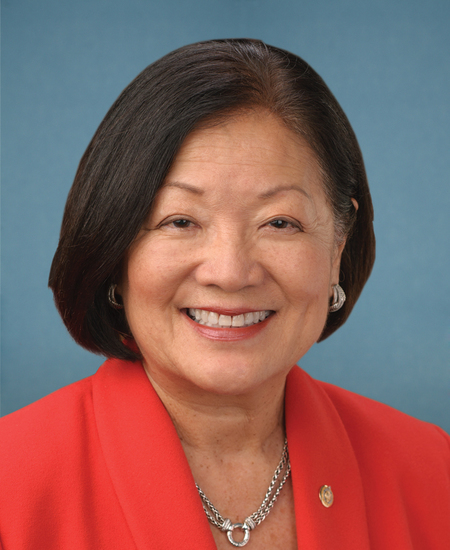
Photo of Mazie K. Hirono
D United States Senate · Hawaii

Sen. Mazie K. Hirono

Compare
Total votes
1,054
all sessions
Attendance
100%
of floor votes
Higher than 92% of chamber peers
With party
97%
of cast votes
Near the chamber average
Bipartisan score
2%
crosses aisle rarely
Near the chamber average
Sponsored
1,735
bills & resolutions
Higher than 82% of chamber peers
Committees
15
assignments
1,735 bills and resolutions

Sponsored bills

Total
1,735
Primary
192
Co-sponsor
1,543
This page
1,735
matching current filters
Co-sponsor S 1319
In committee · United States Senate · Co-sponsor
Preventing Illegal Weapons Trafficking Act of 2023

Maddy summaryThis bill requires federal agencies (Attorney General, Homeland Security, and Treasury) to create a strategy within 120 days to prevent trafficking of machinegun conversion devices - parts that can convert standard firearms into machineguns. The strategy must cover detecting and intercepting these devices at borders, coordinating with state/local law enforcement, tracing devices used in crimes, and addressing domestic production (including 3D printing). Agencies must report the strategy to Congress within 120 days and provide biennial updates. Additionally, the annual firearms trafficking report must include data on crimes involving these devices and whether they originated domestically or abroad.

In committee Apr 26, 2023 1 co-sponsor
Primary S 1301
In committee · United States Senate · Lead sponsor
Partner with Korea Act

Maddy summaryThis bill creates a new visa category allowing South Korean nationals to work in specialty occupations in the U.S. It directly affects South Korean workers in specialized fields and their U.S. employers seeking to hire them. Key provisions include adding a new visa type (E-4) for these workers, setting a yearly cap of 15,000 initial visas for principal applicants only (not including spouses or children), and requiring employer attestations to the Labor Department. The change modifies existing immigration law to establish this dedicated pathway for South Korean specialty workers.

In committee Apr 26, 2023 0 co-sponsors
Co-sponsor S 740
In committee · United States Senate · Co-sponsor
GUARD VA Benefits Act of 2023

Maddy summaryThis bill strengthens penalties for individuals or organizations charging veterans unauthorized fees when assisting with VA benefit claims. It directly affects veterans who might be targeted by unscrupulous representatives and the representatives themselves who attempt to charge such fees. The key provision adds a new subsection (b) to Section 5905, making it illegal to solicit, charge, or receive any fee for preparing or submitting VA claims - except as allowed under specific other sections. Violations can result in fines, up to one year in prison, or both.

In committee Apr 26, 2023 1 co-sponsor
Co-sponsor SRES 173
In committee · United States Senate · Co-sponsor
A resolution recognizing the duty of the Federal Government to create a Green New Deal.

Maddy summarySRES 173 is a non-binding Senate resolution recognizing the Federal Government's duty to develop a Green New Deal framework. It calls for a 10-year national mobilization to achieve climate and social goals, including 100% clean energy by 2030, job creation in clean industries, and infrastructure upgrades to address climate impacts. The resolution emphasizes protecting frontline and vulnerable communities - such as communities of color, low-income workers, and indigenous peoples - by requiring inclusive planning and ensuring no adverse effects from climate policies. While not a law, it sets policy direction for future legislation to achieve climate targets, economic equity, and environmental justice for all Americans.

In committee Apr 25, 2023 1 co-sponsor
Primary S 1265
In committee · United States Senate · Lead sponsor
Stop Judge Shopping Act

Maddy summaryThis bill shifts jurisdiction for certain nationwide legal challenges to the U.S. District Court for the District of Columbia. It requires any lawsuit seeking a nationwide injunction, stay, or similar court order against federal law enforcement to be filed exclusively in DC courts, rather than in other federal districts. This directly affects federal agencies (like the EPA or Department of Justice) defending regulations and plaintiffs challenging them with nationwide relief requests. The law does not change existing Supreme Court or appellate court jurisdiction, nor does it create new legal rights or alter liability under federal or state law.

In committee Apr 25, 2023 0 co-sponsors
Co-sponsor S 1266
In committee · United States Senate · Co-sponsor
Love Lives On Act of 2023

Maddy summaryThe Love Lives On Act of 2023 restores survivor benefits for veterans' spouses who remarried before age 55 and before the bill's enactment, which they previously lost due to remarriage. It removes an expiration date for the Marine Gunnery Sergeant John David Fry Scholarship for surviving spouses and expands access to military commissaries and exchanges for remarried surviving spouses. The bill also extends TRICARE coverage to include remarried widows or widowers whose subsequent marriage ended.

In committee Apr 25, 2023 1 co-sponsor
Primary S 1263
In committee · United States Senate · Lead sponsor
Filipino Veterans Family Reunification Act of 2023

Maddy summaryThis bill exempts certain family members of eligible Filipino veterans from U.S. immigration visa limits. It directly affects spouses, children, and other relatives of Filipino veterans who were naturalized under specific historical laws (the 1990 Immigration Act or the 1940 Act related to WWII service). The key provision amends the Immigration and Nationality Act to create a new exemption category, allowing these family members to qualify for visas without being subject to annual numerical caps. This changes the process by removing a specific barrier to family reunification for this group. The bill focuses on updating visa eligibility rules, not creating new benefits.

In committee Apr 25, 2023 0 co-sponsors
Co-sponsor S 1231
In committee · United States Senate · Co-sponsor
SAD Act

Maddy summaryS 1231 (SAD Act) prohibits crisis pregnancy centers (CPCs) from making deceptive claims about providing abortion services, contraception, or employing licensed medical staff. It directly affects CPCs that falsely represent themselves as reproductive health providers, which the bill states often target underserved communities. The law authorizes the Federal Trade Commission (FTC) to enforce this prohibition under existing consumer protection laws, imposing civil penalties of up to $100,000 or 50% of a CPC's revenue. The FTC must also submit biennial reports to Congress on enforcement actions. The bill aims to ensure patients receive accurate information about reproductive health services.

In committee Apr 20, 2023 1 co-sponsor
Co-sponsor S 1202
In committee · United States Senate · Co-sponsor
Keep Our PACT Act

Maddy summaryS 1202, the "Keep Our PACT Act," mandates increased annual federal funding for two key education programs. It requires specific minimum funding levels for Title I of the Elementary and Secondary Education Act (which supports schools in high-poverty areas) and the Individuals with Disabilities Education Act (IDEA, which funds specialized education for students with disabilities) from fiscal years 2024 through 2033. The bill sets annual dollar targets that increase each year, with IDEA funding eventually reaching 40% of national per-pupil spending for students with disabilities by 2033. These funds directly affect public schools serving low-income students and students with disabilities across all states. The bill does not change eligibility or program requirements but ensures specified funding levels are appropriated annually.

In committee Apr 19, 2023 1 co-sponsor
Co-sponsor S 1193
In committee · United States Senate · Co-sponsor
Latonya Reeves Freedom Act of 2023

Maddy summaryThe Latonya Reeves Freedom Act of 2023 establishes a federally protected right for individuals with disabilities who require long-term services and supports (LTSS) to live in community-based settings rather than institutions. The bill defines specific requirements for "community-based" settings, including housing options that allow individuals to live in their own homes or shared residences with privacy rights, choice, and control over their services. It requires states to develop transition plans with measurable goals to move people from institutional settings to community-based supports within 12 years, along with annual reporting on progress. The Department of Justice and Department of Health and Human Services will enforce the law through investigations, compliance reviews, and the ability to seek injunctive relief for violations.

In committee Apr 19, 2023 1 co-sponsor
Showing 1,091 to 1,100 of 1,735 bills