

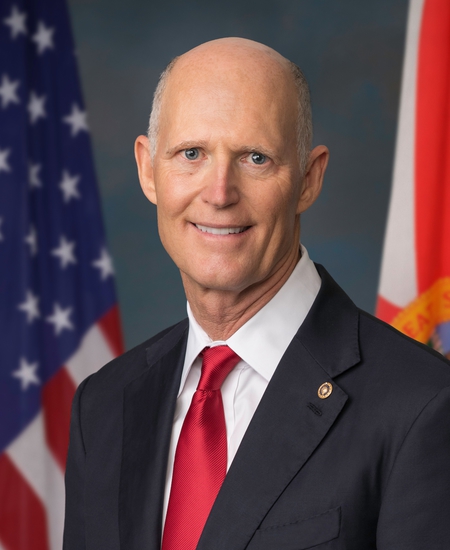
Photo of Rick Scott
R United States Senate · Florida

Sen. Rick Scott

Compare
Total votes
1,054
all sessions
Attendance
98%
23 missed
Higher than 92% of chamber peers
With party
91%
of cast votes
Lower than 86% of chamber peers
Bipartisan score
5%
crosses aisle rarely
Higher than 84% of chamber peers
Sponsored
1,816
bills & resolutions
Higher than 80% of chamber peers
Committees
13
assignments
1,816 bills and resolutions

Sponsored bills

Total
1,816
Primary
427
Co-sponsor
1,389
This page
1,816
matching current filters
Co-sponsor SRES 851
Passed · United States Senate · Co-sponsor
A resolution designating November 2, 2024, as "National Bison Day".

Maddy summarySRES 851 is a Senate resolution designating November 2, 2024, as National Bison Day. It encourages the American public to observe the day with ceremonies and activities to recognize bison's cultural, historical, and economic significance. The resolution highlights bison's role in Indigenous traditions, conservation efforts, and U.S. heritage, as detailed in its preamble. It does not create legal obligations but serves as a symbolic acknowledgment of bison's importance.

Passed Sep 24, 2024 1 co-sponsor
Primary S 5159
In committee · United States Senate · Lead sponsor
A bill to amend the Congressional Budget and Impoundment Control Act of 1974 to require any cost estimate for a bill or joint resolution prepared by the Congressional Budget Office to include the cost to each United States citizen for carrying out such measure, and for other purposes.

Maddy summaryThis bill requires the Congressional Budget Office (CBO) to include per-citizen cost estimates in its budget analyses. Specifically, it mandates that CBO estimates for any bill or resolution must show the pro rata cost to each U.S. citizen for changes in total federal spending and debt if the measure passes. The key mechanism adds a new requirement to CBO's reporting process, breaking down the financial impact of legislation on individual taxpayers. This change affects how budget scores are presented to Congress and the public, making cost impacts more transparent at the individual level.

In committee Sep 24, 2024 0 co-sponsors
Co-sponsor S 5161
In committee · United States Senate · Co-sponsor
Preventing Antisemitic Harassment on Campus Act of 2024

Maddy summaryThis bill amends federal anti-discrimination law to explicitly include antisemitism as a protected category under Title VI, requiring colleges and universities receiving federal funds to address antisemitic harassment. It defines antisemitism broadly to cover both verbal and physical acts targeting Jewish individuals or institutions, and clarifies that "deliberate indifference" to severe, pervasive harassment constitutes discrimination. Colleges found repeatedly violating these standards face escalating fines - 10% for a second violation within five years, and 33% for a third - applied to their federal funding. The law does not create new rights but strengthens enforcement of existing protections against antisemitism in campus environments.

In committee Sep 24, 2024 1 co-sponsor
Co-sponsor S 3558
In committee · United States Senate · Co-sponsor
Prohibiting Foreign Access to American Genetic Information Act of 2024

Maddy summaryThis bill prohibits U.S. government agencies from purchasing biotechnology equipment or services from specific foreign companies tied to national security threats. It bans contracts with entities like BGI, MGI, and Wuxi Apptec (and their affiliates) that pose risks through ties to foreign adversaries, particularly regarding genetic data collection. Exceptions cover intelligence activities, overseas health care for military personnel, and publicly available genetic data. The ban takes effect 60-180 days after implementing guidance is issued, with limited waivers allowed for national security or overseas health care needs.

In committee Sep 23, 2024 1 co-sponsor
Co-sponsor S 5110
In committee · United States Senate · Co-sponsor
Stopping Adversarial Tariff Evasion Act

Maddy summaryS 5110, the "Stopping Adversarial Tariff Evasion Act," clarifies how U.S. tariffs apply to goods made by entities tied to specific adversarial countries. It directly affects importers and manufacturers dealing with goods produced by entities owned, controlled, or operated by entities from China, Russia, Iran, North Korea, Cuba, Venezuela under Maduro, or Syria. The bill requires that any article made by such entities - defined as having 25%+ ownership by these countries through direct or indirect means (including joint ventures or financial arrangements) - be treated as originating from the adversarial country for tariff purposes. This applies to enforcement actions under trade agreements, injury determinations, and national security safeguards, closing loopholes that might allow tariff evasion through third-party manufacturing.

In committee Sep 19, 2024 1 co-sponsor
Co-sponsor S 5117
In committee · United States Senate · Co-sponsor
Frank Connor and Trooper Werner Foerster Justice Act

Maddy summaryThis bill requires the U.S. government to actively pursue the extradition of specific fugitives from the United States who are believed to be living in Cuba, including Joanne Chesimard (convicted of murdering a trooper) and William Morales (linked to bombings). It mandates an annual report from the Secretary of State to Congress detailing efforts to secure their return and determining if Cuba is fulfilling its extradition treaty obligations. The bill also prohibits using certain U.S. law enforcement funds for programs in Cuba until Cuba complies with these extradition requirements. The bill directly affects U.S. diplomatic and law enforcement efforts regarding Cuba and the return of fugitives facing U.S. criminal charges.

In committee Sep 19, 2024 1 co-sponsor
Primary S 5124
In committee · United States Senate · Lead sponsor
Protect our Presidents Act

Maddy summaryThis bill, S 5124 (Protect our Presidents Act), requires the U.S. Secret Service to provide presidential and vice-presidential candidates with security protection equivalent to that given to the sitting president. It specifically covers major party candidates who have accepted nominations at national conventions, their spouses, and the president-elect or vice president-elect. The Secret Service must report to congressional committees every 15 days during election years - detailing threat levels, security costs, personnel assigned, and any unmet security needs for each candidate. Candidates may decline the enhanced protection if they choose. The bill focuses on standardizing security protocols for candidates during elections, not on altering existing protections for current officeholders.

In committee Sep 19, 2024 0 co-sponsors
Primary S 5126
In committee · United States Senate · Lead sponsor
STOP MADURO Act

Maddy summaryThe STOP MADURO Act (S 5126) authorizes a $100 million reward for information leading to the arrest and conviction of Venezuela's President Nicolás Maduro Moros, directly affecting individuals who provide actionable intelligence. It specifies that this reward must be funded exclusively from assets already frozen under existing U.S. sanctions against Maduro and his regime, including those blocked under the Foreign Narcotics Kingpin Act and Venezuela-related executive orders. The bill does not impose new sanctions but repurposes funds from current asset freezes to incentivize cooperation. This provision targets informants who can aid U.S. law enforcement in pursuing Maduro, who faces prior criminal charges related to drug trafficking and narco-terrorism.

In committee Sep 19, 2024 0 co-sponsors
Co-sponsor S 5082
In committee · United States Senate · Co-sponsor
Regulations from the Executive in Need of Scrutiny Act of 2024

Maddy summaryThe Regulations from the Executive in Need of Scrutiny Act of 2024 would require federal agencies to submit detailed reports to Congress before implementing new regulations, including cost-benefit analyses, economic impact assessments, and information about how the public can access the supporting data. Major regulations (those with significant economic effects) would need congressional approval through a joint resolution within 70 legislative days, while nonmajor regulations would follow a simpler disapproval process. The bill would also require agencies to publish all guidance documents online and create a regulatory budget system to track regulatory costs. This would increase transparency in the regulatory process and give Congress more formal oversight over federal regulations. The bill would affect all federal agencies that issue regulations and would require them to comply with these new review procedures.

In committee Sep 18, 2024 1 co-sponsor
Co-sponsor SRES 823
Passed · United States Senate · Co-sponsor
A resolution recognizing Hispanic Heritage Month and celebrating the heritage and culture of Latinos in the United States and the immense contributions of Latinos to the United States.

Maddy summarySRES 823 is a symbolic Senate resolution recognizing Hispanic Heritage Month (September 15-October 15, 2024) and celebrating the cultural contributions and achievements of Latinos in the United States. It does not create new laws or affect specific groups; instead, it urges the public to observe the month through activities honoring Latino heritage. The resolution highlights Latinos' economic impact (e.g., $3.4 trillion purchasing power), demographic significance (19.5% of U.S. population), and historical military service, but these statistics serve as context, not policy changes. As a ceremonial resolution, it has no legal force and is intended to raise awareness, not alter government programs or funding.

Passed Sep 17, 2024 1 co-sponsor
Showing 641 to 650 of 1,816 bills
Previous 1 … 64 65 66 … 182 Next