

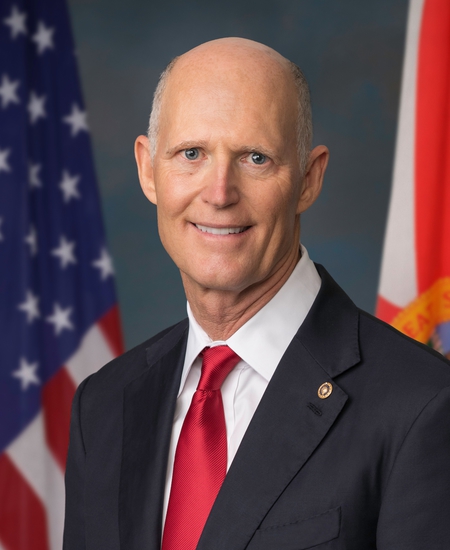
Photo of Rick Scott
R United States Senate · Florida

Sen. Rick Scott

Compare
Total votes
1,054
all sessions
Attendance
98%
23 missed
Higher than 92% of chamber peers
With party
91%
of cast votes
Lower than 86% of chamber peers
Bipartisan score
5%
crosses aisle rarely
Higher than 84% of chamber peers
Sponsored
1,816
bills & resolutions
Higher than 80% of chamber peers
Committees
13
assignments
1,816 bills and resolutions

Sponsored bills

Total
1,816
Primary
427
Co-sponsor
1,389
This page
1,816
matching current filters
Co-sponsor S 537
In committee · United States Senate · Co-sponsor
Protecting Access for Hunters and Anglers Act of 2025

Maddy summaryThis bill prohibits federal agencies (like the Fish and Wildlife Service and Forest Service) from banning lead ammunition or tackle on public lands and waters used for hunting or fishing, directly affecting hunters and anglers who use federal lands. It blocks new federal regulations on lead levels in hunting gear, except in limited cases where a specific area's wildlife decline is linked to lead use and the state wildlife agency approves the restriction. The law requires federal agencies to explain in notices how any exception meets state wildlife department requirements or state law. It does not change existing state laws or allow federal bans on lead where states already prohibit it.

In committee Feb 12, 2025 1 co-sponsor
Co-sponsor S 540
In committee · United States Senate · Co-sponsor
Ensuring Continuity in Veterans Health Act

Maddy summaryThis bill (S 540) is procedural and adds a new "Continuity of care" provision to the Veterans Community Care Program under Section 1703(d)(2) of Title 38, U.S. Code. It does not describe specific policy changes or mechanisms, as the bill text only specifies the addition of the new subsection without detailing its content. The bill directly affects veterans enrolled in the Community Care Program by requiring consideration of continuity of care, though the exact requirements are not defined in the provided text. As a procedural amendment, it serves as a framework for future implementation rather than enacting immediate changes. Without additional bill text explaining the new provision's requirements, no concrete policy details can be summarized.

In committee Feb 12, 2025 1 co-sponsor
Co-sponsor S 541
In committee · United States Senate · Co-sponsor
ELITE Vehicles Act

Maddy summaryThe ELITE Vehicles Act repeals three key tax credits for electric vehicles under the Internal Revenue Code: the clean vehicle credit (Section 30D), the credit for previously-owned clean vehicles (Section 25E), and the credit for qualified commercial clean vehicles (Section 45W). It also excludes electric vehicle recharging property from the alternative fuel vehicle refueling credit. These changes directly affect individuals and businesses purchasing new or used electric vehicles, as well as those installing EV charging infrastructure, by eliminating the associated tax benefits. The repeal applies to vehicles purchased or under binding contract after 30 days following the bill's enactment.

In committee Feb 12, 2025 1 co-sponsor
Primary S 548
In committee · United States Senate · Lead sponsor
Caribbean Border Counternarcotics Strategy Act

Maddy summaryThis bill (S 548) requires the U.S. federal government to develop a Caribbean Border Counternarcotics Strategy. The strategy must outline how agencies will prevent drugs from trafficking through the Caribbean into the U.S., define agency roles, identify needed resources, and avoid hindering legitimate trade. It specifically mandates a focus on reducing drug trafficking to and through Puerto Rico and the U.S. Virgin Islands, including addressing drug-related violence and evaluating assistance needs for local law enforcement. The bill amends existing drug control law to establish this requirement, directly affecting federal agencies like the Office of National Drug Control Policy and their coordination with Caribbean territories.

In committee Feb 12, 2025 0 co-sponsors
Co-sponsor S 554
In committee · United States Senate · Co-sponsor
United States-Israel Defense Partnership Act of 2025

Maddy summaryThis bill establishes a formal U.S.-Israel defense partnership focused on joint development of counter-unmanned systems technology, authorizing $150 million annually from 2026-2030 for a dedicated program. It directly affects U.S. and Israeli defense departments, contractors, and military personnel through collaborative research, joint training, and shared procurement of counter-drone systems. Additional provisions include extending existing anti-tunnel and counter-UAS cooperation with increased funding, creating a new emerging tech program for AI/cybersecurity collaboration, and establishing a U.S. Defense Innovation Unit office in Israel. The bill requires annual reports to Congress on program progress and mandates semiannual financial oversight for all joint activities.

In committee Feb 12, 2025 1 co-sponsor
Co-sponsor S 556
In committee · United States Senate · Co-sponsor
Enhanced Iran Sanctions Act of 2025

Maddy summaryThis bill imposes new sanctions on foreign entities (including banks, insurers, and logistics companies) that knowingly facilitate Iran's oil, gas, LNG, or petrochemical exports. It blocks U.S. property of sanctioned entities and bars targeted individuals from entering the U.S. via visa restrictions or revocation. Exceptions cover goods imports and certain international obligations, while the President may grant limited 180-day waivers for national security reasons, subject to congressional reporting. The law aims to disrupt Iran's energy revenue streams used for terrorism, weapons programs, and repression, with enforcement coordinated through a new interagency working group.

In committee Feb 12, 2025 1 co-sponsor
Co-sponsor S 511
In committee · United States Senate · Co-sponsor
Protecting Taxpayers’ Wallets Act of 2025

Maddy summaryS 511 requires federal labor organizations (like unions representing government employees) to pay quarterly fees for using agency resources and union time. Fees are calculated based on the agency's hourly pay rate for employees (including benefits) for union time, plus market rates for resources like office space, equipment, or parking. Non-payment triggers penalties: denial of union time after 90 days, termination of union allotments after 180 days, and loss of exclusive representation certification after 365 days. The bill aims to offset costs of federal resources used for union activities, with fees deposited into the Treasury general fund.

In committee Feb 11, 2025 1 co-sponsor
Co-sponsor S 515
In committee · United States Senate · Co-sponsor
A bill to repeal the Impoundment Control Act of 1974.

Maddy summaryS 515 would repeal the Impoundment Control Act of 1974, a federal law that restricted the president's ability to withhold funds Congress had appropriated. This bill directly affects the executive branch (the president) and Congress by removing requirements for the president to seek congressional approval before deferring or reducing spending on specific programs. The key mechanism is the complete removal of the legal framework established by the 1974 Act, which previously mandated that the president notify Congress and obtain its consent to withhold funds. This change would allow the president greater unilateral authority over budget execution without congressional approval for deferrals.

In committee Feb 11, 2025 1 co-sponsor
Co-sponsor S 522
In committee · United States Senate · Co-sponsor
Credit Union Board Modernization Act

Credit Union Board Modernization Act This bill revises the required frequency of meetings held by a credit union's board of directors. Specifically, new credit unions and credit unions with a low soundness rating must meet monthly. All other credit unions must hold at least six meetings annually, with at least one meeting held during each fiscal quarter. Currently, all credit union boards must meet at least once a month.

In committee Feb 11, 2025 1 co-sponsor
Primary SRES 62
In committee · United States Senate · Lead sponsor
An original resolution authorizing expenditures by the Special Committee on Aging.

Maddy summaryThis procedural resolution (SRES 62) authorizes the Senate's Special Committee on Aging to spend funds from the Senate's contingent account for its operations. It sets specific budget limits: $2.06 million for March 2025-September 2025, $3.53 million for October 2025-September 2026, and $1.47 million for October 2026-February 2027. The funds cover committee personnel, consultant services (capped at $1,500), and staff training, with most expenses paid directly from the Senate's contingent fund. The resolution does not create new policies but enables the committee's administrative budgeting.

In committee Feb 6, 2025 0 co-sponsors
Showing 511 to 520 of 1,816 bills
Previous 1 … 51 52 53 … 182 Next