

Maddy summaryThis bill establishes federal minimum standards for collective bargaining rights for public employees and supervisors. It directs the Federal Labor Relations Authority (FLRA) to determine if state laws "substantially provide" for specific rights including the right to form unions, bargain collectively, and have interest impasse resolution mechanisms. If a state law doesn't meet these standards, the FLRA would administer collective bargaining for affected employees. The bill also prohibits strikes or lockouts that would disrupt emergency services and preserves existing collective bargaining agreements in place before the bill's enactment. It does not preempt state laws that already meet these minimum standards.
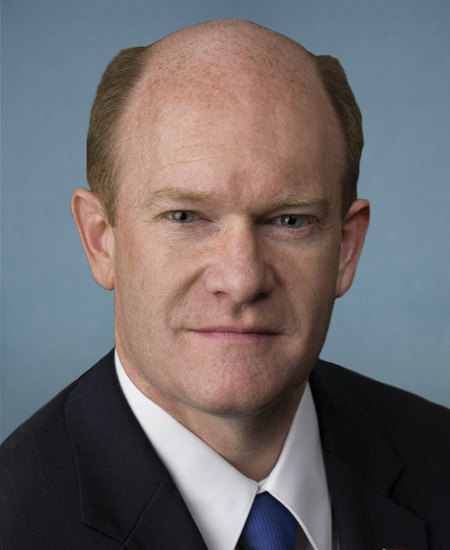
Sen. Christopher A. Coons
Sponsored bills
Maddy summaryThis bill prohibits forced arbitration for age discrimination claims involving people aged 40 or older. It amends federal law to make any pre-dispute arbitration agreement or joint-action waiver unenforceable in cases alleging age discrimination under federal, tribal, or state law. The law directly affects older workers who face age discrimination at work, ensuring they can pursue claims in court rather than being forced into private arbitration. Key provisions require courts - not arbitrators - to decide if the law applies to a dispute, and it applies to all claims arising after the bill's enactment.
Maddy summaryThis resolution (SRES 692) designates May 7, 2024, as National Fentanyl Awareness Day to raise public attention about the dangers of counterfeit fentanyl pills. It highlights alarming statistics, including that illicit fentanyl was involved in 81% of drug-induced deaths among youth aged 14-23 in 2023 and that only 36% of teens were aware of fentanyl in fake pills. The resolution does not create new laws or funding but urges increased awareness and supports law enforcement efforts against counterfeit pills. It directly aims to educate families and young people about the risks of fake pills marketed as legitimate medications.
Maddy summarySRES 693 is a Senate resolution recognizing May as Asian American, Native Hawaiian, and Pacific Islander Heritage Month, celebrating the historical contributions of these communities to U.S. history. The resolution does not create new laws or funding but serves as a symbolic acknowledgment of their achievements, growth (including demographic data and key anniversaries like the 50th anniversary of *Lau v. Nichols*), and ongoing challenges like anti-Asian hate crimes. It directly honors these communities and aims to raise awareness of their diverse impacts on American society.
Maddy summaryThis bill bans the distribution of AI-generated audio or video that falsely appears to show a federal candidate speaking or acting in a way they did not, before elections. It directly affects candidates, political committees, and entities distributing election-related content by prohibiting deceptive AI media intended to influence votes or solicit funds. Exceptions include news organizations that clearly disclose the deception during broadcasts and satirical content. The law also allows candidates to sue for damages if their likeness is misused, treating violations as defamation per se.
Maddy summaryS 4333, "Domenic and Ed's Law," updates the Higher Education Act to expand loan forgiveness for parent borrowers. It adds two specific situations where parent borrowers can have their federal student loans forgiven: if the student borrower becomes permanently disabled (meeting strict medical criteria for at least 60 months) or dies. This applies to all outstanding parent loans, regardless of when the loan was taken out or when the disability or death occurred. The bill directly affects parents who borrowed for their children's education, making forgiveness easier under these defined circumstances. It does not create new programs but adjusts existing rules for loan discharge.
Maddy summaryS 2150, the Unity through Service Act of 2023, establishes a federal Interagency Council on Service to coordinate military, national, and public service programs across government agencies. The Council, composed of cabinet-level officials and agency directors, advises the President on recruitment strategies, develops joint marketing initiatives, and submits biennial reports on service trends and opportunities. Key provisions require agencies to share recruitment data, improve transition assistance for military members moving to national service roles, and create joint advertising campaigns for military and civilian service programs. The bill directly affects federal agencies administering service programs (like the Peace Corps, Defense Department, and Corporation for National and Community Service) and aims to streamline pathways for individuals seeking military, national, or public service careers.
Maddy summaryThis bill amends the Atomic Energy Act to streamline nuclear licensing processes. It allows the Nuclear Regulatory Commission (NRC) to issue construction permits, operating licenses, or routine amendments *without* a hearing if it provides 30 days' notice in the Federal Register, unless someone affected requests a hearing. The key change replaces mandatory hearings for routine applications with a simplified notice-and-comment process, while keeping hearings available for those who request them. This directly affects nuclear facility developers (like power plant companies) and communities that might have sought hearings under previous rules. The NRC can now skip hearings for non-controversial cases, speeding up approvals for nuclear projects.
Maddy summarySRES 505 is a Senate resolution condemning Hamas for allegedly using sexual violence and rape as a weapon of war during its October 7, 2023, attacks on Israel. It cites evidence gathered by Israeli authorities, including reports from over 1,500 victims and witnesses, and references the Fourth Geneva Convention which classifies rape in conflict as a war crime. The resolution calls on the international community to prioritize eliminating gender-based violence in conflicts, respond promptly to reports of such violence, and demand accountability for perpetrators. It directly honors victims of the attacks and stands with survivors and families affected by these alleged atrocities.
Maddy summaryThis bill imposes sanctions on foreign entities that knowingly facilitate Iranian petroleum trade. It targets foreign port owners, vessel operators, refineries, and related individuals (including family members or entities owned by them) involved in transactions with Iranian oil, such as docking vessels carrying Iranian crude or conducting sea-to-sea transfers of petroleum products. Sanctions include banning sanctioned vessels from U.S. ports for up to two years, blocking U.S. assets of targeted entities, and denying visas to involved individuals. The bill also requires a detailed report on Iranian petroleum exports within 120 days, analyzing export volumes, revenue, and key participants.