

Maddy summarySRES 220 is a Senate resolution recognizing the 30th anniversary of the Department of Defense State Partnership Program. The resolution acknowledges the program's 30-year history of building security partnerships with 100 nations and expresses gratitude to National Guard members for their service in fostering these international relationships. It does not create new policy but formally honors the program's role in strengthening global security cooperation.
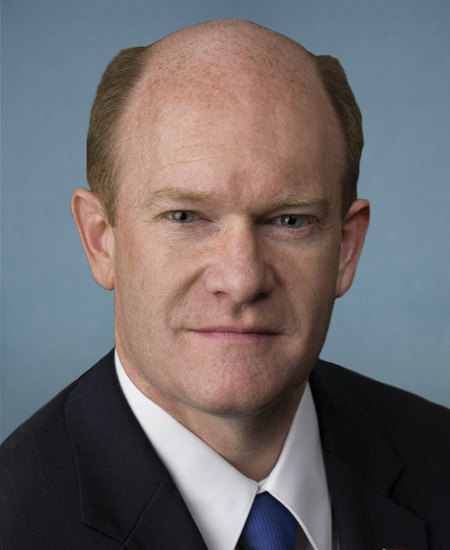
Sen. Christopher A. Coons
Sponsored bills
Maddy summaryThe Democracy Restoration Act of 2023 (S 1677) would restore voting rights for most U.S. citizens with criminal convictions who are not serving a felony sentence in prison. It requires states to notify individuals when they regain voting rights, with specific timelines for notification after sentencing or release from custody. The bill prohibits states from requiring payment of fines or fees to restore voting rights, affecting over 4.6 million disenfranchised citizens. It applies only to federal elections and would take effect for elections held after enactment.
American Infrastructure Bonds Act of 2023 This bill allows the issuer of an American infrastructure bond a tax credit for 28% of the interest payable under such bond.
Stop Tax Penalties on American Hostages Act This bill postpones certain tax filing deadlines for U.S. nationals and their spouses who are unlawfully or wrongfully detained abroad or held hostage abroad. It also allows for reimbursement and abatement of penalties and fines paid by detained individuals.
Maddy summaryThis resolution designates the week of May 14-20, 2023, as "National Police Week" to honor law enforcement officers who have died in the line of duty. It recognizes 444 officers killed in 2022 (including specific names listed in the resolution) and acknowledges 32 officers killed in 2023, while expressing support for law enforcement personnel. The resolution encourages the public to observe this week by honoring law enforcement officers and promoting awareness of their essential service. As a ceremonial resolution, it does not create new policy or alter existing laws.
Maddy summaryS.1667, the America’s CHILDREN Act of 2023, creates a pathway to permanent residency for certain college graduates who entered the U.S. as children under specific visa categories. It directly affects noncitizens who: (1) were lawfully present as dependent children of nonimmigrant workers (excluding H-1B, L-1, etc.) for at least 8 years, (2) maintained lawful presence for 10+ years total, and (3) graduated from a U.S. college or university. Key provisions include age-out protections for dependents who turn 21 while waiting for visas and retention of priority dates for visa processing. The bill modifies immigration law to allow eligible individuals to file for permanent residency without numerical limits, using the date a petition was filed as the basis for age determination. This applies to those whose parents held employment-based nonimmigrant status (e.g., E-1, E-2, O-1), not tourist or student visas.
Maddy summaryThis bill requires the Department of Veterans Affairs (VA) to improve how it processes disability claims for veterans with service-connected post-traumatic stress disorder (PTSD). It mandates that VA update and standardize annual training for claims processors on stressor development and verification, starting 180 days after enactment. The VA must also establish annual processes to analyze processing errors, conduct studies on PTSD claims trends, and update procedural guidance to better support claims processing. These changes directly affect VA claims processors and veterans seeking PTSD disability compensation.
Maddy summaryThe CREST Act of 2023 establishes federal research, development, and pilot programs to advance carbon removal technologies that capture and store carbon dioxide from the atmosphere or oceans. It creates specific programs for biomass carbon removal (including algal systems), geological carbon mineralization, ocean-based carbon removal, and direct air capture technology manufacturing, with funding totaling millions of dollars annually for these initiatives. The bill also establishes a carbon removal purchasing pilot program where the Department of Energy would buy carbon removal services from eligible companies at set prices, requiring measurement, reporting, and verification of carbon removal activities. The legislation defines key terms related to carbon removal and sets requirements for the technologies and approaches that qualify for federal support.
Maddy summaryS 1552, the Coastal Fellowships Act, establishes two fellowship programs - the Coastal Management Fellowship and Digital Coast Fellowship - to provide training, mentorship, and professional development for individuals pursuing careers in coastal management, policy, science, or law. Qualified fellows receive annual stipends of at least $47,000 (adjusted for inflation) for up to two years, with funding covering travel, health insurance, and professional development. The program directly supports coastal states and partner organizations by building local workforce capacity to address coastal vulnerabilities, while offering direct federal hiring opportunities to successful fellows. It authorizes $1.91 million annually for fiscal years 2024-2028 to administer these fellowships.
Maddy summaryThis bill extends monthly dependency and indemnity compensation payments to surviving spouses of veterans who die from amyotrophic lateral sclerosis (ALS), a progressive neurological disease. It changes the eligibility rule so that veterans diagnosed with ALS at any point before death - regardless of how long they had the disease - are treated as if they met the required duration for benefits. The change applies to veterans who died from ALS on or after October 1, 2022, ensuring surviving spouses receive benefits they previously might have been denied due to timing. This directly affects the families of veterans with ALS who pass away, streamlining access to financial support.