

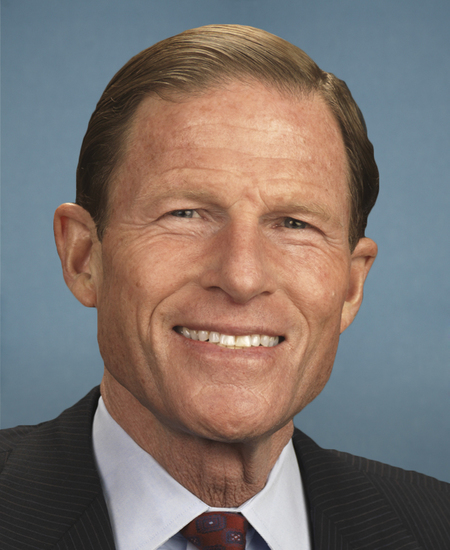
Photo of Richard Blumenthal
D United States Senate · Connecticut

Sen. Richard Blumenthal

Compare
Total votes
1,054
all sessions
Attendance
100%
1 missed
Higher than 82% of chamber peers
With party
97%
of cast votes
Near the chamber average
Bipartisan score
2%
crosses aisle rarely
Near the chamber average
Sponsored
2,861
bills & resolutions
Higher than 99% of chamber peers
Committees
14
assignments
2,861 bills and resolutions

Sponsored bills

Total
2,861
Primary
330
Co-sponsor
2,531
This page
2,861
matching current filters
Primary S 1863
In committee · United States Senate · Lead sponsor
VALOR Act of 2025

Maddy summaryThe VALOR Act of 2025 modifies the Public Service Loan Forgiveness (PSLF) program to better support military service members and veterans with federal student loans. It directly affects borrowers who served in covered active duty, including National Guard members and the NOAA commissioned corps, during their loan repayment period. Key provisions count deferred or forbearance payments made while serving as qualifying payments, waive the standard 10-year full-time public service requirement if the borrower completed 10 years of active duty during the loan term, and allow borrowers to receive forgiveness regardless of when they enrolled in PSLF.

In committee May 22, 2025 0 co-sponsors
Co-sponsor S 1881
In committee · United States Senate · Co-sponsor
Public Service Worker Protection Act

Maddy summaryThis bill expands workplace safety protections under the Occupational Safety and Health Act to cover public employees, including those working for federal, state, or local government agencies. It amends the law to explicitly include "the United States, a State, or a political subdivision of a State" in the definition of covered workers, removing previous exclusions. The key provision requires all public workplaces to follow OSHA safety standards, with a 36-month transition period for states or localities without their own OSHA-approved plans. This directly affects government workers like teachers, police, and sanitation staff who were previously excluded from federal OSHA coverage.

In committee May 22, 2025 1 co-sponsor
Primary S 1856
In committee · United States Senate · Lead sponsor
A bill to amend the Internal Revenue Code of 1986 to exclude military bonuses from gross income.

Maddy summaryThis bill (S 1856) would amend the tax code to exclude certain military bonuses from being counted as taxable income. Specifically, it changes Internal Revenue Code Section 134 to remove bonuses paid to active-duty service members under Chapter 5 of Title 37, U.S. Code, from gross income calculations. The change would apply to tax returns filed for 2025 and later tax years. It directly affects service members receiving these specific bonuses by potentially reducing their federal tax burden.

In committee May 22, 2025 0 co-sponsors
Primary S 1859
In committee · United States Senate · Lead sponsor
Ready Reserve Act of 2025

Maddy summaryThis bill amends military retirement rules for members of the Ready Reserve. It changes the effective date used to calculate early retirement eligibility from January 28, 2008, to September 11, 2001, affecting eligible service members seeking early retirement benefits. The change simplifies the eligibility calculation by aligning it with a historically significant date.

In committee May 22, 2025 0 co-sponsors
Co-sponsor S 1910
In committee · United States Senate · Co-sponsor
Real Education and Access for Healthy Youth Act of 2025

Maddy summaryThis bill would establish federal grants to support comprehensive sex education and sexual health services for young people ages 10-29, with specific emphasis on making these programs evidence-informed, medically accurate, culturally responsive, trauma-informed, and inclusive of diverse identities. The bill authorizes $100 million annually for five years to fund programs in schools, colleges, and youth organizations that provide age-appropriate education on topics like anatomy, contraception, consent, healthy relationships, and STI prevention. It specifically requires programs to address racial and gender equity, serve underserved youth (including Black, Indigenous, Latine, LGBTQ+, and low-income youth), and avoid harmful practices like abstinence-only education. The bill repeals the "abstinence-only-until-marriage" program and redirects those funds to support the new comprehensive approach, requiring grantees to report on program impact including how many young people were served and how programs address racial and gender equity.

In committee May 22, 2025 1 co-sponsor
Primary S 1857
In committee · United States Senate · Lead sponsor
A bill to amend title 14, United States Code, to require the retention of certain enlisted members of the Coast Guard who have completed 18 or more, but less than 20, years of service, and for other purposes.

Maddy summaryThis bill requires the Coast Guard to retain enlisted members who have completed 18 but less than 20 years of service and are facing separation or expiration of their enlistment. It applies to both regular Coast Guard members and Reserve members serving in active status. The key provision mandates that these members must remain on active duty until they qualify for retirement (reaching 20 years), with specific time limits based on their exact service length (e.g., 2-3 years depending on whether they have 18-19 or 19-20 years). This policy directly affects eligible Coast Guard enlisted personnel who would otherwise separate before becoming retirement-eligible.

In committee May 22, 2025 0 co-sponsors
Co-sponsor S 1915
In committee · United States Senate · Co-sponsor
Remove the Stain Act

Maddy summaryS 1915, the "Remove the Stain Act," rescinds 20 Medals of Honor awarded to U.S. Army soldiers for their role in the 1890 Wounded Knee Massacre, where unarmed Lakota men, women, and children were killed. The bill requires removing these soldiers' names from official military Medal of Honor rolls but does not require them to return their medals or deny them federal benefits. This action follows historical findings that the massacre involved the killing of hundreds of unarmed Native Americans, including women and children, and was described by military leaders as "brutal" and "cold-blooded." The bill directly affects the historical record of the Medal of Honor, aligning with requests from the Cheyenne River Sioux Tribe and the National Congress of American Indians.

In committee May 22, 2025 1 co-sponsor
Co-sponsor S 1914
In committee · United States Senate · Co-sponsor
Andrew Kearse Accountability for Denial of Medical Care Act of 2025

Maddy summaryThis bill requires federal law enforcement officers, Bureau of Prisons staff, and U.S. Marshals to immediately obtain or provide medical care when someone in federal custody shows medical distress (like breathing difficulties). It makes it a federal offense for covered officials to negligently fail to act, punishable by fines, up to one year in prison, or both. The bill mandates Inspector General investigations into such failures that cause harm and establishes confidential complaint processes. It also requires agencies to train covered officials on responding to medical distress in custody. The law directly affects individuals in federal custody and the specific federal officials responsible for their care.

In committee May 22, 2025 1 co-sponsor
Co-sponsor S 1887
In committee · United States Senate · Co-sponsor
Vote at Home Act of 2025

Maddy summaryThe Vote at Home Act of 2025 would require all states to mail ballots to registered voters at least two weeks before federal elections, making voting by mail the default option for all eligible voters. It eliminates unnecessary barriers like notary requirements and excuse documentation for mail-in voting while ensuring ballots are accessible for people with disabilities. The bill also mandates free postage for election mail and expands automatic voter registration through motor vehicle departments. These changes would directly affect all voters participating in federal elections across the United States, aiming to increase accessibility and participation.

In committee May 22, 2025 1 co-sponsor
Co-sponsor S 1918
In committee · United States Senate · Co-sponsor
Access Technology Affordability Act of 2025

Maddy summaryS 1918, the Access Technology Affordability Act of 2025, creates a new federal tax credit for expenses related to access technology for blind individuals. It allows taxpayers to claim a credit of up to $2,000 per 3-year period for qualified hardware, software, or IT tools that convert visual information into accessible formats for themselves, their spouse, or a blind dependent. The credit amount adjusts annually for inflation starting in 2026 and expires after 2030. This policy directly affects taxpayers who pay for such technology for blind family members, reducing their tax liability for these qualifying expenses.

In committee May 22, 2025 1 co-sponsor
Showing 681 to 690 of 2,861 bills
Previous 1 … 68 69 70 … 287 Next