

Maddy summaryS 3874, the Prohibiting Political Prosecutions Act of 2026, prohibits federal prosecutors and law enforcement from considering a person’s political views, associations, or activities when deciding whether to bring charges or investigations. It requires prosecutors to attest in legal filings that political beliefs weren’t a factor, mandates disclosure of exculpatory evidence to grand juries, and allows defendants to seek dismissal if political bias is suspected. The bill also bans White House interference in individual prosecution decisions and requires DOJ staff to report political bias allegations to oversight offices. It directly affects federal prosecutors, FBI agents, and White House staff involved in criminal investigations or prosecutions.
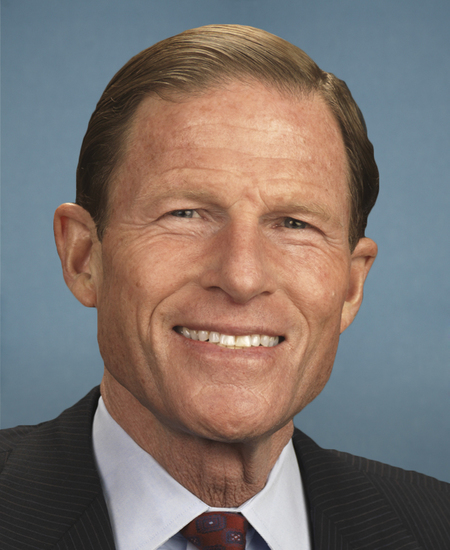
Sen. Richard Blumenthal
Sponsored bills
Maddy summaryThis bill requires the Federal Trade Commission (FTC) to study firearm advertising and marketing for unfair or deceptive practices, such as ads targeting people under 18, implying illegal use, or promoting semiautomatic assault weapons. Within two years, the FTC must report findings to Congress and then create regulations to ban these practices within 18 months of the report. These regulations would apply to firearm manufacturers, dealers, and importers, prohibiting specific deceptive marketing tactics. Violations would be enforced under existing FTC authority, with penalties matching current unfair business practice violations.
Maddy summaryThis bill amends highway safety programs to better protect people near disabled vehicles and in work zones. It expands safety measures to include "occupants of and pedestrians associated with disabled vehicles" in existing programs and requires better data collection on roadside and work zone deaths. The bill creates two working groups - one focused on disabled vehicle crashes and another on work zone crashes - to analyze data, develop safety solutions, and improve data sharing with the National Highway Traffic Safety Administration. It also mandates annual reports tracking how states use work zone safety funds and their effectiveness. The bill directly affects drivers, pedestrians near breakdowns, road construction workers, and state transportation agencies responsible for implementing these safety measures.
Maddy summaryJaime's Law (S 3873) amends federal law to regulate the transfer of ammunition between private individuals, directly affecting people who want to give or receive ammunition without going through a licensed dealer. It requires licensed dealers to handle all private ammunition transfers - meaning a licensed dealer must first take possession of the ammunition before it can be given to an unlicensed person - unless specific exceptions apply. Key exceptions include transfers between family members (spouses, parents/children, etc.), law enforcement acting in their duties, temporary transfers for safety reasons (like preventing domestic violence), or transfers at shooting ranges. The bill does not expand background checks but changes how ammunition transfers are processed, and it explicitly prohibits creating a national ammunition registry.
Maddy summaryThis bill would add wigs (classified as cranial prostheses) to Medicare's coverage of durable medical equipment. It requires a dermatologist, oncologist, or treating physician to certify in writing that a wig is medically necessary due to hair loss caused by conditions like cancer, chemotherapy, or autoimmune diseases. Beneficiaries would need this certification to receive coverage for wigs under Medicare Part B. The change directly affects Medicare beneficiaries experiencing hair loss from these specific medical conditions.
Maddy summaryThis bill establishes minimum nurse staffing requirements for nursing homes participating in Medicare and Medicaid. It requires facilities to provide 24-hour registered nurse coverage (transitioning from 8-hour daily coverage within 180 days of enactment) and maintain a minimum of 3.48 hours of nursing care per resident daily. The bill mandates a study every four years to review staffing standards based on resident needs and safety data, with findings informing future regulations. Additionally, it directs states to use a portion of collected civil penalties to fund workforce programs like student loan repayment and career pathway development for nursing home staff.
Maddy summary# Summary of Workplace Discrimination and Harassment Legislation This comprehensive bill expands protections against workplace discrimination and harassment while strengthening enforcement mechanisms for workers. Key provisions include: 1. **Expanded Protections (Section 301)**: - Extends anti-discrimination protections to independent contractors, interns, fellows, volunteers, and trainees under major civil rights laws - Creates "covered establishment" definition for entities engaging these workers 2. **Nondisclosure/Nondisparagement Clause Ban (Section 302)**: - Prohibits employers from requiring workers to sign nondisclosure or nondisparagement clauses covering harassment or discrimination - Establishes strict requirements for settlement agreements (including 21-day consideration period, 7-day revocation period, and clear written disclosure) - Protects workers' right to report harassment to the EEOC without penalty 3. **Arbitration Restrictions (Section 303)**: - Bans mandatory pre-dispute arbitration agreements that prevent class or collective actions - Establishes new requirements for post-dispute arbitration agreements - Allows workers to sue employers who violate these provisions 4. **Federal Contractor Compliance (Section 304)**: - Requires federal contractors to disclose past violations of labor and civil rights laws - Establishes Labor Compliance Advisors at executive agencies - Creates a system for monitoring contractor compliance with labor laws 5. **Grant Programs (Sections 401-436)**: - Creates national grants to prevent and address employment discrimination - Establishes grants for legal assistance for low-income workers facing discrimination - Creates a system of state advocacy for workers' rights through state-level systems The bill aims to strengthen worker protections against discrimination and harassment while expanding access to legal remedies and creating new mechanisms for enforcement and prevention. It also includes provisions to ensure federal contractors comply with labor and civil rights laws and establishes new reporting requirements for contractors with past violations.
Maddy summaryThe FUTURES Act (S 3855) establishes a formal U.S.-Israel Defense Technology Cooperation Initiative to accelerate joint development and integration of defense technologies. It directs the U.S. Secretary of Defense to identify Israeli-origin technologies for rapid adoption into American military systems, focusing on areas like counter-drone systems, missile defense, AI, cyber security, and directed energy. The bill authorizes $150 million annually (2027-2029) for this initiative, requiring regular reports to Congress on progress, technology transitions, and industry partnerships. This policy directly affects U.S. defense contractors, Israeli defense firms, and military acquisition programs by creating new pathways to incorporate Israeli innovations into U.S. systems.
Maddy summarySRES 605 is a Senate resolution formally rejecting former President Donald Trump's public statements suggesting he could "nationalize" or "commandeer" federal elections. It states that the Constitution grants primary authority over elections to state and local officials (per Article I, Section 4), not the president, and declares any attempt to override this would be unconstitutional. The resolution explicitly rejects the idea that the president has lawful power to take direct control of elections and warns such actions would undermine federalism and the rule of law. As a symbolic measure, it does not create new law but affirms the Senate's position on constitutional boundaries.
Maddy summaryThis bill updates financial disclosure reporting thresholds for federal employees under Title 5, U.S. Code. It revises the dollar amounts requiring disclosure for certain financial interests (like dividends, rents, interest, and capital gains) by adding new higher-value brackets, ranging from $5 million to $1 billion. The bill also modifies asset value reporting categories, introducing new tiers from $50 million up to $1 billion. These changes apply to financial disclosure reports filed on or after the bill's enactment date. The bill directly affects federal employees required to submit financial disclosure reports under Chapter 131 of Title 5.