This joint resolution proposes a constitutional amendment prohibiting the United States or any state from denying or abridging equal rights under the law on account of sex.
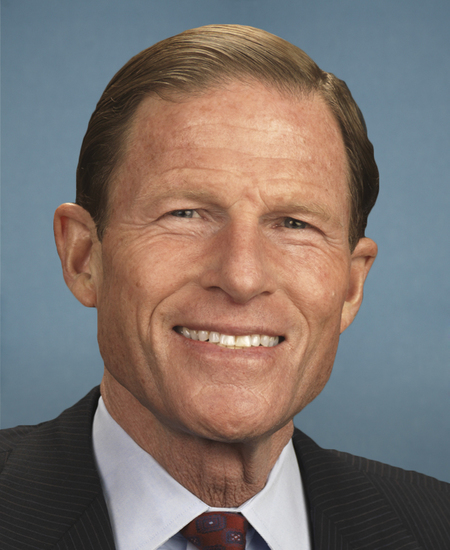
Sen. Richard Blumenthal
Sponsored bills
Maddy summarySRES 411 designates October 6, 2021, as "Energy Efficiency Day" to celebrate the economic and environmental benefits of energy efficiency policies and private sector innovation. The resolution calls on the American public to observe the day with programs and activities highlighting how these efforts have saved consumers billions annually in energy costs and reduced energy waste. It references decades of bipartisan support for energy efficiency, including federal policies that have driven significant energy savings and job growth in the sector. The bill does not create new regulations but serves as a symbolic recognition of existing achievements in energy conservation.
Maddy summaryThis resolution designates October 8, 2021, as "National Hydrogen and Fuel Cell Day" to recognize the importance of hydrogen and fuel cell technologies. It does not create new laws, regulations, or funding, serving solely as a symbolic observance. The bill references hydrogen's role in energy, transportation, and space programs but contains no concrete policy changes. It directly affects no individuals or entities, as it is purely a ceremonial designation by the Senate.
Fair Adjudications for Immigrants Act This bill narrows the scope of certain crime-based grounds for barring or removing an alien from the United States. (Generally, a conviction for certain crimes, such as a crime that carries a term of incarceration of a certain length, may constitute grounds for denying an individual certain immigration benefits.) The bill redefines the term conviction to exclude convictions that have been dismissed, expunged, deferred, annulled, invalidated, withheld, vacated, or pardoned. The term must also exclude adjudications where a court issued a recommendation against removal, an order of probation without entry of judgment, or a similar disposition. In addition, any reference to a term of imprisonment or sentence must, unless otherwise provided (1) only consider the period of incarceration ordered by a court, and (2) exclude any suspended portion of a sentence. Currently, for immigration purposes, a term of incarceration includes any part of the sentence that was suspended. These provisions pertaining to the definition of conviction and terms of imprisonment shall apply to convictions and judgments entered either before or after this bill's enactment. Furthermore, certain crime-based grounds for barring or removing an alien shall not apply if the sentencing court issues a recommendation that the alien not be removed on the basis of the conviction.
Global Malnutrition Prevention and Treatment Act of 2021 This bill sets out programs and otherwise directs the U.S. Agency for International Development (USAID) to carry out activities to prevent and treat malnutrition globally. In coordination with relevant federal agencies, bilateral and multilateral donors, partner countries, and other stakeholders, the USAID may scale up programs for preventing and treating malnutrition globally. This includes focusing on interventions for the populations most susceptible to severe malnutrition (e.g., pregnant and lactating women and children younger than five years of age). The USAID must select countries based on specified malnutrition-related indicators for purposes of targeting malnutrition prevention and treatment programs and update the selection within five years. To support these programs, the USAID must leverage additional private sector resources in priority countries, including by considering opportunities within the Development Finance Corporation's impact framework for supporting improved nutrition outcomes. The USAID must provide Congress with an implementation plan and annual reports concerning its programs for preventing and treating malnutrition. The bill also establishes the Nutrition Leadership Council, comprised of various USAID bureaus and offices, to coordinate agency activities to prevent and treat malnutrition. The bill's provisions terminate seven years after its enactment.
Homes for Every Local Protector, Educator, and Responder Act of 2021 or the HELPER Act of 2021 This bill establishes a program administered by the Department of Housing and Urban Development to provide mortgage assistance to law enforcement officers, elementary and secondary school teachers, firefighters, or other first responders. Specifically, these individuals may be eligible for a one-time mortgage on a primary family residence with no down payment and no monthly mortgage insurance premium.
Preventing Opportunities for Teen E-Cigarette and Tobacco Addiction Act or the PROTECT Act This bill requires the Centers for Disease Control and Prevention (CDC) to develop a strategy and carry out a specific initiative to prevent and reduce the use of electronic cigarettes and emerging tobacco products among youth and young adults. As part of the initiative, the CDC must conduct research and surveillance on types of products, patterns of use, health impacts, and other aspects of the use of such products by youth and young adults; evaluate prevention and intervention strategies and develop guidance for intervening and treating youth and young adults who use such products; identify effective messaging and communication efforts and implement a national public education campaign concerning the use of such products; and continue to fund grants for tobacco control programs in health departments, including efforts to prevent and reduce the use of such products by youth and young adults.
American Energy Worker Opportunity Act of 2021 This bill establishes the Office of American Energy Workers in the Department of the Treasury to provide displaced coal workers with wage replacement, health care premiums, retirement savings contributions, and educational assistance. The bill also provides educational assistance for the children of displaced coal workers and provides an incentive for clean energy employers to hire displaced coal workers.
Child Suicide Prevention and Lethal Means Safety Act This bill requires the Department of Health and Human Services (HHS) to establish grant programs and set up a website to reduce suicide rates among youth and young adults (those under age 26), including by addressing the use of firearms in suicides and suicide attempts. Specifically, HHS must award grants to states, Indian tribes, health departments, hospitals, or other organizations to train health care providers on lethal means safety (e.g., safe storage of firearms), relevant laws concerning the use and possession of firearms, and other suicide prevention and intervention strategies for youth and young adults. Grantees may use a portion of funds to make secure gun storage or safety devices available to residences with an individual under age 26 who is at risk of suicide. In addition, HHS must award grants to health professional schools to integrate content into their curricula and continuing education programs about suicide prevention strategies and interventions to reduce suicide rates among youth and young adults. The bill also requires HHS to develop and maintain a website that contains information for individuals under age 26, their families, health care providers, and health professional schools concerning suicide prevention and the use of firearms in suicide attempts.

Last Green Valley National Heritage Corridor and the Upper Housatonic Valley National Heritage Area Reauthorization Act This bill reauthorizes through FY2036 the Last Green Valley National Heritage Corridor and the Upper Housatonic Valley National Heritage Area in Connecticut and Massachusetts. The bill also repeals the limitation on the total amount of funding that may be appropriated for the corridor and heritage area.