

Support Our Military Working Dogs Act This bill addresses provisions regarding the care and study of military working dogs. First, the bill authorizes the Department of Defense (DOD) to accept donations for the purpose of providing long-term care for retired military working dogs that have been adopted. The bill authorizes DOD to enter into a multi-year agreement with a veterans service organization or nonprofit entity to solicit, accept, and transfer funds to provide long-term care for adopted military working dogs. The bill prohibits charging a fee for the adoption of a military animal. The bill updates the duties of the Joint Trauma Education and Training Directorate. Specifically, the bill requires the directorate to develop a comprehensive trauma care registry with respect to military working dogs. Additionally, the directorate must inform and advise the conduct of research on the leading causes of morbidity and mortality of military working dogs in combat. Finally, DOD must establish a personnel management plan for veterinary care.
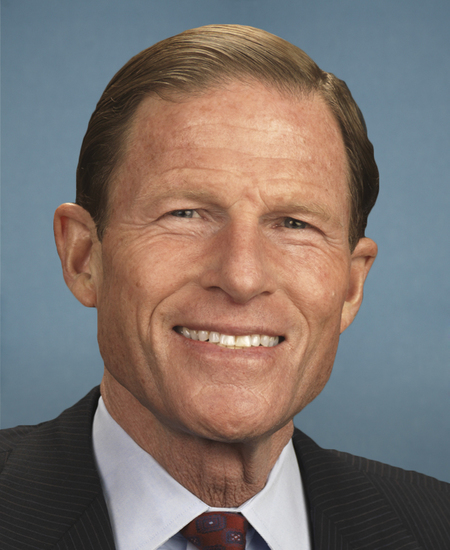
Sen. Richard Blumenthal
Sponsored bills
Cancer Drug Parity Act of 20 21 This bill requires group health plans that cover anticancer medications administered by a health care provider to provide no less favorable cost sharing for patient-administered anticancer medications. This requirement applies to medications that are (1) approved by the Food and Drug Administration; (2) medically necessary for the cancer treatment; and (3) clinically appropriate in terms of type, frequency, extent site, and duration. To comply with this requirement, plans may not, with respect to anticancer medications (1) change or replace benefits to increase out-of-pocket costs, (2) reclassify benefits to increase costs, or (3) apply more restrictive limitations to orally administered medications than to intravenously administered or injected medications.
Social Security 2100: A Sacred Trust This bill makes changes to Social Security benefits, taxes, and other aspects of the program, including by raising the primary insurance amount, increasing the maximum taxable earnings that are subject to Social Security payroll taxes, and requiring Social Security account statements to be mailed unless the individual recipient opts for electronic delivery.
Promoting Reentry through Education in Prisons Act of 2021 or the PREP Act This bill establishes, within the Bureau of Prisons, an Office of Prison Education. The office must provide educational services to incarcerated individuals in federal prisons and correctional institutions.
Preventing Vigilante Stalking Act of 2021 This bill increases the maximum prison term for a stalking offense, if the offense is committed with the intent to obtain health care information of an individual or to prevent the health care decisions of an individual.
Higher Education Mental Health Act of 2021 This bill requires the Department of Education to establish an Advisory Commission on Serving and Supporting Students with Mental Health Disabilities in Institutions of Higher Education. The commission must conduct a study and report on services available to students with mental health disabilities in institutions of higher education (IHEs) and the effectiveness of such services in supporting these students; the impact of policies and procedures, such as reasonable accommodation and disciplinary policies, that help or hinder the goal of providing equal opportunity to these students; the use of protected health information of these students by IHEs; the impact of providing mental health services on a student's academic performance, well-being, and ability to complete college; conclusions on the major challenges facing these students; and recommendations to improve the overall education, retention, and graduation of these students.
Inspector General Access Act of 2021 This bill transfers responsibility for investigating certain allegations of misconduct from the Department of Justice (DOJ) Office of Professional Responsibility to the DOJ Office of the Inspector General. Specifically, the bill transfers responsibility for allegations relating to a DOJ attorney's authority to investigate, litigate, or provide legal advice.
Improving Seniors' Timely Access to Care Act of 2021 This bill establishes several requirements and standards relating to prior authorization processes under Medicare Advantage (MA) plans. Specifically, MA plans must (1) establish an electronic prior authorization program that meets specified standards, including the ability to provide real-time decisions in response to requests for items and services that are routinely approved; (2) annually publish specified prior authorization information, including the percentage of requests approved and the average response time; and (3) meet other standards, as set by the Centers for Medicare & Medicaid Services, relating to the quality and timeliness of prior authorization determinations.
Veterans Dental Care Eligibility Expansion and Enhancement Act This bill modifies and expands the provision of dental care by the Department of Veterans Affairs (VA), including by expanding care to include all veterans enrolled in the VA health care system, implementing a program of education to promote dental health, and implementing a student loan reimbursement program for qualified dentists, dental hygienists, and oral surgeons who agree to accept positions within the VA's dental workforce.
State Justice Improvement Act This bill reauthorizes through FY2027 the State Justice Institute, a nonprofit corporation established by federal law, and authorizes the institute to award grants for the development and implementation of best policies and practices for the constitutional and equitable enforcement of fines and fees. Specifically, the institute may award these grants to state and local courts, nonprofit organizations, institutions of higher education, and other specified entities. The policies and practices must incorporate guidance that courts should, among other things, consider alternatives to incarceration for defendants who are unable to pay fines.