

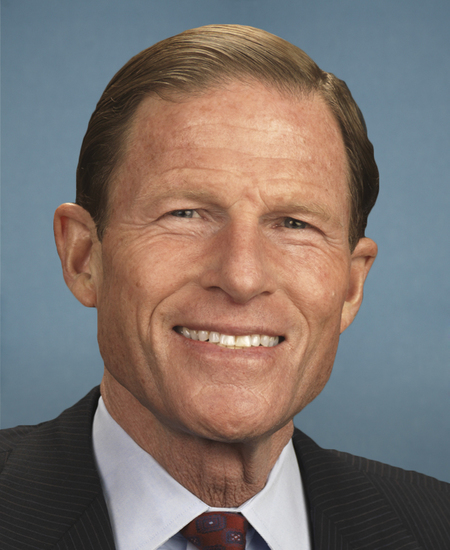
Photo of Richard Blumenthal
D United States Senate · Connecticut

Sen. Richard Blumenthal

Compare
Total votes
1,054
all sessions
Attendance
100%
1 missed
Higher than 82% of chamber peers
With party
97%
of cast votes
Near the chamber average
Bipartisan score
2%
crosses aisle rarely
Near the chamber average
Sponsored
2,861
bills & resolutions
Higher than 99% of chamber peers
Committees
14
assignments
2,861 bills and resolutions

Sponsored bills

Total
2,861
Primary
330
Co-sponsor
2,531
This page
2,861
matching current filters
Co-sponsor SRES 771
In committee · United States Senate · Co-sponsor
A resolution supporting the designation of the week of August 26 through August 30, 2024, as the second annual "National Community Health Worker Awareness Week".

Maddy summarySRES 771 is a symbolic Senate resolution designating August 26-30, 2024, as "National Community Health Worker Awareness Week" (the second annual observance). It recognizes community health workers - frontline professionals who bridge communities and health services - as vital to improving health access and reducing disparities in underserved areas. The resolution encourages federal, state, and local collaboration to raise awareness of their roles, which include cultural mediation, health education, care coordination, and advocacy. This resolution has no binding effect or policy changes; it is purely a statement of support.

In committee Jul 25, 2024 1 co-sponsor
Co-sponsor S 4773
In committee · United States Senate · Co-sponsor
Health Equity and Accountability Act of 2024

Maddy summary# Summary of the Health Equity and Accountability Act of 2024 This comprehensive healthcare legislation focuses on improving health equity, expanding access to care, and diversifying the healthcare workforce. Key provisions include: 1. **Language Access & Cultural Competence**: Mandates language access services for patients with limited English proficiency, requiring healthcare providers to implement cultural competence training and provide interpretation services. 2. **Workforce Development**: Establishes numerous new programs to increase diversity in healthcare professions, including: - Scholarships and fellowships for underrepresented minorities - Programs targeting historically Black colleges, Hispanic-serving institutions, and other minority-serving institutions - Leadership development programs for underrepresented health professionals - Enhanced training for internationally educated health professionals 3. **Physician Immigration Reform**: Amends immigration laws to: - Extend and modify the Conrad State 30 program for physician retention - Create pathways for foreign-trained physicians to practice in underserved areas - Streamline visa processes for healthcare professionals 4. **Funding Mechanisms**: Establishes the Health Professions Workforce Fund with substantial annual appropriations ($392 million in FY2025, increasing to $552 million by FY2032) to support healthcare education and training programs. 5. **Underserved Areas Focus**: Prioritizes funding for institutions in medically underserved communities and health professional shortage areas, with specific provisions for nursing education and medical schools in underserved regions. 6. **Data Collection & Reporting**: Requires collection and reporting of demographic data to track progress in diversifying the healthcare workforce and improving health outcomes in underserved populations. The legislation aims to address systemic disparities in healthcare access and quality by increasing workforce diversity, improving access to care in underserved communities, and creating more equitable pathways into healthcare careers.

In committee Jul 25, 2024 1 co-sponsor
Co-sponsor S 4778
In committee · United States Senate · Co-sponsor
Employer Participation in Repayment Act

Maddy summaryThis bill makes permanent a tax exclusion allowing employers to pay employees' student loans tax-free under educational assistance programs. It directly affects employees who receive such employer assistance and employers offering these programs. The key provision removes the previous expiration date (January 1, 2026), ensuring the tax exclusion remains in effect indefinitely. The change applies to all payments made after the bill's enactment, eliminating future uncertainty for both employers and employees.

In committee Jul 25, 2024 1 co-sponsor
Co-sponsor S 4804
In committee · United States Senate · Co-sponsor
Health Over Wealth Act

Maddy summaryThe Health Over Wealth Act (S 4804) requires for-profit corporations owning health care entities (such as hospitals, physician practices, and nursing facilities) to disclose detailed financial and operational information to the government. Covered firms must report on debt levels, ownership structures, staffing patterns, political spending, and other metrics to increase transparency about private equity's role in health care. The bill establishes risk mitigation requirements, including escrow accounts for 5 years, and prohibits certain real estate transactions that could weaken health care entities. It also creates a Task Force to monitor private equity's impact on health care access, quality, and equity, with annual reporting requirements to Congress.

In committee Jul 25, 2024 1 co-sponsor
Co-sponsor S 4731
In committee · United States Senate · Co-sponsor
DINE Act

Maddy summaryThe DINE Act amends the Older Americans Act to integrate "food is medicine" programs into existing services for older adults. It requires screening for eligibility in these programs during routine assessments and adds referrals to them as part of care coordination. Key provisions include incorporating produce prescriptions and medically tailored meals into nutrition education, counseling, and service delivery systems. The bill directly affects older Americans by expanding access to nutrition-based health interventions through existing federal and community programs. It modifies specific sections of the Older Americans Act to include these food-focused approaches without creating new funding streams.

In committee Jul 23, 2024 1 co-sponsor
Primary S 4739
In committee · United States Senate · Lead sponsor
BRAIN Act

Maddy summaryThe BRAIN Act aims to advance research and improve care for people living with brain tumors, directly affecting over 1 million Americans with brain tumors and their families. Key provisions include creating a searchable database of NIH-funded brain tumor biospecimens, establishing a $50 million annual research network for glioblastoma treatment, and funding a $10 million annual program for CAR-T cell therapy research. The bill also authorizes a national awareness campaign about clinical trials and biomarker testing, and creates pilot programs to develop better long-term care models for brain tumor survivors. These concrete policy changes address the lack of treatment options and stagnant survival rates for brain tumors, which have remained unchanged for 45 years.

In committee Jul 23, 2024 0 co-sponsors
Co-sponsor S 4745
In committee · United States Senate · Co-sponsor
Federal Food Administration Act of 2024

Maddy summaryS 4745 establishes the Federal Food Administration (FFA) within the Department of Health and Human Services to oversee all food safety and regulatory functions previously handled by the Food and Drug Administration (FDA). The bill transfers specific FDA offices - such as the Center for Food Safety and the Office of Regulatory Affairs - to the FFA, renaming the FDA as the "Federal Drug Administration" for drug, cosmetic, and device oversight. It mandates risk-based inspections: high-risk facilities (like meat processors) must be inspected annually, intermediate-risk facilities every two years, and low-risk facilities (such as warehouses) every three years. The FFA’s Commissioner, appointed by the President, will enforce food safety rules, develop science-based standards, and coordinate responses to foodborne illness outbreaks.

In committee Jul 23, 2024 1 co-sponsor
Co-sponsor S 4749
In committee · United States Senate · Co-sponsor
Stop Corporate Capture Act

Maddy summaryThe Stop Corporate Capture Act requires agencies to disclose conflicts of interest when reviewing studies submitted by interested parties, including corporations, industry groups, or advocacy organizations. It mandates that agencies make these studies publicly available and consider social equity impacts in rulemaking decisions. The bill establishes an Office of the Public Advocate to improve public participation in the regulatory process and conduct social equity assessments. It also includes penalties for submitting false information to agencies and requires agencies to explain why they withdraw proposed rules. These provisions aim to increase transparency and reduce undue corporate influence in regulatory decision-making.

In committee Jul 23, 2024 1 co-sponsor
Co-sponsor S 4751
In committee · United States Senate · Co-sponsor
Agency Stability Restoration Act of 2024

Maddy summaryThe Agency Stability Restoration Act of 2024 amends two federal laws to clarify the timeframe for challenging agency decisions in court. It adds a 6-year statute of limitations for lawsuits under Section 702 of Title 5 (which governs judicial review of agency actions), requiring such cases to be filed within 6 years of the final agency decision. This change affects individuals, businesses, or organizations seeking to legally contest federal agency actions. The bill does not alter substantive agency powers but standardizes the deadline for judicial review under existing law.

In committee Jul 23, 2024 1 co-sponsor
Co-sponsor S 4752
In committee · United States Senate · Co-sponsor
SAFE Act

Maddy summaryThe SAFE Act establishes a national strategy to protect fish, wildlife, and plants from climate change impacts by requiring Federal agencies to integrate climate adaptation into their conservation efforts. It mandates states to develop adaptation plans focusing on habitat protection, ecological processes, and incorporating traditional knowledge from Tribal and Native Hawaiian organizations. The Act creates a Climate Adaptation Science Center Network to provide scientific support for adaptation efforts across different regions. It requires regular review and updates of adaptation plans every four years to address changing climate conditions. This legislation directly affects Federal agencies, state governments, Tribal nations, and Native Hawaiian organizations in their conservation planning and management activities.

In committee Jul 23, 2024 1 co-sponsor
Showing 1,091 to 1,100 of 2,861 bills