This resolution (1) recognizes the importance of the Americans with Disabilities Act of 1990 in advancing independent living for individuals with disabilities; (2) pledges continued efforts to address remaining barriers for individuals with disabilities; and (3) calls on federal agencies to provide additional resources for individuals with disabilities with respect to economic self-sufficiency, community-based services, housing, and transportation.
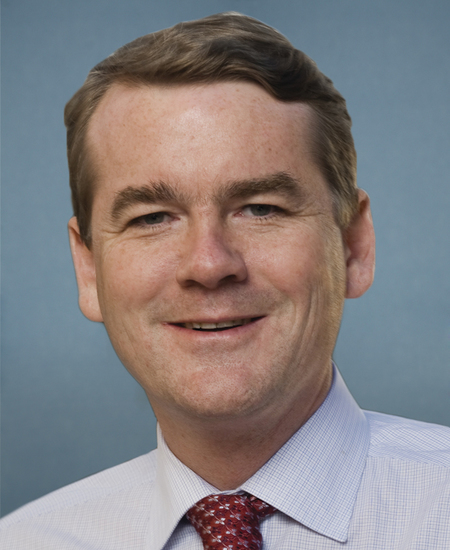
Sen. Michael F. Bennet
Sponsored bills
This resolution remembers former Prime Minister of Japan Shinzo Abe and his work to strengthen the alliance between the United States and Japan. It also extends condolences to his family and the people of Japan.
This resolution condemns the use of hunger, including the starvation of civilians, as a weapon of warfare. It also calls on the U.S. government to prioritize diplomatic efforts to call out and address instances where hunger and intentional deprivation of food is being utilized as a weapon of war, including through efforts to ensure that security operations minimize civilian harm and do not undermine livelihoods of civilian populations.
Increasing Home Ownership for Servicemembers Act This bill requires the Department of Defense to seek to enter into an agreement with a federally funded research and development center or nonprofit entity to study and report on the barriers to home ownership for members of the Armed Forces.
BAH Calculation Improvement Act This bill requires the Department of Defense to submit to Congress a report on the basic allowance for housing for members of the uniformed services that includes elements related to the calculation of such allowance.
Respect for Marriage Act This bill provides statutory authority for same-sex and interracial marriages. Specifically, the bill repeals and replaces provisions that define, for purposes of federal law, marriage as between a man and a woman and spouse as a person of the opposite sex with provisions that recognize any marriage that is valid under state law. (The Supreme Court held that the current provisions were unconstitutional in United States v. Windsor in 2013.) The bill also repeals and replaces provisions that do not require states to recognize same-sex marriages from other states with provisions that prohibit the denial of full faith and credit or any right or claim relating to out-of-state marriages on the basis of sex, gender, race, ethnicity, or national origin. (The Supreme Court held that state laws barring same-sex marriages were unconstitutional in Obergefell v. Hodges in 2015; the Court held that state laws barring interracial marriages were unconstitutional in Loving v. Virginia in 1967.) The bill allows the Department of Justice to bring a civil action and establishes a private right of action for violations.
Expanding Access to Family Planning Act This bill provides, subject to specified conditions, funding through FY2032 for federally funded family planning services and clinics. In particular, the funds must be used for (1) grants and contracts that support the provision of family planning services, and (2) clinic infrastructure (e.g., construction and renovation of clinics). Clinics that receive funding to provide family planning services must offer each patient with a positive pregnancy test the opportunity for nondirective counseling on (1) prenatal care and delivery; (2) infant care, foster care, and adoption; and (3) pregnancy termination. This counseling must include referrals if requested by a patient. Additionally, if a funding recipient makes subawards for the provision of family planning services, the recipient may not prohibit an entity from participating in a subaward program for reasons other than the entity's inability to provide family planning services.
Democracy Is Strengthened by Casting Light On Spending in Elections Act of 2021 or the DISCLOSE Act of 2021 This bill addresses campaign finance, including by expanding the prohibition on campaign spending by foreign nationals, requiring additional disclosures of campaign expenditures, and requiring additional disclosures regarding certain political advertisements. First, the bill prohibits foreign nationals from participating in the decision-making process regarding an election expenditure. Additionally, the bill expands existing foreign money prohibitions to include disbursements for paid web-based or digital communications and federal judicial nomination communications. It also prohibits foreign nationals from contributing to campaigns related to ballot initiatives and referenda. The Federal Election Commission (FEC) must conduct an audit after each federal election cycle to determine the incidence of illicit foreign money. Next, the bill makes it unlawful to establish or use a corporation, company, or other entity with the intent to conceal an election contribution or donation by a foreign national. A violator is subject to criminal penalties—a fine, a prison term of up to five years, or both. Covered organizations (e.g., corporations, labor organizations, and political organizations) must, within 24 hours, file reports with the FEC to disclose campaign expenditures of more than $10,000 during an election cycle. Finally, the bill requires organizations to provide additional disclosures regarding political advertisements, including the donors who contributed the most money to that organization in the last year.

Democracy Technology Partnership Act This bill establishes the International Technology Partnership Office, led by the Special Ambassador for Technology, in the Department of State. The office shall advance U.S. technology policy through the creation of an International Technology Partnership with specified foreign countries. Specifically, the office must create a partnership of democratic countries to develop technology governance regimes, with a focus on key technologies such as artificial intelligence and machine learning, 5G telecommunications, semiconductor chip manufacturing, biotechnology, and quantum computing. Partner countries must be democratic countries with advanced technology sectors that have a demonstrated record of trust or an expressed interest in international cooperation and coordination with the United States on defense and intelligence matters. The bill also establishes the International Technology Partnership Fund in the Department of the Treasury. The State Department may use amounts from this fund to support joint research projects from International Technology Partnership member countries and technology investments in third-country markets. The State Department must also submit reports (1) outlining a national strategy for technology and national security; and (2) assessing other countries' standards and governance regimes for privacy, human rights, consumer protection, and free expression.
Supporting Mental Assistance Responder Teams Community Policing Act or the SMART Community Policing Act This bill expands the Community Oriented Policing Services (COPS) program to specifically allow funds to be used for mobile crisis teams, behavioral health personnel, and case management or outreach teams to help deescalate situations between law enforcement and individuals experiencing a mental health crisis.