

Hospital Revitalization Act of 2021 This bill establishes a program within the Department of Health and Human Services (HHS) to provide grants and low-interest loans to hospitals that, prior to 2020, were small, had poor financial indicators, and served a high number of patients with public insurance. Hospitals may use grants to construct and modernize their facilities, including rural health clinics, off-site outpatient departments, and other facilities that are not physically part of the hospital building. HHS must develop criteria to prioritize grant recipients based on, for example, the age and physical state of the hospital and whether the hospital is located in an area with a shortage of health care providers.
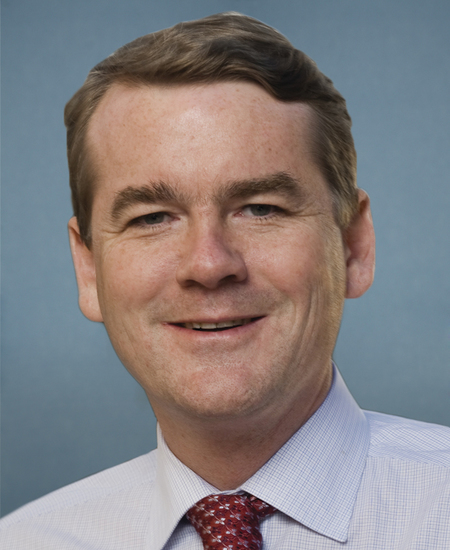
Sen. Michael F. Bennet
Sponsored bills
Fair Day in Court for Kids Act of 2021 This bill provides legal protections for a noncitizen (i.e., an individual referred to as an alien in federal law) who is detained or subject to immigration-related proceedings. The Department of Justice (DOJ), or the Department of Health and Human Services (HHS) in a case involving an unaccompanied child, may appoint or provide counsel at the government's expense to noncitizens in removal proceedings and related appeals. An unaccompanied child must be represented by counsel paid for and appointed by the government at every stage of such proceedings unless the child has obtained counsel at their own expense. If HHS fails to provide counsel to an unaccompanied child, the deadline for filing a motion to reopen a proceeding shall not apply, and the filing of such a motion shall stay the child's removal from the United States. The Department of Homeland Security (DHS) must provide a complete copy of a noncitizen's immigration file to the noncitizen (or the noncitizen's counsel) within seven days of a notice to appear for an immigration proceeding, and failure to provide the file shall result in a delay in the proceeding. DHS must provide access to counsel for all detained noncitizens. The bill authorizes HHS to enter into contacts or award grants for providing immigration-related legal services to children. The Office of Refugee Resettlement must develop model guidelines for representing noncitizen children in immigration proceedings.
Solar Energy Manufacturing for America Act This bill allows a new tax credit for the production and sale of certain solar equipment produced and sold in a taxpayer's trade or business.
Improving Seniors' Timely Access to Care Act of 2021 This bill establishes several requirements and standards relating to prior authorization processes under Medicare Advantage (MA) plans. Specifically, MA plans must (1) establish an electronic prior authorization program that meets specified standards, including the ability to provide real-time decisions in response to requests for items and services that are routinely approved; (2) annually publish specified prior authorization information, including the percentage of requests approved and the average response time; and (3) meet other standards, as set by the Centers for Medicare & Medicaid Services, relating to the quality and timeliness of prior authorization determinations.
Save Our Servicemembers Act of 2021 This bill requires the Office of the Under Secretary of Defense for Personnel and Readiness within the Department of Defense (DOD) to evaluate and standardize DOD's suicide prevention efforts. Specifically, the bill directs the Defense Suicide Prevention Office to collaborate with each military department to (1) develop and implement a process to ensure that individual nonclinical suicide prevention efforts are assessed for effectiveness, and (2) develop consistent suicide-related definitions for use throughout DOD. The bill also requires the use of such suicide-related definitions in any updated policies of DOD or each military department.
Freedom to Vote Act This bill addresses voter registration and voting access, election integrity and security, redistricting, and campaign finance. Specifically, the bill expands voter registration (e.g., automatic and same-day registration) and voting access (e.g., vote-by-mail and early voting). It also limits removing voters from voter rolls. Next, the bill establishes Election Day as a federal holiday. The bill declares that the right of a U.S. citizen to vote in any election for federal office shall not be denied or abridged because that individual has been convicted of a criminal offense unless, at the time of the election, such individual is serving a felony sentence. The bill establishes certain federal criminal offenses related to voting. In particular, the bill establishes a new criminal offense for conduct (or attempted conduct) to corruptly hinder, interfere with, or prevent another person from registering to vote or helping someone register to vote. Additionally, the bill sets forth provisions related to election security, including by requiring states to conduct post-election audits for federal elections. The bill outlines criteria for congressional redistricting and generally prohibits mid-decade redistricting. The bill addresses campaign finance, including by expanding the prohibition on campaign spending by foreign nationals, requiring additional disclosure of campaign-related fundraising and spending, requiring additional disclaimers regarding certain political advertising, and establishing an alternative campaign funding system for certain federal offices.
This resolution supports the designation of October 3-October 9, 2021, as National 4-H Week. It also (1) recognizes the important role of 4-H in youth development and education, and (2) encourages all citizens to recognize 4-H for the significant impact the organization and members have made and continue to make by empowering young people with the skills needed to lead for a lifetime.
This resolution recognizes (1) the celebration of Hispanic Heritage Month from September 15 - October 15, 2021; and (2) the integral role of Latinos and their manifold heritage in the economy, culture, and identity of the United States.
Helping American Victims Afflicted by Neurological Attacks Act of 2021 or the HAVANA Act of 2021 This bill specifically authorizes the Central Intelligence Agency, the Department of State, and other agencies to provide payments to agency personnel who incur brain injuries from hostilities while on assignment. Specifically, the bill allows agency personnel and their families to receive payments for brain injuries that are incurred (1) during a period of assignment to a foreign or domestic duty station; (2) in connection with war, insurgency, hostile acts, terrorist activity, or other agency-designated incidents; and (3) not as the result of willful misconduct. The bill's authority applies to injuries incurred before, on, or after the date of the bill's enactment. Agencies must submit classified reports on the bill's implementation, including the number of payments made and the amount of each payment. Since 2016, some intelligence, diplomatic, and other governmental personnel have reported experiencing unusual cognitive and neurological impairments while on assignment (particularly abroad), the source of which is currently under investigation. Symptoms were first reported by personnel stationed in Cuba and have since been collectively referred to as Havana Syndrome .
This bill requires the Department of Veterans Affairs (VA) to designate one week each year as Buddy Check Week for the purposes of organizing outreach events and educating veterans on how to conduct peer wellness checks. The VA shall ensure that the Veterans Crisis Line has a plan for handling the potential increase in calls that may occur during such week.