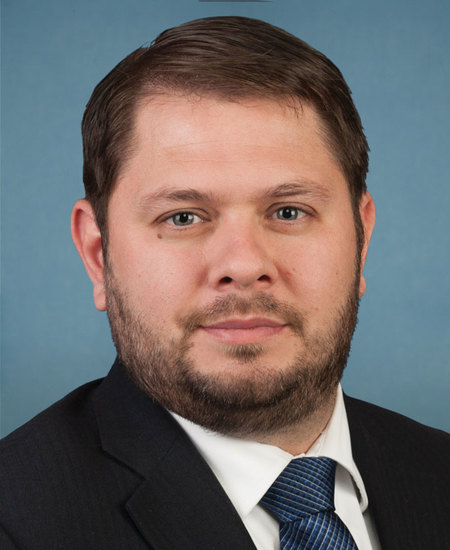
Photo of Ruben Gallego
D United States Senate · Arizona

Sen. Ruben Gallego

Compare
Total votes
2,625
all sessions
Attendance
90%
254 missed
Lower than 97% of chamber peers
With party
96%
of cast votes
Near the chamber average
Bipartisan score
2%
crosses aisle rarely
Near the chamber average
Sponsored
1,452
bills & resolutions
Near the chamber average
Committees
12
assignments
1,452 bills and resolutions

Sponsored bills

Total
1,452
Primary
131
Co-sponsor
1,321
This page
1,452
matching current filters
Co-sponsor HR 3125
In committee · United States House · Co-sponsor
To amend the Internal Revenue Code of 1986 to increase the information reporting threshold for slot winnings.

Maddy summaryHR 3125 raises the IRS reporting threshold for slot machine winnings from $1,200 to $5,000 per single play. This means casinos and other businesses operating slot machines no longer need to report winnings under $5,000 to the IRS for individual plays. The $5,000 threshold will automatically adjust annually for inflation starting in 2025. The bill affects casinos' reporting obligations but does not change tax liability for gamblers. It becomes effective for winnings after December 31, 2023.

In committee May 5, 2023 1 co-sponsor
Co-sponsor HR 2891
In committee · United States House · Co-sponsor
SAFE Banking Act of 2023

Maddy summaryThe SAFE Banking Act of 2023 would protect banks and financial institutions that provide services to state-legal marijuana businesses and hemp-related businesses by preventing federal regulators from taking adverse actions against them solely for serving these businesses. It clarifies that income from state-legal marijuana businesses can be considered for mortgage applications, and requires regulators to update guidance on suspicious activity reports related to these businesses. The bill does not require financial institutions to serve these businesses, but ensures they won't face penalties for doing so. It extends similar protections to hemp-related businesses, which have faced banking challenges despite being federally legal under the 2018 Farm Bill.

In committee May 3, 2023 1 co-sponsor
Co-sponsor HR 2992
In committee · United States House · Co-sponsor
EDUCATORS for America Act

Maddy summary# Summary of EDUCATORS for America Act Provisions This comprehensive legislation makes significant changes to educator preparation, certification, and support systems, with a strong focus on loan forgiveness and retention of educators in high-need settings. ## Key Provisions: 1. **Enhanced Loan Forgiveness Programs**: - Creates new "Educator Loan Forgiveness Programs" under sections 428J and 460 of the Higher Education Act - Provides 100% loan forgiveness for educators who complete 5 years of qualifying service in high-need schools or early childhood education programs - Offers monthly loan forgiveness/cancellation during the service period (in addition to annual forgiveness) 2. **Expanded Eligibility**: - Defines "high need school" as schools where: * Over 30% of students meet poverty measures * School is identified for comprehensive support * School is Bureau of Indian Education funded * School is operated by Tribal educational agencies - Includes Tribal early childhood programs, Native Hawaiian education systems, and Bureau of Indian Education programs as eligible settings - Special rule for educators providing instruction in Native American languages 3. **"Qualifying Educator" Definition**: - Includes elementary/secondary teachers (with full certification) - Includes school leaders (with full certification) - Includes early childhood educators and program directors - Includes educators working in Native American language instruction regardless of certification status 4. **New Support Programs**: - Centers of Excellence for teacher preparation at institutions serving underrepresented populations - Recruitment and completion grants for underrepresented students in education - Resiliency grants for technology integration and educator workforce partnerships - Doctoral fellowships to diversify faculty in high-need education areas 5. **Implementation Details**: - Monthly loan credit program for eligible educators in income-driven repayment plans - Allows counting of partial service years under specific conditions - Prevents double benefits with other service programs - Allows for promotions within qualifying schools without losing eligibility This legislation aims to create a more diverse, stable, and well-prepared educator workforce by reducing financial barriers to entering and remaining in the education profession, particularly in high-need schools and early childhood education settings.

In committee Apr 28, 2023 1 co-sponsor
Co-sponsor HR 2922
In committee · United States House · Co-sponsor
Baltic Security Initiative Act

Maddy summaryThis bill authorizes $350 million annually for fiscal years 2024-2026 to establish the "Baltic Security Initiative," a U.S. defense program focused on strengthening security cooperation with Estonia, Latvia, and Lithuania (the "Baltic countries"). It requires the Secretary of Defense to develop a strategy within one year to enhance military capabilities like missile defense, cyber resilience, long-range weapons, and coordination with NATO allies - including Poland - to deter Russian aggression and address security threats from Russia and China. The initiative operates under existing U.S. defense authorities (Title 10, U.S. Code) and mandates a report to Congress detailing how these security objectives will be achieved. The bill directly affects U.S. defense funding and the security planning of the three Baltic nations.

In committee Apr 27, 2023 1 co-sponsor
Primary HR 2945
In committee · United States House · Lead sponsor
Excess Urban Heat Mitigation Act of 2023

Maddy summaryHR 2945 establishes a federal grant program to fund heat mitigation projects in urban areas disproportionately affected by extreme heat. It directs at least 75% of annual funding ($30 million per year from 2023-2030) toward high-poverty neighborhoods (defined as census tracts with ≥20% poverty rate) and communities with low tree cover and higher summer temperatures. The program supports concrete projects like planting native trees, installing cool roofs/pavements, building renewable-powered cooling centers, and creating community gardens to reduce urban heat islands. Eligible applicants include cities, tribes, nonprofits, and community groups, with requirements for community engagement and annual reporting on project outcomes. The law aims to address health and economic impacts of heat while prioritizing environmental justice in implementation.

In committee Apr 27, 2023 0 co-sponsors
Co-sponsor HR 2976
In committee · United States House · Co-sponsor
Child Care for Working Families Act

Maddy summaryThe Child Care for Working Families Act establishes a federal entitlement program providing subsidized child care for working families with children under age 6 who are not yet in kindergarten. It creates a sliding fee scale where families at or below 85% of State median income pay no copayment, while higher-income families pay up to 7% of their income based on income thresholds. The bill requires states to develop quality rating systems for child care providers and ensures providers receive sufficient funding to meet quality standards, including wages equivalent to elementary educators. It prioritizes access for underserved populations including children with disabilities, infants and toddlers, children experiencing homelessness, and families in low-income communities. The program is funded with $20 billion for fiscal year 2024 and subsequent years through 2029.

In committee Apr 27, 2023 1 co-sponsor
Co-sponsor HR 2972
In committee · United States House · Co-sponsor
Failed Bank Executives Clawback Act

Failed Bank Executives Clawback Act This bill requires the Federal Deposit Insurance Corporation (FDIC) to claw back compensation paid to certain responsible parties when an insured depository institution or financial company is placed into FDIC receivership.  Specifically, all or part of the compensation paid the previous five years to an institution-affiliated party substantially responsible for the condition of the institution must be paid to FDIC to prevent unjust enrichment and to assure that the party bears losses consistent with their responsibility. Compensation includes salary, bonuses, awards, and profits from buying or selling securities. Finally, the bill establishes that an insured depository institution's holding company is liable to the FDIC for payments to insured depositors, the FDIC's receiver costs, and interest when the institution is under FDIC receivership.

In committee Apr 27, 2023 1 co-sponsor
Co-sponsor HR 2918
In committee · United States House · Co-sponsor
Fair Housing for Survivors Act of 2023

Maddy summaryHR 2918, the Fair Housing for Survivors Act of 2023, amends the Fair Housing Act to explicitly protect survivors of domestic violence, sexual assault, and sex trafficking from housing discrimination. It adds "survivor of domestic violence, sexual assault, or severe forms of trafficking" as a protected class under the law, prohibiting landlords and housing providers from refusing to rent, evicting, or charging more based on this status. The bill also clarifies that discrimination based on survivor status - including denial of housing due to protective orders, shelter stays, or prior incidents - is illegal. This directly affects survivors who face barriers like denied rentals, evictions, or higher costs when seeking safe housing, addressing documented discrimination reported by 67% of survivors in New York studies. The law preserves survivors' ability to pursue other discrimination claims under the Fair Housing Act.

In committee Apr 26, 2023 1 co-sponsor
Co-sponsor HR 2870
In committee · United States House · Co-sponsor
Raise the Age Act of 2023

Raise the Age Act of 2023 This bill establishes new restrictions on the sale or transfer of certain semiautomatic firearms to individuals under 21 years of age. Specifically, this bill makes it unlawful for a licensed gun dealer, importer, manufacturer, or collector to sell or deliver a semiautomatic center-fire rifle or semiautomatic center-fire shotgun that has (or has the capacity to accept) an ammunition feeding device with a capacity of more than five rounds to an individual who the licensee knows or has reasonable cause to believe is under age 21. The prohibition does not apply if the individual under age 21 is a full-time law enforcement officer or active-duty member of the Armed Forces. The bill also requires the Federal Bureau of Investigation to report on the operation of its public access line, including a description of information sharing protocols and recommendations for improving such protocols.

In committee Apr 26, 2023 1 co-sponsor
Co-sponsor HR 2851
In committee · United States House · Co-sponsor
National Apprenticeship Act of 2023

Maddy summary# Summary of the National Apprenticeship Act of 2023 This proposed legislation establishes a comprehensive framework to modernize and expand apprenticeship programs in the United States, creating a National Apprenticeship System designed to address current workforce needs and increase opportunities for underrepresented populations. ## Key Provisions ### System Framework - Establishes clear quality standards for apprenticeship, pre-apprenticeship, and youth apprenticeship programs - Requires programs to meet specific criteria including: - Minimum 2,000 hours of on-the-job learning (with flexibility for some occupations) - Structured related instruction (minimum 144 hours per year for time-based programs) - Progressive wage scales - Safety training and equipment - Equal opportunity for participation ### Program Types - **Apprenticeship Programs**: Time-based, competency-based, or hybrid models for full-time workers - **Pre-apprenticeship Programs**: Designed to prepare individuals without meeting minimum qualifications for apprenticeship - **Youth Apprenticeship Programs**: For high school students, integrating academic and work-based learning ### Diversity & Inclusion Requirements - Requires programs to actively recruit and support nontraditional apprenticeship populations: - Women, minorities, individuals with disabilities - Long-term unemployed - Individuals impacted by the criminal or juvenile justice system - Foster and former foster youth - Individuals with barriers to employment ### Registration & Oversight - Requires formal registration of programs with a registration agency - Mandates annual performance data collection and reporting - Establishes procedures for program review, technical assistance, and deregistration ### Grant Program (Title II) - Authorizes $4 billion over five years ($400M-$800M annually) for competitive grants - Funds will support: - Creation and expansion of apprenticeship programs in high-demand sectors - Encouraging employer participation, particularly with small- and medium-sized businesses - Supporting intermediaries (national and local) - Strengthening educational alignment with secondary and postsecondary systems ### Evaluation Requirements - Mandates independent evaluations of grant programs - Requires collection of disaggregated data by program type and demographic factors - Focuses on measuring outcomes including: - Program completion rates - Employment rates in related fields - Wage growth - Increased participation of underrepresented groups ### Conforming Amendments - Repeals outdated sections of the American Competitiveness and Workforce Improvement Act of 1998 - Amends the Immigration and Nationality Act to align with the new apprenticeship system This legislation represents a significant investment in workforce development, aiming to create a more inclusive, high-quality apprenticeship system that responds to 21st-century labor market needs while expanding opportunities for historically underrepresented groups.


In committee Apr 25, 2023 1 co-sponsor
Showing 731 to 740 of 1,452 bills
Previous 1 … 73 74 75 … 146 Next