

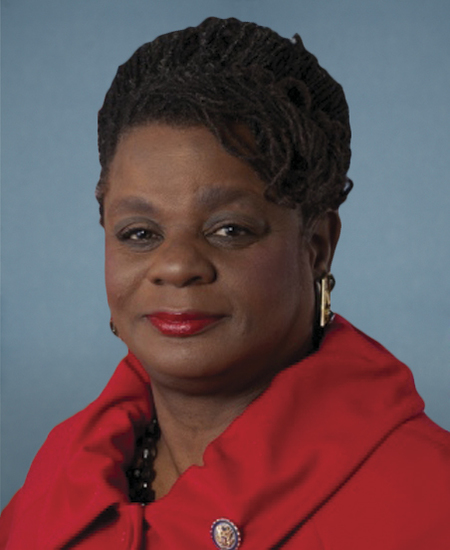
Photo of Gwen Moore
D United States House · District 4 · Wisconsin On the 2026 ballot

Rep. Gwen Moore

Compare
Total votes
2,837
all sessions
Attendance
96%
107 missed
Near the chamber average
With party
97%
of cast votes
Near the chamber average
Bipartisan score
2%
crosses aisle rarely
Near the chamber average
Sponsored
1,876
bills & resolutions
Higher than 85% of chamber peers
Committees
5
assignments
1,876 bills and resolutions

Sponsored bills

Total
1,876
Primary
93
Co-sponsor
1,783
This page
1,876
matching current filters
Primary HRES 196
In committee · United States House · Lead sponsor
Expressing support for the designation of the week beginning March 2, 2025, as "School Social Work Week".

Maddy summaryHRES 196 is a symbolic resolution designating the week beginning March 2, 2025, as "School Social Work Week." It does not create new laws or policies but formally expresses the House's support for recognizing school social workers. The resolution honors these professionals for their role in supporting students facing challenges like mental health issues, poverty, or trauma, and for helping schools address barriers to learning. It encourages the public to observe the week with activities that highlight their contributions to student success. This is a ceremonial gesture with no binding effect on government actions or funding.

In committee Mar 5, 2025 0 co-sponsors
Co-sponsor HR 1877
In committee · United States House · Co-sponsor
Protecting Americans’ Social Security Data Act

Protecting Americans’ Social Security Data Act This bill prohibits political appointees and special government employees from accessing Social Security data systems that contain personally identifiable information about Social Security beneficiaries. Specifically, political appointees and special government employees may not access systems maintained by the Social Security Administration (SSA) that issue or record Social Security account numbers, that are used to determine eligibility for or to pay Social Security benefits, or that otherwise contain personally identifiable information about individuals receiving or applying for benefits.  The bill also establishes a civil right of action for an individual whose information was negligently accessed or disclosed in violation of these provisions. The individual may bring suit against the United States if the violator was a U.S. employee or officer, or against the violator if they were not a U.S. employee or officer. Such a claim must be brought within two years of the affected individual’s discovery of the violation. Upon a finding of liability, defendants are liable for specified monetary damages.  If an individual is criminally charged or subject to proposed disciplinary or adverse action by a federal or state agency for having accessed or disclosed information in violation of these provisions, SSA must notify the individual whose information was accessed or disclosed of the violation as soon as practicable.  Finally, the bill requires the SSA Office of the Inspector General to investigate and report to Congress on any unauthorized access to or disclosure of information in a beneficiary data system.

In committee Mar 5, 2025 1 co-sponsor
Co-sponsor HR 1876
In committee · United States House · Co-sponsor
Keeping Our Field Offices Open Act

Maddy summaryHR 1876, the "Keeping Our Field Offices Open Act," prevents the Social Security Administration (SSA) from closing, consolidating, or restricting access to its field offices, hearing offices, or resident stations for 180 days after enactment, with exceptions for emergencies. The bill requires the SSA Commissioner to submit a detailed report to Congress by January 2029, analyzing closure criteria, transportation burdens for elderly/disabled users, cost-benefit impacts, and plans to replace lost services. For future closures, it mandates 120 days of public notice, two public hearings, and a final report to Congress, while ensuring total office numbers don’t fall below 2025 levels. This directly affects SSA field offices, their users (including elderly and disabled individuals), and employees. The bill’s key mechanism is a procedural safeguard to ensure transparency and minimize disruption before any office changes take effect.

In committee Mar 5, 2025 1 co-sponsor
Co-sponsor HR 14
In committee · United States House · Co-sponsor
John R. Lewis Voting Rights Advancement Act of 2025

Maddy summaryThis bill strengthens the Voting Rights Act of 1965 by clarifying how to prove voting discrimination and expanding requirements for preclearance of voting changes. It establishes new standards for determining when voting practices dilute minority voting strength or deny/abridge voting rights, requiring plaintiffs to show specific conditions for vote dilution claims and including factors like historical discrimination and racial polarization in court analyses. The bill modifies the criteria for determining which states and political subdivisions must seek preclearance for voting changes, and adds new transparency requirements for jurisdictions to publicly disclose changes to voting qualifications, polling locations, and election districts. It directly affects states and local governments that implement voting policies, particularly those with a history of voting rights violations or that make changes to voting qualifications, procedures, or district boundaries. The bill aims to prevent discriminatory voting practices by providing clearer standards for courts and requiring greater transparency in voting rule changes.

In committee Mar 5, 2025 1 co-sponsor
Co-sponsor HR 20
In committee · United States House · Co-sponsor
Richard L. Trumka Protecting the Right to Organize Act of 2025

Maddy summaryThe Richard L. Trumka Protecting the Right to Organize Act of 2025 strengthens workers' organizing rights by making it an unfair labor practice for employers to threaten permanent replacement of striking workers, discriminate against workers who support unions, or require employees to attend employer campaigns unrelated to their job duties. It expands the definition of "employee" to make it harder for companies to classify workers as independent contractors and requires employers to post notices about workers' rights in conspicuous locations. The bill establishes a new electronic voting system for union elections, creates a 90-day bargaining period before mediation can be requested, and increases penalties for violations of labor laws. These changes are intended to make it easier for workers to form unions and negotiate better wages and working conditions.

In committee Mar 5, 2025 1 co-sponsor
Co-sponsor HRES 185
In committee · United States House · Co-sponsor
Recognizing the need of Congress to prevent, address, and treat obesity as a disease in the United States on this World Obesity Day, March 4, 2025.

Maddy summaryHRES 185 is a symbolic House resolution recognizing obesity as a disease and urging congressional action on March 4, 2025 (World Obesity Day). It does not create new laws or funding but formally acknowledges obesity’s health impacts (linked to over 200 conditions like diabetes and heart disease), economic costs ($283 billion in U.S. health expenses in 2023), and disparities (e.g., 49.9% obesity rate among Black adults). The resolution encourages evidence-based prevention and treatment strategies while highlighting obesity’s role in preventable deaths and its disproportionate burden on low-income and rural communities. As a non-binding resolution, it has no direct effect on policy or affected individuals.

In committee Mar 4, 2025 1 co-sponsor
Co-sponsor HR 1841
In committee · United States House · Co-sponsor
Peace on the Korean Peninsula Act

Maddy summaryThis bill directs the State Department to review restrictions on U.S. citizens traveling to North Korea, particularly focusing on humanitarian visits for Americans with relatives there (estimated at 100,000 people). It requires the Secretary of State to submit a report within 180 days detailing how the U.S. will pursue a formal end to the Korean War through diplomatic negotiations with North and South Korea. The bill also mandates a separate report outlining a clear roadmap for achieving a binding peace agreement, including necessary negotiation steps and key stakeholders. These provisions aim to address the ongoing state of war, which the bill states prevents formal U.S.-North Korea relations and family reunifications.

In committee Mar 4, 2025 1 co-sponsor
Co-sponsor HR 803
In committee · United States House · Co-sponsor
Sergeant Gary Beikirch Medal of Honor Act

Maddy summaryHR 803, the Sergeant Gary Beikirch Medal of Honor Act, amends a provision in the U.S. Code (38 U.S.C. §1562) to allow Medal of Honor recipients to receive both the Medal of Honor and the special pension benefit concurrently. Currently, a provision in the law prevents recipients from receiving this pension alongside the Medal of Honor. The bill removes the specific language (subparagraph (C)) that created this conflict. This change directly affects living Medal of Honor recipients who would now be eligible for the full pension benefit without losing it due to the award. The bill is procedural, focusing solely on updating the pension eligibility rules.

In committee Mar 4, 2025 1 co-sponsor
Co-sponsor HRES 181
In committee · United States House · Co-sponsor
Original Black History Month Resolution of 2025

Maddy summaryHRES 181 is a symbolic resolution recognizing Black History Month by highlighting the historical and ongoing contributions of Black labor to the U.S. economy and society. It commemorates Black labor from slavery through modern times, including agricultural work, unionization efforts (like A. Philip Randolph’s Brotherhood of Sleeping Car Porters), and contemporary issues like the racial wage gap (where Black workers earned $878 weekly vs. $1,059 for others in 2023). The resolution does not create new laws or policies but formally acknowledges these contributions to raise public awareness. It is sponsored by 70+ House members and aligns with the 2025 Black History Month theme focused on "African Americans and Labor." As a commemorative resolution, it has no direct effect on individuals or legislation.

In committee Mar 3, 2025 1 co-sponsor
Co-sponsor HR 1787
In committee · United States House · Co-sponsor
Roberto Clemente Commemorative Coin Act

Maddy summaryHR 1787 authorizes the U.S. Mint to produce commemorative coins honoring baseball legend Roberto Clemente, including $5 gold, $1 silver, and half-dollar coins, with specific specifications for weight, size, and metal content. The bill requires the coins to feature Clemente's image and commemorative inscriptions, and mandates a surcharge ($35 for gold, $10 for silver, $5 for half-dollar) paid to the Roberto Clemente Foundation for its educational, youth sports, and disaster relief programs. All coins must be minted in 2027, sold at face value plus surcharge and production costs, and will be legal tender. The bill focuses solely on the coin program, not broader policy changes.

In committee Mar 3, 2025 1 co-sponsor
Showing 451 to 460 of 1,876 bills
Previous 1 … 45 46 47 … 188 Next