

Protecting America's Workers Act This bill expands the coverage of requirements governing workplace safety and health to include protection for federal, state, and local government employees. However, the bill does not cover working conditions otherwise covered by federal requirements for mine safety and health. The bill revises requirements governing worker protection, including by expanding protections for whistle-blowers, such as protections for employees who refuse to perform work because they reasonably believe the work would result in serious injury or illness and for employees who aid inspections; directing employers to furnish a hazard-free place of employment to all individuals performing work, not just employees; directing employers to report work-related deaths or certain injuries, illnesses, or hospitalizations; requiring the Department of Labor to investigate fatalities or significant incidents in the workplace; establishing rights for victims, or representatives of victims, with respect to inspections or investigations of work-related bodily injuries or deaths; setting the permitted period for employers to correct serious, willful, or repeated violations while citations for the violations are being contested; increasing civil and criminal penalties for certain violations; expanding enforcement requirements relating to state occupational safety and health plans; expanding requirements for workplace health hazard evaluations by the National Institute for Occupational Safety and Health; and requiring Labor to provide training programs concerning employee rights and employer responsibilities.
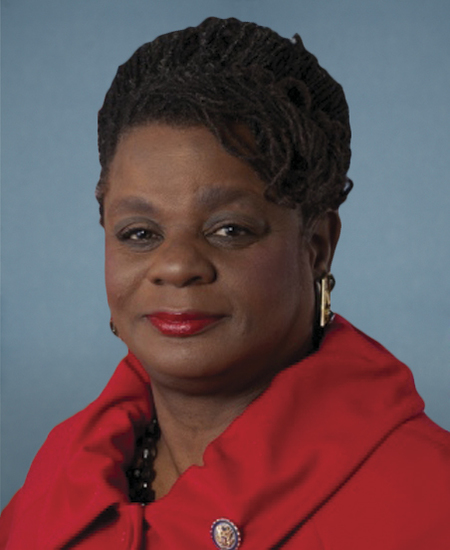
Rep. Gwen Moore
Sponsored bills
Universal Child Care and Early Learning Act This bill provides funds to the Department of Health and Human Services (HHS) for an affordable child care and early learning program. Children who are at least six weeks of age but not yet required to attend school may participate in the program regardless of family income, disability status, citizenship status, or employment of a family member. Under the program, HHS must support sponsors (e.g., states, local governments, tribal organizations, and nonprofit community organizations) that provide child care and early learning services for families. Families must pay a subsidized fee, based on their income, for the services. The fees are waived for children from families with incomes below 200% of the poverty line. The fees are capped at 7% of a family's income regardless of the family's income level.
Ghost Guns Are Guns Act This bill broadens the definition of firearm for purposes of federal firearms laws. Specifically, it includes as a firearm any combination of parts designed or intended to be used to convert a device into a firearm and from which a firearm may be readily assembled.
Mental Health Justice Act of 2021 This bill creates a grant program for states and local governments to train and dispatch mental health professionals to respond, instead of law enforcement officers, to emergencies that involve people with behavioral health needs. The Substance Abuse and Mental Health Services Administration (SAMHSA) must manage the program in consultation with the Department of Justice (DOJ). SAMHSA may cancel grants that increase incarceration or institutionalization. Grantees must use funds for purposes including de-escalation and anti-racism training. The Department of Health and Human Services and the DOJ must evaluate this program.
Eric Garner Excessive Use of Force Prevention Act of 2021 This bill modifies the criminal civil rights statute that prohibits the deprivation of rights under color of law. Currently, the second prong of the prohibition bars the application of different punishments, pains, or penalties based on an individual's alien status, color, or race. This bill specifies that the application of any pressure to a person's throat or windpipe, the use of maneuvers that restrict blood or oxygen flow to the brain, or carotid artery restraints that prevent or hinder breathing or reduce intake of air (e.g., a chokehold) constitute a punishment, pain, or penalty.
Mainstreaming Addiction Treatment Act of 2021 This bill removes the requirement that a health care practitioner apply for a separate waiver through the Drug Enforcement Administration (DEA) to dispense certain narcotic drugs (e.g., buprenorphine) for maintenance or detoxification treatment (i.e., substance use disorder treatment). Further, a community health aide or community health practitioner may dispense certain narcotic drugs for maintenance or detoxification treatment without registering with the DEA if the drug is prescribed by a health care practitioner through telemedicine. It preempts state laws related to licensure for this activity. The bill also directs the Substance Abuse and Mental Health Services Administration to conduct a national campaign to educate health care practitioners and encourage them to integrate substance use disorder treatment into their practices.
Repeal Existing Policies that Encourage and Allow Legal HIV Discrimination Act of 2021 or the REPEAL HIV Discrimination Act of 2021 This bill concerns the burdens that federal and state laws, policies, and regulations may place upon people living with human immunodeficiency virus (HIV). The bill directs the Department of Justice (DOJ), the Department of Health and Human Services (HHS), and the Department of Defense (DOD) to initiate a national review of federal (including military) and state laws, policies, regulations, and judicial precedents and decisions regarding criminal and related civil commitment cases involving people living with HIV. DOJ must transmit to Congress and make publicly available the results of such review with related recommendations. DOJ and HHS must (1) develop and publicly release guidance and best practice recommendations for states, and (2) establish an integrated monitoring and evaluation system to measure state progress. DOJ, HHS, and DOD must transmit to the President and Congress any proposals necessary to implement adjustments to federal laws, policies, or regulations. This bill shall not be construed to discourage the prosecution of individuals who intentionally transmit or attempt to transmit HIV to another individual.
Holding Russia Accountable for Malign Activities Act of 2021 This bill directs the President to impose visa- and asset-blocking sanctions on any current or former official of Russia's government involved in the August 20, 2020, poisoning of Russian opposition leader Alexei Navalny or the subsequent cover-up of the poisoning. An individual or entity that violates, attempts to violate, conspires to violate, or causes a violation of such sanctions shall be subject to civil and criminal penalties. In addition, the President shall report to Congress on the personal wealth of Russian President Vladimir Putin and his family members. The Department of State shall report to Congress on the circumstances of the February 27, 2015, assassination of Russian opposition leader Boris Nemtsov.
U.S. Citizenship Act This bill establishes a path to citizenship for certain undocumented individuals. The bill also replaces the term alien with noncitizen in the immigration statutes and addresses other related issues. Specifically, the bill establishes a new status of lawful prospective immigrant . This status shall be available to an applying noncitizen who meets certain requirements, including being continually present in the United States from January 1, 2021, and passing background checks. After at least five years with this status, an eligible noncitizen may apply for and receive permanent resident status. The bill also provides permanent resident status to certain applying noncitizens, specifically for eligible noncitizens who (1) entered the United States as a minor, (2) were eligible for temporary protected status or deferred enforced departure on January 1, 2017, or (3) worked a certain amount of agricultural labor in the five years prior to applying. Among other things, the bill also redefines for immigration purposes the term conviction to exclude convictions that have been expunged or vacated, requires the Department of State to implement a strategy to advance reforms in Central America and address key factors contributing to migration from the region to the United States, requires the State Department to establish refugee processing centers in Central America, requires Customs and Border Patrol sectors and stations to have a certain number of employees with certain qualifications such as paramedic training, generally prohibits religious discrimination in granting or denying immigration benefits, and establishes grant programs for providing training and services to immigrants.
Preventing Tragedies Between Police and Communities Act of 2021 This bill requires a state or local government that receives funding under the Edward Byrne Memorial Justice Assistance Grant (JAG) program to train law enforcement officers on de-escalation techniques and require law enforcement to use such techniques. The Department of Justice (DOJ) may reduce the JAG allocation of a state or local government that fails to comply with the training requirement. DOJ must reduce by 15% the JAG allocation of a state or local government that fails to require law enforcement officers to use de-escalation techniques.