

Jaime's Law This bill establishes background check requirements for the sale and transfer of ammunition. Specifically, the bill prohibits a licensed importer, manufacturer, or dealer from transferring ammunition to an unlicensed individual prior to submitting a background check through the National Instant Criminal Background Check System. It also establishes penalties for violations. (Currently, background checks are required under these circumstances for the transfer of firearms, but not for ammunition.) Additionally, it prohibits an ammunition transfer between private parties (i.e., unlicensed individuals) unless a licensed importer, manufacturer, or dealer first takes possession of the ammunition to conduct a background check. However, this prohibition does not apply to certain ammunition transfers, such as a gift between spouses in good faith.
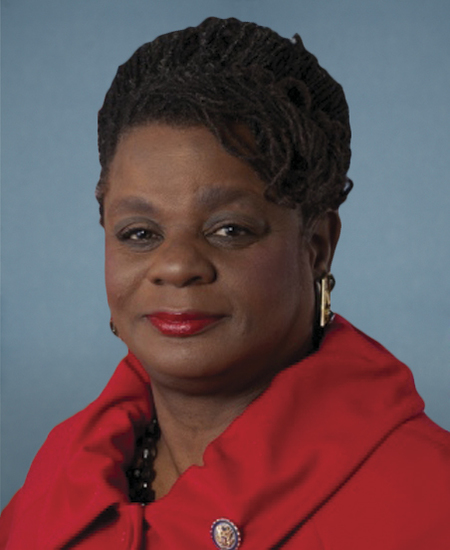
Rep. Gwen Moore
Sponsored bills
Fair Housing for Domestic Violence and Sexual Assault Survivors Act of 2021 This bill prohibits discrimination against survivors of domestic violence, sexual assault, or sex trafficking in the sale or rental of housing and other related real estate activities.
Defending Each and Every Person from False Appearances by Keeping Exploitation Subject to Accountability Act of 2021 or the DEEP FAKES Accountability Act This bill establishes requirements for advanced technological false personation records (i.e., deep fakes) and establishes criminal penalties for related violations. Specifically, it requires producers of deep fakes to generally comply with certain digital watermark and disclosure requirements (e.g., verbal and written statements). It establishes new criminal offenses related to (1) the production of deep fakes which do not comply with related watermark or disclosure requirements, and (2) the alteration of deep fakes to remove or meaningfully obscure such required disclosures. A violator is subject to a fine, up to five years in prison, or both. It also establishes civil penalties and permits individuals to bring civil actions for damages. Additionally, it revises the criminal offense of fraud in connection with certain identification documents to include deep fakes. The bill also directs the Department of Justice to take certain actions, such as publishing a report related to deep fakes that includes a description of the efforts of Russia and China to use technology to impact elections. Software manufacturers who reasonably believe software will be used to produce deep fakes must ensure it has the technical capability to insert watermarks and disclosures. Finally, the bill directs the Department of Homeland Security to establish a task force to, among other things, advance efforts of the federal government to combat the national security implications of deep fakes.
Prevent Gun Trafficking Act This bill establishes new federal criminal offenses for gun trafficking and related conduct. First, the bill establishes a stand-alone federal criminal offense for gun trafficking. A violation is punishable by a fine, a prison term of up to 10 years, or both. The bill also authorizes the seizure and forfeiture of the firearms and ammunition involved in the offense, the property involved in the offense, and the proceeds (or property traceable to the proceeds) derived from the offense. Second, the bill makes it unlawful to sell or dispose of a firearm or ammunition to any person knowing or having reason to believe that the person intends to sell or dispose of the firearm in violation of a federal law, or to sell or dispose of the firearm to a person in another state in violation of that state's law. A violation is subject to existing penalties under current law—a fine, a prison term of up to 10 years, or both. Current law already authorizes the seizure and forfeiture of firearms and ammunition involved in the offense. This bill also authorizes the seizure and forfeiture of the property involved in the offense and the proceeds (or property traceable to the proceeds) derived from the offense.
Camp Lejeune Justice Act of 2021 This bill allows certain individuals to sue and recover damages for harm from exposure to contaminated water at Camp Lejeune in North Carolina between August 1, 1953, and December 31, 1987. This action is available only to individuals who were exposed to contaminated water for at least 30 days. The bill prohibits the U.S. government from asserting specified immunity from litigation in response to such a lawsuit. The bill also prohibits an individual who brings such an action from bringing a separate tort action against the United States based on the same harm.
Dignity for Detained Immigrants Act of 2021 This bill directs the Department of Homeland Security (DHS) to establish standards for facilities holding aliens in its custody, phases out using non-DHS facilities for such purposes, and contains other related provisions. The standards shall comply with the American Bar Association's Civil Immigration Detention Standards. The DHS Office of Inspector General (OIG) shall conduct periodic unannounced inspections of each facility and shall take various actions against noncompliant facilities, including imposing fines, cancelling contracts, and closing facilities. DHS shall report to Congress any death of an alien in its custody within 24 hours and conduct an investigation within 30 days that identifies policy changes that could reduce the likelihood of such a death. DHS is prohibited from entering into contracts for third parties to operate detention facilities or alternatives to detention programs and shall terminate existing contracts within three years of the bill's enactment. The bill establishes that OIG facility inspection reports and contracts for an outside entity to operate a detention facility are records available to the public under the Freedom of Information Act. DHS shall maintain certain information relating to detained aliens, including the alien's location and whether the alien was separated from family. The bill provides for various requirements and procedures related to detaining aliens, including (1) prohibiting DHS from detaining children, (2) imposing a presumption that an alien should be released, and (3) establishing that aliens in custody shall be subject to the least restrictive conditions. The bill also abolishes mandatory detention for asylum seekers.
Equal Access to Abortion Coverage in Health Insurance Act of 2021 or the EACH Act of 2021 This bill requires federal health care programs to provide coverage for abortion services and requires federal facilities to provide access to those services. The bill also permits qualified health plans to use funds attributable to premium tax credits and reduced cost sharing assistance to pay for abortion services.
Closing the Law Enforcement Consent Loophole Act of 2021 This bill establishes a framework to prohibit law enforcement officers at the federal, state, and local levels from engaging in sexual acts with individuals who are in custody. At the federal level, the bill makes it unlawful for a federal law enforcement officer who is acting under color of law to engage in a sexual act with an individual who is under arrest, in detention, or in custody. Consent is not a defense to prosecution for unlawful conduct. A violator is subject to criminal penalties—a fine, a prison term of up to 15 years, or both. At the state and local level, the bill conditions eligibility for funds under the Community Oriented Policing Services program on the enactment of a similar law.
PrEP Assistance Program Act This bill establishes a grant program to provide pre-exposure prophylaxis (PrEP) and related services to individuals at no cost. PrEP is medication given to individuals at risk of HIV to reduce their likelihood of contracting the virus. The Department of Health and Human Services must award the grants to state, tribal, and local governments; certain health clinics; and community-based organizations.
Outdoors for All Act This bill directs the Department of the Interior to establish an outdoor recreation legacy partnership grant program under which Interior may award grants to states, certain political subdivisions of a state, special purpose districts, Indian tribes, or Alaska Native or Native Hawaiian communities or organizations. Funds must be used for projects to (1) acquire land and water for parks and other outdoor recreation purposes in qualifying areas, and (2) develop new or renovate existing outdoor recreation facilities that provide outdoor recreation opportunities to the public in qualifying areas. A qualifying area is an area that has a population of 30,000 or more in the most recent census, or that is administered by an Indian tribe or an Alaska Native or Native Hawaiian community organization. Interior shall give priority to projects that create or significantly enhance access to park and recreational opportunities in an urban neighborhood or community, engage and empower underserved communities and youth, provide opportunities for employment or job training for youth or underserved communities, establish or expand public-private partnerships, and take advantage of coordination among various levels of government.