Designates the facility of the United States Postal Service located at 120 Doty Street in Kaukauna, Wisconsin, as the "Sgt. Nickolas Mueller Post Office Building."
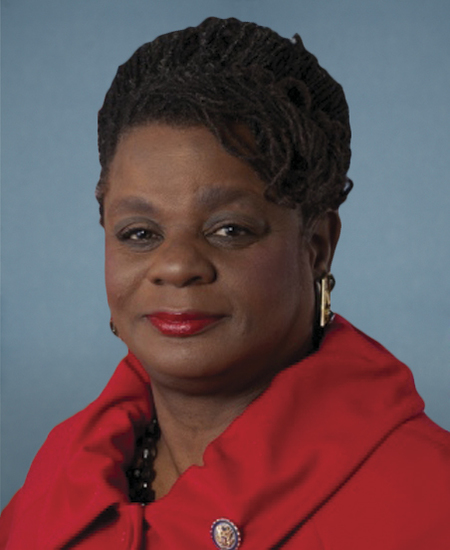
Rep. Gwen Moore
Sponsored bills
Boundary Waters Wilderness Protection and Pollution Prevention Act This bill withdraws certain federal lands and waters in Minnesota from mining and related activities. Specifically, the bill withdraws approximately 234,328 acres of federal land and waters in a specified area in the Rainy River Watershed of Superior National Forest from entry, appropriation, and disposal under the public land laws; location, entry, and patent under the mining laws; and operation of the mineral leasing, mineral materials, and geothermal leasing laws. The area is adjacent to the Boundary Waters Canoe Area Wilderness and the Boundary Waters Canoe Area Wilderness Mining Protection Area. Land or interest in land within such area that is acquired by the United States shall be immediately withdrawn in accordance with this bill. The Forest Service is authorized to permit the removal of sand, granite, iron ore, and taconite from national forest system lands within such area if the removal is not detrimental to the water quality, air quality, and health of forest habitat within the Rainy River Watershed.
Respect for Marriage Act This act provides statutory authority for same-sex and interracial marriages. Specifically, the act replaces provisions that define, for purposes of federal law, marriage as between a man and a woman and spouse as a person of the opposite sex with provisions that recognize any marriage between two individuals that is valid under state law. (The Supreme Court held that the current provisions were unconstitutional in United States v. Windsor in 2013.) The act also replaces provisions that do not require states to recognize same-sex marriages from other states with provisions that prohibit the denial of full faith and credit or any right or claim relating to out-of-state marriages on the basis of sex, race, ethnicity, or national origin. (The Supreme Court held that state laws barring same-sex marriages were unconstitutional in Obergefell v. Hodges in 2015; the Court held that state laws barring interracial marriages were unconstitutional in Loving v. Virginia in 1967.) The act allows the Department of Justice to bring a civil action and establishes a private right of action for violations. The act does not (1) affect religious liberties or conscience protections that are available under the Constitution or federal law, (2) require religious organizations to provide goods or services to formally recognize or celebrate a marriage, (3) affect any benefits or rights that do not arise from a marriage, or (4) recognize under federal law any marriage between more than two individuals.

International Violence Against Women Act of 2022 This bill requires a U.S. global strategy to prevent and respond to violence against women and girls. The bill establishes in the Department of State an Office of Global Women's Issues, which shall be headed by an Ambassador-at-Large for Global Women's Issues. The Ambassador-at-Large shall (1) coordinate U.S. government efforts regarding gender equality and the advancement of women and girls in foreign policy, and (2) develop or update periodically a U.S. global strategy to prevent and respond to gender-based violence. The bill establishes in the U.S. Agency for International Development the position of Senior Coordinator for Gender Equality and Women's Empowerment who shall coordinate policies, programs, and funding regarding gender equality and women's empowerment.
Working for Immigrant Safety and Empowerment Act of 2022 or the WISE Act of 2022 This bill addresses immigration-related issues for victims of domestic violence and other crimes. For example, the bill (1) extends the period of admission into the United States for certain spouses or children who derive their immigration status from an individual who is abusing the spouse or child; and (2) establishes a presumption that an individual with certain pending applications, such as for a visa for a victim of human trafficking or certain other crimes, should be released from immigration detention without conditions.
Safe Connections Act of 2022 This act establishes requirements concerning access to communication services for survivors of domestic violence, human trafficking, and related harms. At a survivor's request, a mobile service provider must separate from a shared mobile service contract the survivor's line (and the line of any individual in the survivor's care) from the abuser's line unless separation is operationally or technologically infeasible. A survivor requesting this must (1) verify through appropriate documentation that an individual under the contract committed or allegedly committed an act of domestic violence, trafficking, or a related criminal act against the survivor; and (2) assume financial responsibility for services after a line separation. A provider may not charge fees or impose other requirements on such requests. Additionally, a provider must separate the line within two business days of receiving a request; allow requests to be made remotely (if feasible); meet conditions related to confidentiality of, disposal of, and other matters concerning communications about requests; and make information about the process for requests available through consumer-facing communications (e.g., websites). The act (1) provides liability protection for providers' acts or omissions undertaken to comply with such requests, and (2) requires the Federal Communications Commission (FCC) to adopt rules for these requests. Additionally, the FCC must (1) expand access to federally subsidized communication services for survivors facing financial hardship, and (2) evaluate this expanded access. The FCC must also consider rules requiring communication service providers to omit from consumer-facing logs calls and texts to hotlines for domestic violence and similar issues while retaining internal records.
Maddy summaryThis bill ratifies the Bureau of Indian Affairs' 2018 decision to place approximately 6.7 acres of land into federal trust for the Samish Indian Nation. It confirms this trust status for the specific land described in the 2018 decision and applies to all current or future legal challenges regarding this land or similar actions. The bill explicitly states it does not prevent the Samish Nation from seeking additional land to be placed into trust in the future. It directly affects the Samish Indian Nation's ownership rights to this specific parcel and their legal standing on related land claims.
Truth and Healing Commission on Indian Boarding School Policies Act This bill establishes the Truth and Healing Commission on Indian Boarding School Policies in the United States and sets forth its powers, duties, and membership. Among other duties, the commission must investigate the impacts and ongoing effects of the Indian Boarding School Policies (federal policies under which American Indian, Alaska Native, and Native Hawaiian children were forcibly removed from their family homes and placed in boarding schools). Further, the commission must develop recommendations on ways to (1) protect unmarked graves and accompanying land protections; (2) support repatriation and identify the tribal nations from which children were taken; and (3) discontinue the removal of American Indian, Alaska Native, and Native Hawaiian children from their families and tribal communities by state social service departments, foster care agencies, and adoption agencies.
Save Oak Flat Act This bill repeals the requirement for the Department of Agriculture to convey the 2,422 acres of Forest System land located in Tonto National Forest in Pinal County, Arizona, known as Oak Flat, to Resolution Copper Mining, LLC, in exchange for various parcels of land owned by Resolution Copper. Oak Flat is withdrawn from (1) entry, appropriation, or disposal under the public land laws; (2) location, entry, and patent under the mining laws; and (3) disposition under all laws pertaining to mineral and geothermal leasing or mineral materials.
Designates the facility of the United States Postal Service located at 410 Franklin Street in Appleton, Wisconsin, as the "Mitchell F. Lundgaard Post Office Building."