

Maddy summaryThis bill amends the National School Lunch Act to require schools participating in the program to offer flavored milk to students. It directly affects public schools receiving federal funding for lunches, changing the existing provision to mandate flavored milk availability. The key mechanism is adding a new clause (iii) stating schools "shall offer students flavored milk," replacing previous language that allowed discretion. This is a procedural change to program requirements, not a substantive policy shift in nutrition standards.
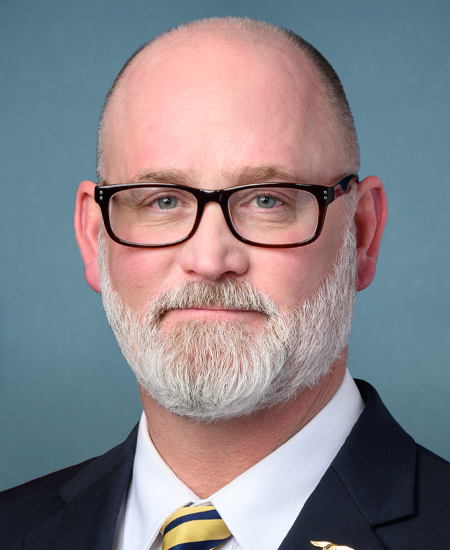
Rep. Derrick Van Orden
Sponsored bills
Maddy summaryHR 3869, the Trucker Bathroom Access Act, requires certain businesses (like warehouses, distribution centers, and shipping/receiving facilities) to allow commercial truck drivers access to their restrooms when delivering or waiting to transport goods. It specifically applies to drivers regulated by the Department of Transportation and excludes small businesses (under 800 sq ft) with employee-only restrooms. The bill mandates that businesses provide access without requiring physical restroom modifications, and for port terminals, requires operators to provide sufficient restrooms with parking access for large cargo trucks (over 33,000 lbs) while avoiding obvious safety risks.
Maddy summaryThe NOTAM Improvement Act of 2023 requires the Federal Aviation Administration (FAA) to establish a task force within 180 days to review and improve the system for delivering flight safety notices (NOTAMs) to pilots. The task force, including representatives from airlines, airports, pilot and dispatcher unions, and aviation safety experts, will evaluate current practices and recommend ways to make notices more accurate, timely, and user-friendly. The FAA must also implement a new Federal flight safety notice system by September 30, 2024, including a backup system and a plan for global standardization with international aviation formats. The task force must submit its recommendations to Congress within one year, focusing on enhancing safety information delivery for pilots and air traffic operations.
Maddy summaryHR 3792 extends U.S. security funding for Israel through 2028 (Section 3) and expands energy cooperation to include advanced nuclear technologies and carbon capture (Section 5). It requires annual reports on regional security partnerships involving Israel (Section 6) and ensures countries in the Abraham Accords can access U.S. development programs (Section 8). The bill also mandates reports on diplomatic efforts against ICC investigations targeting the U.S. and Israel (Section 10) and encourages people-to-people programs to strengthen the Abraham Accords (Sections 7, 9). These provisions directly affect Israel’s diplomatic engagement, security partnerships, and economic cooperation in the Middle East.
Maddy summaryThe SHOPP Act (HR 3127) expands the types of healthy foods SNAP participants can buy with their benefits. It allows fresh frozen fruits and vegetables to count toward nutrition incentives year-round and adds legumes (like beans and lentils) to the list of eligible items. This directly affects SNAP recipients by increasing access to affordable, nutritious options beyond just fresh produce. The changes take effect March 6, 2024, modifying the 2008 Food, Conservation, and Energy Act.
Maddy summaryThe VET-TEC Authorization Act of 2023 establishes a new program under the Department of Veterans Affairs to provide educational assistance for high technology training to eligible veterans. It limits participation to 8,000 veterans annually and funds non-degree programs in fields like computer programming that last 6-28 weeks. The program ties funding to student employment outcomes, with training providers receiving payments based on graduates finding jobs in their field within 180 days. This program directly affects veterans with at least 36 months of active duty service who haven't reached age 62, and educational institutions that meet specific quality standards for high technology training.
Maddy summaryHR 3684, the Douglas Mike Day Psychedelic Therapy to Save Lives Act of 2023, authorizes the Department of Defense to fund research on using psychedelic substances for treating specific conditions in active-duty military personnel. The bill creates a grant program to support phase II clinical trials (using substances like MDMA, psilocybin, or ibogaine) or training for treating PTSD, traumatic brain injury, or chronic traumatic encephalopathy, with participants including active-duty service members. It removes barriers for military personnel to join these trials, regardless of federal scheduling of the substances or military justice rules. The bill appropriates $15 million annually from 2024 to 2028 for this research and requires regular reports to Congress on grant recipients and trial findings.
Maddy summaryThe Sailor Standard of Care Act of 2023 requires the Navy to improve mental health support for service members designated for "limited duty" (temporarily restricted from full duties due to medical needs). It mandates quarterly mental health screenings for these members, additional medical staff in units with over 15 such personnel, and a framework for centralized care coordination during their limited duty period. The bill also directs the Navy to study multiple suicides within units, report on TRICARE mental health provider credentialing timelines and reimbursement rates, and establish a dashboard tracking quality-of-life program usage. These provisions directly affect active-duty Navy members in limited duty status and aim to address systemic gaps in mental health care access and response.
Maddy summaryThis bill requires that AM radio receivers be included as standard equipment in all new motor vehicles (such as cars and trucks) sold in the United States, with a rule to be issued by the Department of Transportation within one year. The rule must ensure AM radio is easily accessible on the dashboard and allows manufacturers to use digital AM radio technology instead of traditional AM. During the one-year period between the bill's enactment and the rule's effective date, manufacturers must clearly label vehicles without AM radio. The bill also directs a study to evaluate whether an alternative system could deliver emergency alerts as reliably as AM radio across the country, especially during crises.
Maddy summaryThis bill establishes federal standards for labor-management cooperation between public safety employers (state and local governments) and public safety workers (law enforcement officers, firefighters, and emergency medical services personnel). It requires the Federal Labor Relations Authority to determine if states substantially provide rights like collective bargaining, union representation, and binding arbitration for these workers. States found lacking would need to follow federal bargaining procedures after a two-year transition period or following the next legislative session. The bill explicitly respects existing state laws that provide comparable or better rights to public safety workers. It also prohibits strikes or work stoppages that would disrupt emergency services.