

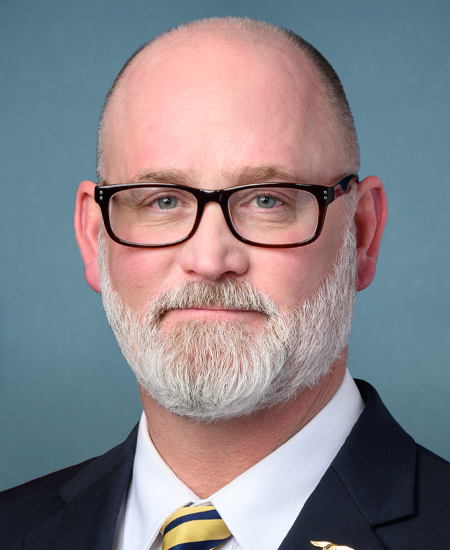
Photo of Derrick Van Orden
R United States House · District 3 · Wisconsin On the 2026 ballot

Rep. Derrick Van Orden

Compare
Total votes
1,879
all sessions
Attendance
95%
91 missed
Lower than 90% of chamber peers
With party
92%
of cast votes
Near the chamber average
Bipartisan score
4%
crosses aisle rarely
Near the chamber average
Sponsored
786
bills & resolutions
Near the chamber average
Committees
9
assignments
786 bills and resolutions

Sponsored bills

Total
786
Primary
61
Co-sponsor
725
This page
786
matching current filters
Co-sponsor HR 1872
In committee · United States House · Co-sponsor
Fairness in Veterans’ Education Act

Maddy summaryThis bill amends a specific section of the law governing Post-9/11 GI Bill benefits. It updates the repayment rules for service members who contributed to their education assistance, removing outdated language from the existing code. The change directly affects veterans and service members who paid into the program and are now required to repay contributions. The amendment takes effect on August 1, 2025, but does not alter benefit amounts or eligibility. This is a technical correction to the existing repayment process.

In committee Apr 9, 2025 1 co-sponsor
Co-sponsor HR 1423
In committee · United States House · Co-sponsor
Guard and Reserve GI Bill Parity Act of 2025

Maddy summaryHR 1423, the Guard and Reserve GI Bill Parity Act of 2025, expands GI Bill benefits to National Guard members who serve on full-time National Guard duty or active duty under Title 32. It removes previous exclusions by counting this service toward eligibility for Post-9/11 educational benefits, just like active-duty service. The change applies retroactively to service performed since September 11, 2001, allowing affected veterans to access benefits they were previously denied. This policy adjustment directly affects National Guard members who completed qualifying full-time duty since 2001.

In committee Apr 9, 2025 1 co-sponsor
Co-sponsor HR 2729
In committee · United States House · Co-sponsor
Carnivals are Real Entertainment Act

Maddy summaryHR 2729, the "Carnivals are Real Entertainment Act," creates a new temporary work visa category for carnival and circus workers. It directly affects mobile entertainment providers (like traveling carnivals, circuses, and affiliated food/game concession services) and their workers who perform essential tasks such as transporting, assembling, operating, and maintaining rides and equipment at seasonal fairs and festivals. The bill amends immigration law to define "mobile entertainment workers" as those entering temporarily for functions integral to these operations, subject to labor program requirements similar to other temporary work visas. It requires the Departments of Homeland Security and Labor to issue implementing rules within one year of enactment.

In committee Apr 8, 2025 1 co-sponsor
Co-sponsor HR 2687
In committee · United States House · Co-sponsor
End Kidney Deaths Act

Maddy summaryHR 2687, the End Kidney Deaths Act, creates a federal tax credit for living kidney donors who give non-directed donations (meaning they don't know the recipient's identity). It provides a $10,000 annual credit for five years ($50,000 total) to donors whose kidney is removed after December 31, 2026, with special rules if the donor dies during this period. The credit applies only to living, non-directed kidney donations and explicitly states it does not count as "valuable consideration" under laws prohibiting organ sales. This bill directly affects living kidney donors who choose to donate anonymously, aiming to incentivize such donations by offsetting related costs through tax relief. The credit expires after December 31, 2036.

In committee Apr 7, 2025 1 co-sponsor
Co-sponsor HR 2666
In committee · United States House · Co-sponsor
CBO Scoring Accountability Act

Maddy summaryHR 2666, the CBO Scoring Accountability Act, requires the Congressional Budget Office (CBO) to annually analyze and publicly report on the actual costs and revenue impacts of major federal legislation for the first 10 years after it becomes law. It mandates that the CBO compare actual spending/revenue results against prior estimates, and if discrepancies exceed 10% for costs or revenue, the CBO must explain the causes in a report to Congress. This applies to bills projected to affect at least 0.25% of U.S. GDP in spending or revenue (defined as "major legislation"), and federal agencies must provide data to support these analyses. The bill aims to improve transparency around budget estimates without altering legislative processes.

In committee Apr 7, 2025 1 co-sponsor
Co-sponsor HR 2253
In committee · United States House · Co-sponsor
Puppy Protection Act of 2025

Maddy summaryThis bill, HR 2253 (Puppy Protection Act of 2025), sets new federal standards for commercial dog dealers who sell puppies to the public. It requires specific housing sizes based on dog size (e.g., 12-30 square feet per dog), daily exercise in safe outdoor areas, clean water and nutritious food twice daily, and annual veterinary exams including dental checks. The bill also limits breeding frequency (max 2 litters in 25 months), sets age minimums for breeding (18 months for small dogs, 2 years for large dogs), and mandates health screenings to prevent genetic diseases. These requirements apply directly to commercial dealers, with final regulations to be issued within 18 months of enactment.

In committee Apr 4, 2025 1 co-sponsor
Co-sponsor HR 2102
In committee · United States House · Co-sponsor
Major Richard Star Act

Maddy summaryThis bill, HR 2102 (Major Richard Star Act), allows veterans with combat-related disabilities to receive both full military retired pay and veterans' disability compensation simultaneously, without the previous offset that reduced retired pay. It directly affects veterans already eligible for both benefits due to combat-related injuries, removing the requirement that their retired pay be reduced by the disability compensation amount. The key provision amends Title 10 and Title 38 to eliminate the offset rule (sections 5304 and 5305 of Title 38) for these veterans. The change applies to payments starting after the bill’s enactment date, effective for all qualifying veterans. This is a policy change to increase financial support for affected veterans, not a new benefit.

In committee Apr 4, 2025 1 co-sponsor
Co-sponsor HR 2589
In committee · United States House · Co-sponsor
Consensual Donation and Research Integrity Act of 2025

Maddy summaryHR 2589 requires entities that profit from selling whole human bodies or body parts (not for transplantation) to register with federal authorities. It mandates detailed records of donor consent, medical history, and chain of custody, plus standardized labeling and packaging to ensure safety and transparency. Exempt from these rules are funeral homes, medical schools, and organ transplant networks. The law aims to standardize handling for educational and research use while protecting donor privacy. Violations could result in fines or loss of registration.

In committee Apr 2, 2025 1 co-sponsor
Co-sponsor HR 2540
In committee · United States House · Co-sponsor
SSI Savings Penalty Elimination Act

Maddy summaryThis bill raises the asset limits for Supplemental Security Income (SSI) recipients to allow more savings without losing benefits. It increases the individual resource limit from $2,250 to $20,000 (in 2025) and the couple limit from $1,500 to $10,000, with automatic annual inflation adjustments based on the Consumer Price Index. These changes directly affect low-income seniors and people with disabilities who rely on SSI. The bill eliminates the current "savings penalty" that previously forced recipients to spend down savings to qualify. The new limits will adjust each year to maintain their real value against inflation.

In committee Apr 1, 2025 1 co-sponsor
Co-sponsor HR 2531
In committee · United States House · Co-sponsor
Workplace Violence Prevention for Health Care and Social Service Workers Act

Workplace Violence Prevention for Health Care and Social Service Workers Act This bill requires the Department of Labor to address workplace violence in health care, social service, and similar sectors. Specifically, Labor must issue an occupational safety and health standard that requires certain employers to take actions to protect workers and other personnel from workplace violence. The standard applies to employers in the health care sector, in the social service sector, and in sectors that conduct activities similar to those in the health care and social service sectors. Among other elements, the standard must require each employer to (1) develop a workplace violence prevention plan, (2) promptly investigate incidents of workplace violence, and (3) provide relevant training and education to employees.  The bill requires certain hospitals and skilled nursing facilities to comply with this standard as a condition of Medicare participation.

In committee Apr 1, 2025 1 co-sponsor
Showing 301 to 310 of 786 bills
Previous 1 … 30 31 32 … 79 Next