

Maddy summaryThis bill amends the federal tax code to exclude certain overtime pay from taxable income. It directly affects workers who earn overtime under the Fair Labor Standards Act (FLSA) or through specific employer-employee agreements meeting defined conditions (like exceeding 40 hours per week or railway work standards). The key provision defines "qualified overtime compensation" to exclude this pay from federal income tax calculations. The change applies to tax returns filed for 2025 and later. This creates a concrete tax exemption for qualifying overtime earnings.
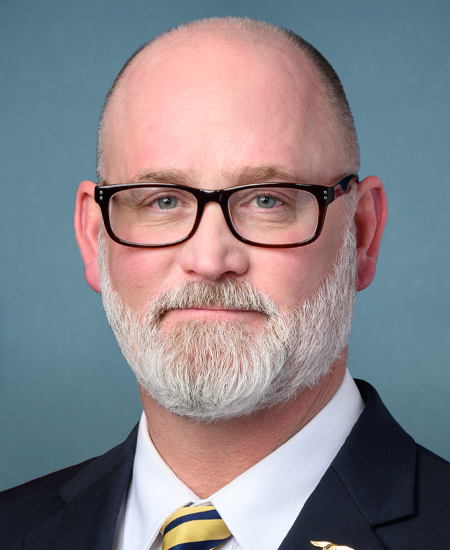
Rep. Derrick Van Orden
Sponsored bills
Maddy summaryThis bill allocates $5 million annually (2026-2030) to states for collecting de-identified stillbirth data through existing health systems, including risk factor analysis. It also provides $1 million yearly to develop standardized guidelines for healthcare providers and public educational materials about stillbirths, requiring consultation with medical professionals, bereavement organizations, and affected families. The bill mandates that all data collection complies with privacy laws and requires the Department of Health and Human Services to publish a public report on stillbirth guidelines within five years. It directly affects state health departments, healthcare providers, and families experiencing stillbirth by improving data quality and access to resources.
Maddy summaryThe Choice Arrangement Act creates a new type of employer-provided health benefit called a "CHOICE arrangement" that allows employees to use employer funds to pay for health care expenses. These arrangements must meet specific requirements including nondiscrimination rules, enrollment verification, and proper notice to employees. Employers offering CHOICE arrangements can claim a tax credit of $100 per month for the first year and $50 per month for the second year for each employee enrolled. Employees in CHOICE arrangements remain eligible to purchase health insurance through the marketplace. The changes apply to plan years beginning after December 31, 2025.
Maddy summaryThis bill requires the Department of Veterans Affairs (VA) to create an electronic system allowing veterans and eligible individuals to send and receive official communications about their educational benefits. It directly affects veterans using VA educational assistance programs by offering a digital alternative to paper mail. The key provision mandates that veterans must actively opt in to use this electronic system (rather than it being automatic), and the VA must notify enrolled students about this option. The VA will now be required to provide this electronic communication mechanism as part of managing educational benefit correspondence.
Maddy summaryHRES 723 is a ceremonial resolution recognizing the 180th anniversary of the United States Naval Academy, established on October 10, 2025. It formally commemorates the Academy's founding, historical contributions, and legacy of producing naval and marine leadership. The resolution highlights the Academy's role in educating graduates who have served in major conflicts, earned military honors, and held significant national leadership positions. As a symbolic gesture with no policy changes or direct impact on constituents, it serves solely to honor the institution's history and ongoing mission.
Maddy summaryHRES 727 is a symbolic resolution designating October 14, 2025, as a "National Day of Remembrance for Charlie Kirk." It does not create new law but formally honors Charlie Kirk, founder of Turning Point USA and a prominent advocate for free speech and civic education, who died by assassination on September 10, 2025. The resolution encourages educational institutions and citizens to observe the day with activities promoting civic engagement, liberty, and democracy. It directly affects no specific group through policy changes, as it is a commemorative gesture without binding requirements.
Maddy summaryHR 5401, the Pay Our Troops Act of 2026, ensures military personnel, civilian Defense workers, and supporting contractors receive pay during government funding gaps in fiscal year 2026. It appropriates emergency funds for active-duty service members, reserves, and their supporting personnel (including Coast Guard staff under DHS) if regular appropriations aren't enacted by the end of the fiscal year. The bill provides necessary pay and allowances during any period when full-year funding is unavailable, covering both active service and support roles. Funding expires when regular appropriations are passed, a funding resolution is enacted, or January 1, 2027, whichever comes first. This is a procedural measure to prevent pay delays for military and support staff during fiscal year 2026 funding lapses.
Maddy summaryHR 3579 requires veterans to submit an application before the VA can begin an initial evaluation for vocational rehabilitation services. It limits employment assistance under the program to a maximum of 365 days per veteran. The bill also mandates the VA to annually report veterans' regional office assignments, pre- and post-program wages, and average wait times for counselor meetings to Congress and the public. Additionally, it requires an independent review of VA rehabilitation programs within one year of enactment to recommend improvements.
Maddy summaryThis bill modifies the Edith Nourse Rogers STEM Scholarship program for veterans. It reduces the maximum months of scholarship use from 60 to 45 and lowers the required benefit usage threshold from 90% to 67.5% for certain veterans. The changes prioritize veterans who have used the most months of their regular education benefits and those pursuing STEM degrees. Veterans must now exhaust all their regular education benefits under Chapter 33 before accessing this scholarship, as specified in new subsection (d)(5). The bill directly affects veterans using education benefits to pursue STEM fields.
Equal COLA Act This bill applies a cost-of-living adjustment (COLA) for annuities paid under the Federal Employees Retirement System that is equal to the increase in inflation, regardless of the amount of the increase. Specifically, for any year in which the Consumer Price Index (CPI) has increased over the previous year, the COLA amount shall be increased by the change in the CPI from the previous year. Current law applies an adjustment equal to the change in CPI only if the change is 2% or less. If the change is between 2% and 3%, the adjustment is limited to 2%. If the change is more than 3%, the adjustment is limited to 1% less than the change.